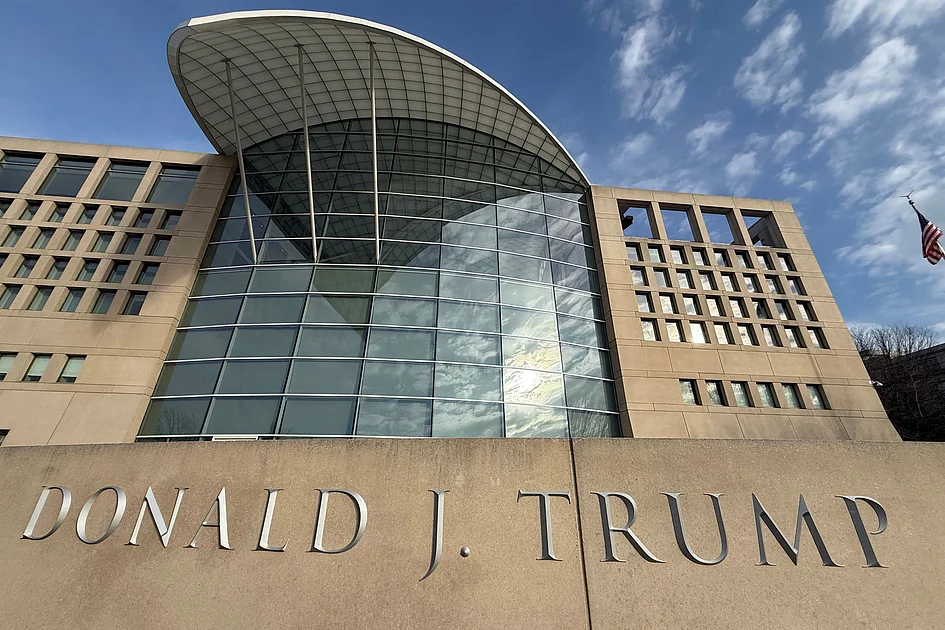
In an unprecedented fusion of personal branding with national governance, former President Donald Trump has embarked on a comprehensive campaign to affix his name to federal institutions and programs throughout his second term. This strategic initiative represents a remarkable convergence of commercial marketing tactics with presidential authority, creating a new paradigm in American political legacy-building.
The scope of this naming blitz encompasses diverse sectors of government operations. Washington’s premier cultural venue has been redesignated as the Donald J. Trump and John F. Kennedy Memorial Centre for the Performing Arts, while a government-funded conflict resolution think tank now operates as the Donald J. Trump Institute of Peace. The administration has further extended this branding to include a proposed class of Navy warships designated as ‘Trump-class’ battleships, children’s savings accounts labeled ‘Trump Accounts’ on official IRS documentation, and specialized visa programs branded as the ‘Trump Gold Card’.
This systematic rebranding has generated significant controversy among historians, political analysts, and civil society organizations. Critics argue that these actions create the perception that government services originate from Trump personally rather than representing institutional state functions. The Kennedy Centre renaming particularly ignited public backlash, resulting in several performing artists canceling scheduled appearances in protest.
Presidential historian Julian Zelizer of Princeton University notes that while previous administrations have taken credit for policy achievements, the current scale of personal branding represents a qualitative departure from traditional practice. ‘This approach prioritizes immediate symbolic recognition over substantive legislative accomplishment,’ Zelizer observed. ‘The relative ease of attaching names to buildings and programs contrasts sharply with the challenging process of creating enduring policy frameworks.’
The administration defends these initiatives as natural extensions of Trump’s leadership philosophy. White House spokeswoman Elizabeth Huston characterized the branding as incidental to substantive achievements, stating that ‘historic initiatives including drug pricing agreements, national landmark upgrades, peace agreements, and wealth-creation accounts for children would not have been possible without President Trump’s bold leadership.’
Historical precedent suggests that such naming conventions may prove temporary, particularly if subsequent administrations choose to reverse them. The durability of these designations remains uncertain, as many require congressional approval for modification. This naming campaign exemplifies the distinctive intersection of personal branding and governmental authority that has characterized Trump’s unconventional approach to presidential legacy construction.