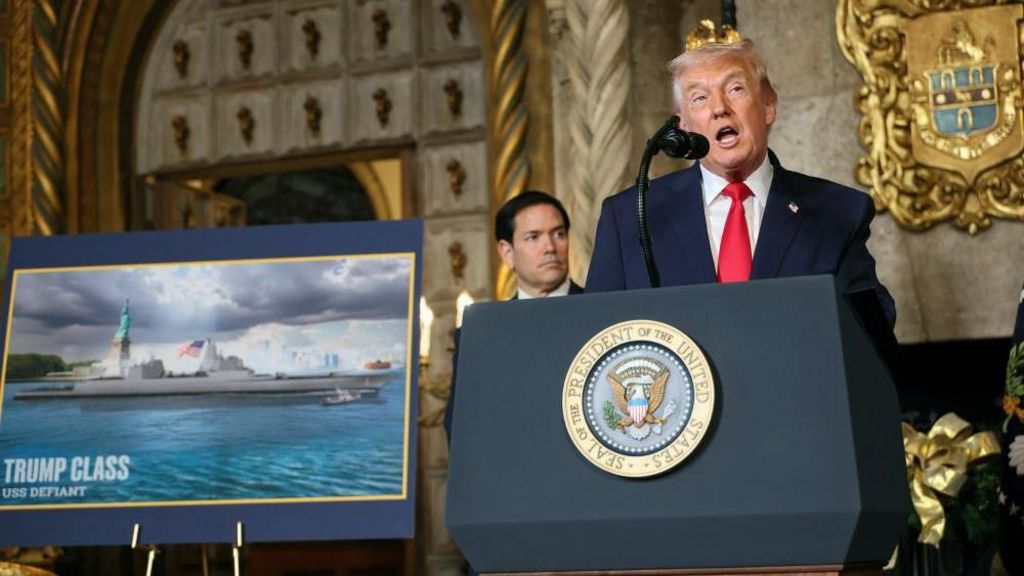
In a significant military policy announcement, former President Donald Trump has revealed plans for a new class of heavily armed naval vessels to be named in his honor. The revelation came during a press conference at his Mar-a-Lago estate in Florida, where Trump was joined by key administration officials including Defense Secretary Pete Hegseth, Secretary of State Marco Rubio, and Navy Secretary John Phelan.
The proposed ‘Trump Class’ battleships, designated as USS Defiant models, represent the centerpiece of a comprehensive naval expansion strategy dubbed the ‘Golden Fleet’ initiative. According to Trump, these vessels will incorporate hypersonic weapons systems and advanced lethal capabilities, positioning them as future flagships of the U.S. Naval fleet. Initial construction will commence with two vessels, with ambitions to eventually produce up to twenty-five ships in this class.
This naval development occurs against the backdrop of growing concerns about American shipbuilding capacity relative to global competitors. Administration officials have repeatedly highlighted China’s dominant position in both naval production scale and commercial shipbuilding output, with Chinese shipyards capturing over sixty percent of global orders this year alone.
The announcement follows recent Navy disclosures about additional vessel acquisitions based on the Coast Guard’s Legend-class National Security Cutter design. Chief of Naval Operations Daryl Caudle emphasized operational necessities driving these acquisitions, noting that current small combatant vessel inventory stands at merely one-third of required levels.
The Trump administration’s naval strategy appears focused on domestic industrial revitalization alongside military enhancement. The president emphasized that construction would occur exclusively in American shipyards, potentially generating thousands of manufacturing jobs. This approach continues initiatives from Trump’s previous term, though similar previous efforts like the Constellation-class frigate program faced cancellation in 2024 due to budgetary overruns and scheduling delays.
Geopolitical context adds urgency to these developments, with U.S. naval and air assets recently deployed to the Caribbean region amid escalating tensions with Venezuela. The administration has linked naval expansion to counter-narcotics operations, claiming successful interdiction of drug trafficking vessels since September operations commenced.
Despite administrative enthusiasm, the proposed battleship program may encounter scrutiny regarding budgetary implications and strategic necessity, particularly given the Navy’s ongoing transition toward distributed maritime operations and unmanned vessel integration.