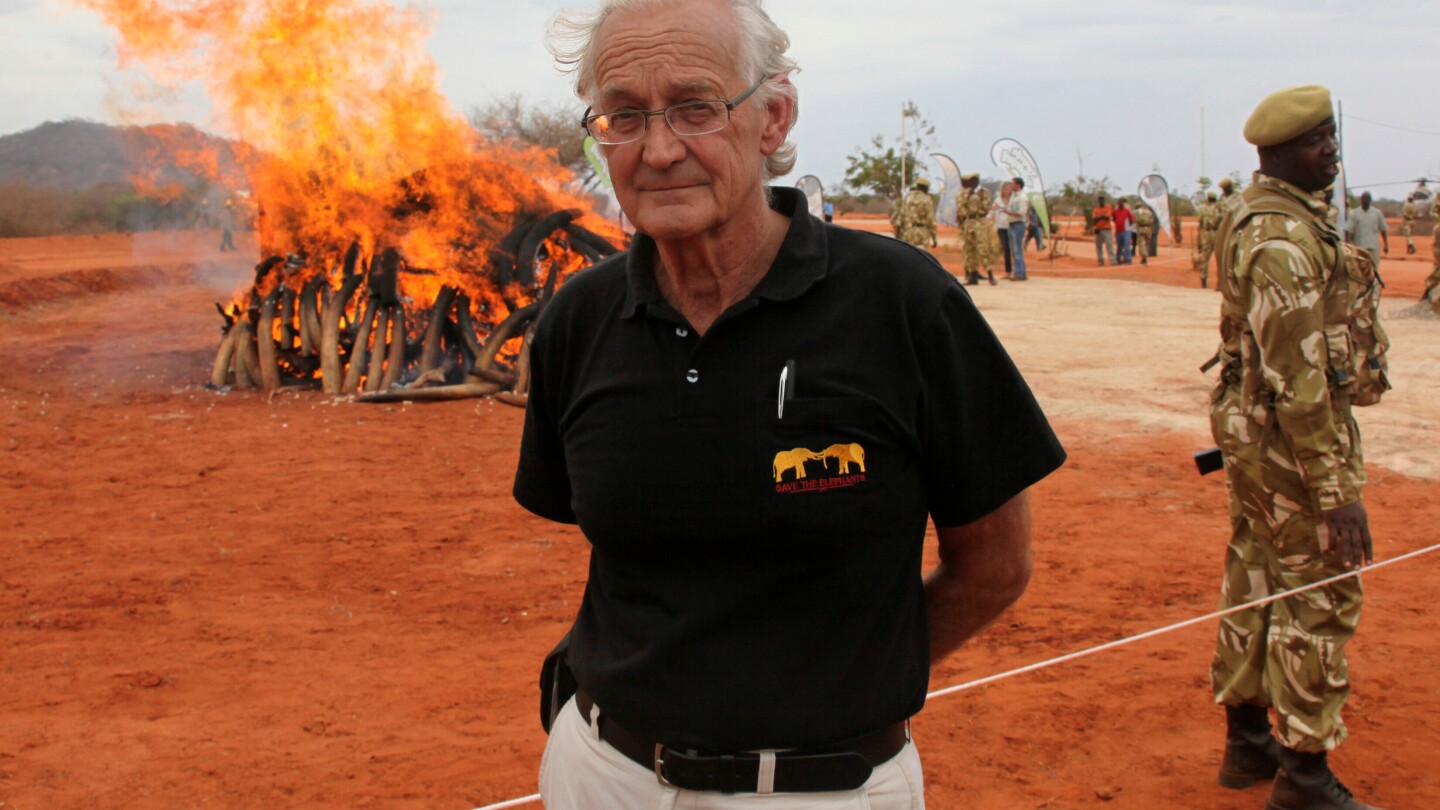
NAIROBI, Kenya — The conservation world mourns the passing of Dr. Iain Douglas-Hamilton, the visionary British zoologist who revolutionized elephant protection strategies and spearheaded global efforts against ivory trafficking. The renowned conservationist died Monday in Kenya at age 83, according to his organization Save the Elephants.
Douglas-Hamilton’s pioneering work established revolutionary animal tracking methodologies, including advanced collar systems that enabled unprecedented monitoring of elephant movements and poaching patterns. His groundbreaking research during the 1980s revealed the catastrophic decline of Africa’s elephant populations—with over half eliminated within a single decade—providing critical evidence that compelled the international community to implement the 1989 ivory trade ban through the Convention on International Trade in Endangered Species.
“He never lost his lifelong curiosity about what was happening inside the minds of one of our planet’s most intriguing creatures,” remarked Frank Pope, CEO of Save the Elephants, describing Douglas-Hamilton’s unique connection to the animals he devoted his life to understanding. Colleagues remembered his characteristic enthusiasm whether observing elephants from the ground, analyzing movement maps, or conducting aerial surveys in his aircraft.
Beyond scientific contributions, Douglas-Hamilton’s advocacy extended to policy transformation, playing instrumental roles in shuttering domestic ivory markets across multiple nations during the 2010s. His work significantly influenced China’s landmark decision to close its legal ivory markets, which he acknowledged in a 2017 interview: “With the end of the legal ivory trade in China, the survival chances for elephants have distinctly improved.”
The Uganda Conservation Foundation honored his legacy of knowledge sharing and capacity building, noting he “empowered the people protecting them” while creating collaborative conservation networks. His academic credentials included degrees from Oxford University, and his work received recognition through numerous honors including Commander of the British Empire (2015) and the Esmond B. Martin Royal Geographical Society Prize awarded earlier this year.
Douglas-Hamilton’s comprehensive approach addressed all threats to elephant survival, including climate-related challenges. During Kenya’s severe 2009 drought, he documented how food scarcity weakened elephant immune systems, increasing vulnerability to disease. His conservation philosophy extended beyond protection to deep ecological understanding, captured in his co-authored books with wife Oria and the 2024 documentary “A Life Among Elephants.”
He is survived by his wife, two daughters, and six grandchildren, leaving a legacy that transformed global wildlife conservation practices and provided renewed hope for elephant species survival.