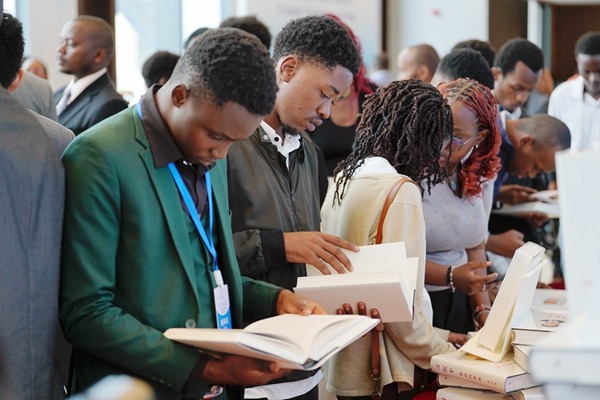
NAIROBI – International scholars and political figures gathered in Kenya’s capital this month for a symposium examining the English edition of the fifth volume of “Xi Jinping: The Governance of China,” with attendees hailing the publication as both a theoretical framework for socioeconomic transformation and a practical guide to understanding China’s development model.
The December event attracted approximately 200 participants who engaged in detailed analysis of the compilation, which contains 91 works by President Xi Jinping across 18 thematic areas spanning from May 2022 to December 2024. The collection includes reports, speeches, talks, addresses, articles, and instructions that collectively provide unprecedented insight into China’s governance approach.
Hassan Omar Hassan, Secretary-General of Kenya’s United Democratic Alliance, characterized the volume as “an extraordinary foundation” for socioeconomic transformation based on “an experiment on governance that actually worked.” He suggested the Chinese model presented in the text offers “a template that many countries can adapt into their national contexts.”
Academic perspectives highlighted the theoretical contributions of the work. Luis Paulino, Professor at São Paulo State University, noted the volume represents China’s “development of Marxist theory” while characterizing Chinese Communists under Xi’s leadership as “the most creative practitioners of Marxist theory.”
Helga Zepp-LaRouche, Chairperson of Germany’s Schiller Institute, identified the Communist Party’s distinctive approach as its “adherence to integrating the basic principles of Marxism with China’s specific realities and with the fine traditional Chinese culture.”
Several analysts pointed to the practical applications of China’s development experience. Colin Cruywagen, a senior official in South Africa’s Presidency for Planning, Monitoring and Evaluation, observed that Xi’s works demonstrate “consistent, systematic and forward-looking nature of China’s policies and concepts” that help explain the country’s maintained growth momentum despite complex international conditions.
Asian perspectives emphasized the volume’s relevance to regional development. Wirun Phichaiwongphakdee, Director of Thailand’s China Research Center for the Belt and Road Initiative, described the book as containing “valuable experience gained from the practice of 1.4 billion people” while noting China’s actions in pursuing “common interests of all humankind” amid global challenges.
The symposium also examined China’s recent Global Governance Initiative (GGI) proposed by Xi during the Shanghai Cooperation Organization Tianjin Summit in September. Robert Lawrence Kuhn, Chairman of the Kuhn Foundation, characterized China’s global initiatives – including GGI, Global Development Initiative, Global Security Initiative, and Global Civilization Initiative – as “a complete architecture that embodies Xi’s vision of building a community with a shared future for humanity.”
Italian analyst Vito Petrocelli, President of the Italy BRICS Institute, noted that China-proposed initiatives advocate for “a more inclusive international system through dialogue, cooperation and mutual benefit,” bringing diverse perspectives into global governance structures.
Marta Montoro, Vice Chairwoman of Spain’s Catedra China Foundation, concluded that China now plays “a key role in global governance” by promoting “a fair, stable, just, and sustainable international system” that offers humanity the possibility of collective progress.