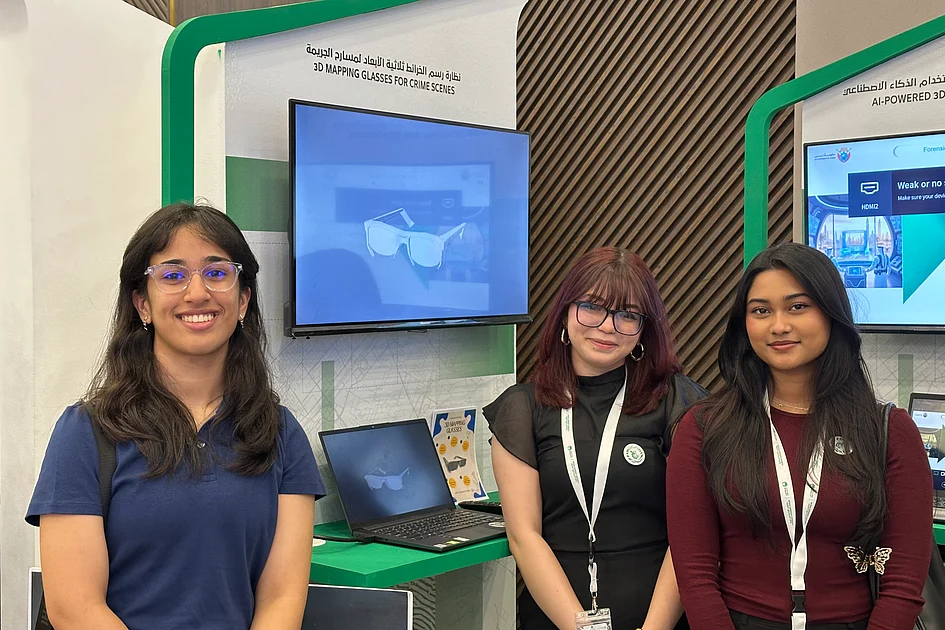
Dubai became the epicenter of forensic science innovation as UAE university students unveiled cutting-edge technological solutions at the Forensic Evidence Forum on Thursday. The event, hosted by the Dubai Police General Department of Forensic Science and Criminology in celebration of World Science Day, demonstrated how emerging technologies are poised to transform criminal investigations and public safety protocols.
Under the theme ‘Innovate. Connect. Solve.’, the forum showcased remarkable advancements including AI-enhanced 3D mapping glasses developed by Amity University Dubai students. The team of Khadija Ashraf, Cerusha Pereira, Neola D’Souza, and Rim Issa created eyewear equipped with LiDAR sensors that generate instant three-dimensional crime scene replicas, eliminating traditional sketching and photographic methods. The intelligent system incorporates artificial intelligence to automatically identify and tag evidence such as weapons, shell casings, and footprints through voice command recognition. A groundbreaking ‘twin live viewing’ feature enables real-time collaboration between field investigators and headquarters-based experts, with future iterations planned to include virtual reality reenactments for courtroom presentations.
Concurrently, Amity University student Farhana Shaju presented a revolutionary Smart Wearable Biosensor Patch designed for rapid narcotics detection. The innovative patch analyzes sweat samples to identify substances of abuse within five minutes, dramatically accelerating the screening process for law enforcement officers. This technology offers particular utility in identifying impaired drivers and conducting preliminary cadaver examinations, providing crucial initial results while maintaining laboratory confirmation as the definitive standard.
Beyond crime scene applications, Al Ain University software engineering students demonstrated iCare—an AI-driven mobile application addressing medication management challenges for elderly and disabled individuals. Developed by Abrar Hamdi, Mohammed Tariq, Shahd Adel, and Umama Binte Sayed, the system employs optical character recognition to interpret medical prescriptions, incorporates an intelligent chatbot for user assistance, and delivers customized reminder notifications to prevent missed doses with automatic rescheduling capabilities.
The forum highlighted Dubai Police’s strategic commitment to academic partnerships and technological innovation in forensic sciences. By engaging directly with the next generation of forensic specialists, the event provided a compelling vision of how digital transformation will continue to revolutionize justice administration and public safety mechanisms across the UAE and potentially global law enforcement communities.