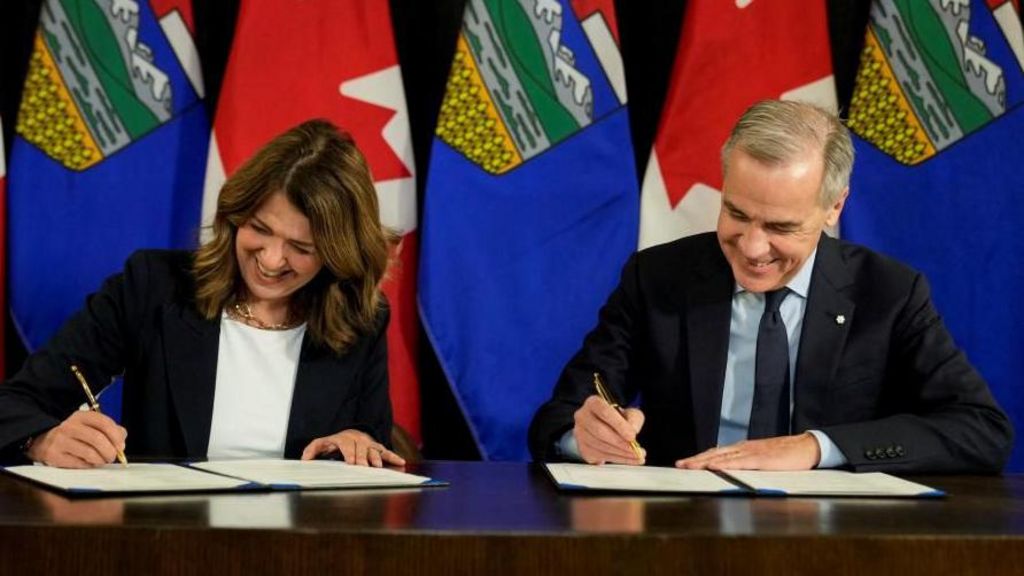
In a landmark political development, Canadian Prime Minister Mark Carney and Alberta Premier Danielle Smith have finalized a comprehensive energy agreement that establishes the framework for a proposed oil pipeline to the Pacific coast. The Thursday signing in Calgary represents a significant policy shift from previous federal administrations, granting the prospective project exemptions from select federal environmental regulations, including the coastal tanker ban off British Columbia’s shoreline and the federal oil and gas emissions cap.
The accord establishes a reciprocal arrangement where Alberta must intensify its environmental commitments by accelerating carbon pricing mechanisms and expanding carbon capture initiatives to counterbalance emissions. The agreement explicitly mandates that the pipeline must secure Indigenous co-ownership and private sector financing, prohibiting the use of public tax dollars for its development.
This arrangement marks a substantial departure from the policies of former Prime Minister Justin Trudeau and addresses Alberta’s longstanding grievances about federal impediments to resource development. Premier Smith characterized the agreement as signaling the end of “dark times” for her province’s energy sector.
Despite this bilateral progress, the project faces formidable opposition. British Columbia Premier David Eby expressed vehement opposition, labeling the pipeline “fictional” and criticizing the exclusion of his province from preliminary negotiations. The project currently lacks both private financial backing and support from First Nations communities whose territories would be traversed by the pipeline.
Prime Minister Carney defended the initiative as crucial for Canada’s economic diversification, noting that over 90% of Canadian crude exports currently go to the United States—a vulnerability highlighted by recent protectionist trade policies. The administration aims to double non-U.S. exports within the next decade, with Asian markets representing a key strategic objective.
The agreement commits both federal and Alberta governments to immediately engage British Columbia in subsequent discussions, though the project remains in preliminary stages without a defined route to BC’s northern coast.