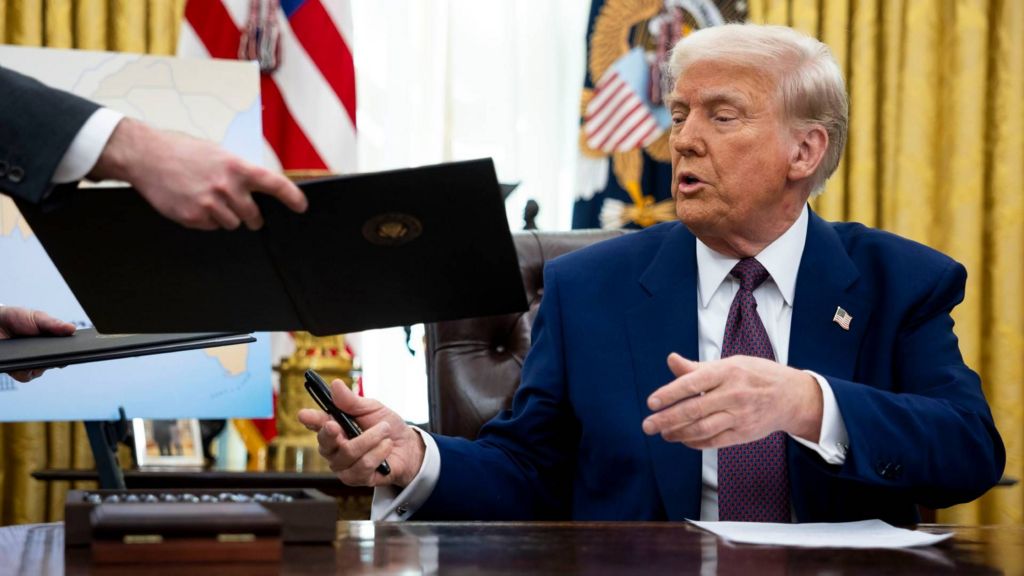
The legality of former President Donald Trump’s sweeping global tariffs is set to be determined by the US Supreme Court. The highest court in the nation will assess whether Trump’s use of emergency powers to impose these tariffs constitutes an overreach of presidential authority. A hearing is scheduled for November 5, following a federal appeals court ruling that declared the tariffs illegal. These tariffs, announced in April, imposed a flat 10% rate on imports from all countries, a move Trump argued was necessary to address ‘unfair’ trade relations with the US. The case reached the Supreme Court after two lower courts ruled that Trump lacked the authority to implement such broad tariffs. The appellate court’s 7-4 decision rejected Trump’s claim that the International Emergency Economic Powers Act (IEEPA) permitted these tariffs, stating that the law does not grant the president the power to impose tariffs or taxes. Trump criticized the ruling, calling it ‘highly partisan’ and a ‘disaster’ for the country. The case originated from legal challenges by small businesses and a group of 12 US states. The Supreme Court’s decision could have significant implications for Trump’s political legacy, the US economy, and global trade relations. If the court upholds the lower courts’ rulings, it could lead to uncertainty in financial markets and questions about the validity of existing trade deals. Conversely, a ruling in Trump’s favor could embolden future presidents to use the IEEPA more aggressively. The conservative majority on the Supreme Court has frequently sided with Trump, but the court has also been critical of presidential overreach. The ruling will specifically address Trump’s ‘reciprocal tariffs,’ which include various rates on imports from countries like China, Mexico, and Canada. Tariffs imposed under Section 232, aimed at protecting national security, remain unaffected by this case.
What happens if the Supreme Court rules Trump’s ‘reciprocal’ tariffs illegal?