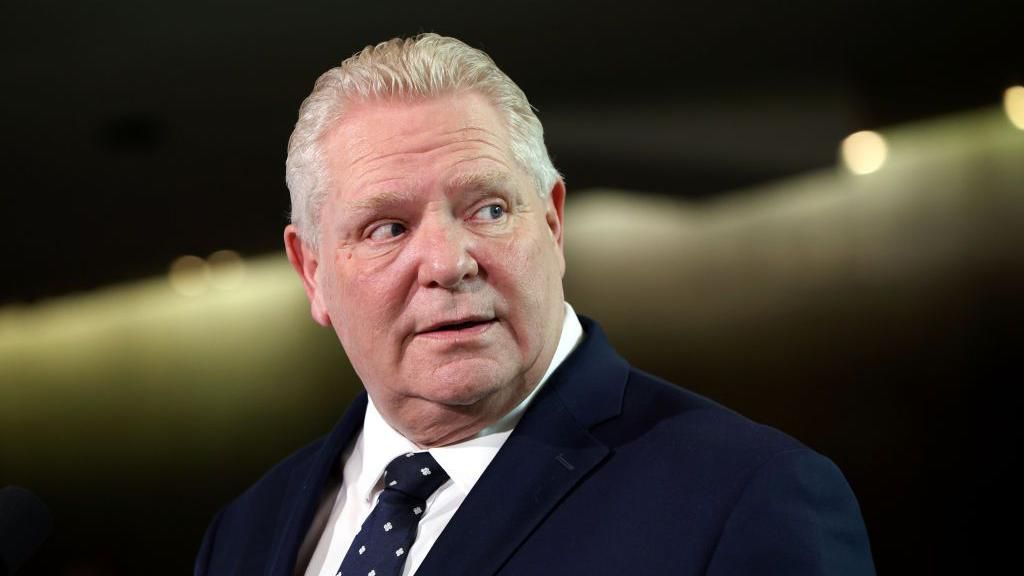
Ontario Premier Doug Ford has reaffirmed his stance on a controversial anti-tariff advertisement aired in the United States, which featured former President Ronald Reagan and drew sharp criticism from President Donald Trump. Ford declared that the ad, which has reportedly garnered one billion views, successfully sparked a global conversation about tariffs. The advertisement, funded by the Ontario government, included excerpts from Reagan’s 1987 radio address, emphasizing that tariffs ‘hurt every American.’
President Trump responded by suspending trade talks with Canada and announcing an additional 10% tariff on Canadian goods, though specifics on its implementation remain unclear. Trump dismissed the ad as ‘fraudulent’ and accused Canada of attempting to influence an upcoming US Supreme Court case regarding the legality of his tariffs on multiple countries, including Canada, Mexico, and China.
Canadian Prime Minister Mark Carney, who is currently attending the ASEAN summit in Asia alongside Trump, revealed that the two nations were nearing a trade agreement before the ad disrupted negotiations. Carney refrained from directly criticizing Ford but emphasized that trade negotiations fall under federal jurisdiction.
Ford, however, remained defiant, stating that the ad was ‘the most successful in the history of North America’ and that he would not back down in the face of Trump’s attacks. The premier also disclosed that Carney and his chief of staff had reviewed the ad prior to its release. Support for Ford has emerged from various Canadian politicians, including Brampton Mayor Patrick Brown and British Columbia Premier David Eby, who plans to launch his own anti-tariff campaign targeting US lumber tariffs.
The escalating tensions highlight the fragile state of US-Canada trade relations, with the US already imposing a 35% tariff on Canadian goods, though most are exempt under existing agreements. Specific sectors, such as steel, aluminum, and automobiles, face even higher tariffs. As the dispute unfolds, the international community watches closely, with the ad serving as a focal point in the broader debate over trade policies and their global implications.