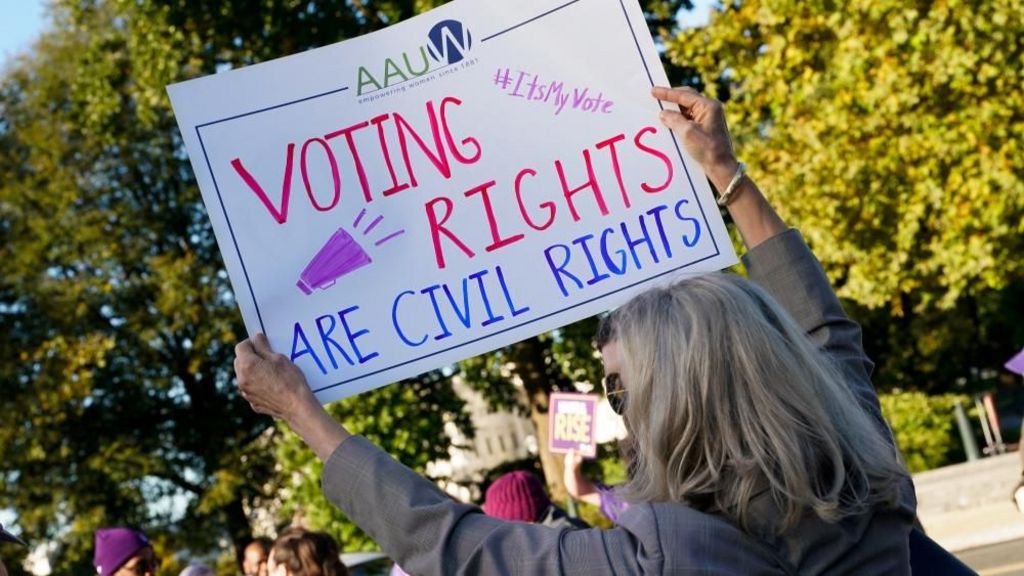
The U.S. Supreme Court heard oral arguments on Wednesday in a landmark case that could significantly alter the electoral landscape of the American South. The case challenges a key provision of the 1965 Voting Rights Act, which was enacted to safeguard the voting rights of Black Americans against state-level discrimination. The session, initially slated for an hour, extended well beyond as the justices rigorously questioned the attorneys involved. The outcome could lead to a substantial reinterpretation of the law, potentially redrawing congressional districts across the South and shifting more than a dozen seats from Democratic to Republican control. This could provide President Donald Trump’s Republican Party with a decisive advantage in the upcoming midterm elections, given the current narrow partisan divide in the U.S. House of Representatives. The case originated from a lawsuit by Black voters in Louisiana, who sought to compel the state to create a second majority-Black congressional district to better reflect the state’s demographic composition. Section 2 of the Voting Rights Act prohibits states from denying or limiting voting rights based on race, color, or language. Over the years, the Supreme Court has interpreted this provision to require states to create ‘opportunity districts’ that allow minority populations to elect legislators in proportion to their share of the state’s population. Louisiana’s population is approximately 31% Black, yet only one of its six congressional districts has a Black majority. The conservative majority on the court has indicated a willingness to reconsider whether Section 2 violates the U.S. Constitution by mandating that states consider race when drawing congressional districts. Louisiana’s Republican officials, initially defending their state’s legislative map as compliant with the Voting Rights Act, have now asked the court to eliminate the law’s Black-district requirements entirely. The Trump administration has joined the case to make a similar request. Janai Nelson, representing the original group of Black Louisiana voters, warned that abandoning Voting Rights Act protections would be ‘pretty catastrophic,’ emphasizing the law’s role in diversifying leadership and ensuring minority voters have an equal opportunity to participate in the electoral process. Louisiana’s Solicitor General, J Benjamin Aguiñaga, countered that explicitly considering race when drawing legislative lines constitutes unacceptable discrimination, arguing that the Constitution does not tolerate government-mandated racial balancing. The Supreme Court is not expected to issue its decision for several months, but the oral arguments suggest a majority may favor discarding or significantly paring back the current Voting Rights Act requirements. Justice Brett Kavanaugh, a potential swing vote, expressed concerns about the duration of the law’s minority-district requirements. Chief Justice John Roberts, who authored a 2013 ruling striking down a separate provision of the Voting Rights Act, is also seen as a decisive vote in this case. The court’s decision could mark a significant shift in American political dynamics, potentially leading to a rush to redraw congressional lines and cement a House of Representatives majority.
Supreme Court weighs ‘earthquake’ ruling that could reshape political map