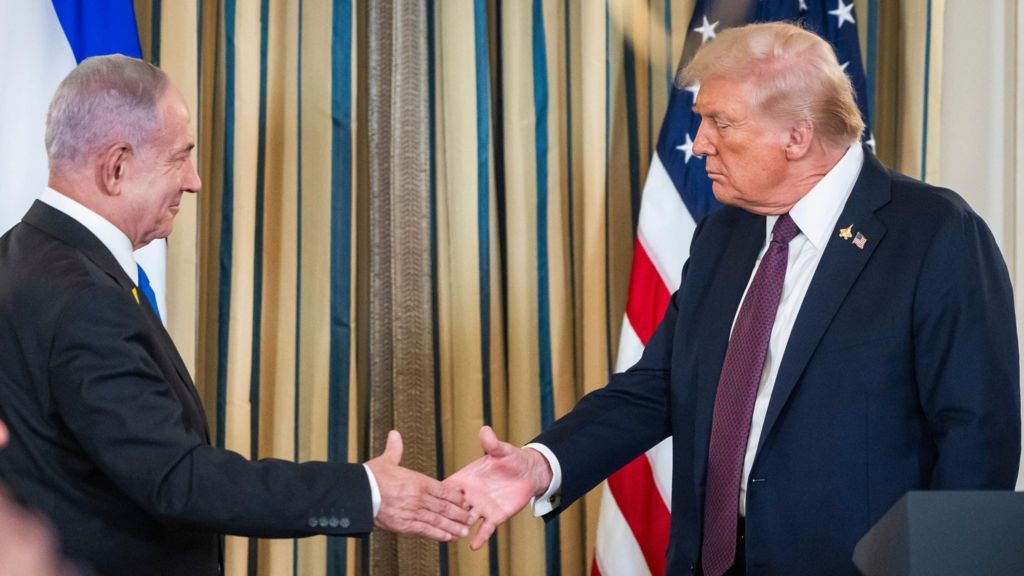
A framework agreement proposed by former U.S. President Donald Trump to end the Gaza war and reconstruct the devastated territory has garnered significant momentum, driven by Trump’s personal influence and support from key Arab and Islamic nations, including Jordan, Egypt, Qatar, Saudi Arabia, the UAE, Pakistan, Indonesia, and Turkey. Israeli Prime Minister Benjamin Netanyahu, standing alongside Trump, has also accepted the plan, despite its implicit nod to a potential pathway to Palestinian statehood—a concept he has vehemently opposed. Trump has set a tight deadline, giving Hamas ‘three to four days’ to decide on the proposal, warning that a rejection would result in the continuation of hostilities. The plan bears resemblance to an earlier initiative by President Joe Biden, which faltered due to Netanyahu’s shifting demands under pressure from his hard-right cabinet. However, Trump’s framework marks a pivotal moment, as it represents the first instance of him exerting pressure on Israel to cease the conflict. The document, endorsed by the UK and other European countries, outlines a rough roadmap for an IDF pullback but lacks detailed specifics, a hallmark of Trumpian diplomacy. While mainstream Israeli opposition parties have backed the plan, it has drawn condemnation from ultra-nationalist factions within Netanyahu’s coalition, who previously supported the controversial ‘Trump Riviera’ proposal advocating for the displacement of Gaza’s Palestinian population. The new plan explicitly states that no Palestinian will be forced to leave, a stance that has angered hardliners like Finance Minister Bezalel Smotrich, who likened it to the 1938 Munich Agreement. The agreement’s ambiguity allows for divergent interpretations, with Netanyahu viewing it as a step toward Israel’s victory over Hamas, while Arab and Islamic nations see it as a pathway to a two-state solution and the rebuilding of Gaza. The plan’s success hinges on intricate negotiations, with numerous opportunities for breakdowns, particularly given the structural flexibility it affords Israel to veto unfavorable moves. Ultimately, the framework’s lack of clarity and detail raises questions about its viability in resolving a century-old conflict.
Bowen: Momentum is the strength of Trump’s Gaza plan, but lack of detail is its weakness