LIMA, Peru – Peru’s 2025 presidential first-round vote has plunged into prolonged uncertainty, with election officials facing weeks of vote counting and legal challenges to determine which two candidates will advance to the June 7 runoff election. As of Thursday’s updated results, the race for the second and third qualifying spots remains so tight that a final outcome could take more than a month to formalize, echoing but far outstripping the delays seen in the country’s 2021 presidential contest.
Early tallies have all but confirmed that former presidential candidate Keiko Fujimori, the conservative standard-bearer and daughter of disgraced ex-president Alberto Fujimori, will claim first place in the 35-candidate field held in Sunday’s vote. With 93% of all ballots processed, Fujimori holds a steady lead with 17.06% of the vote – a comfortable advantage over her rivals, but far short of the 50%+1 threshold required to win the presidency outright and skip a runoff.
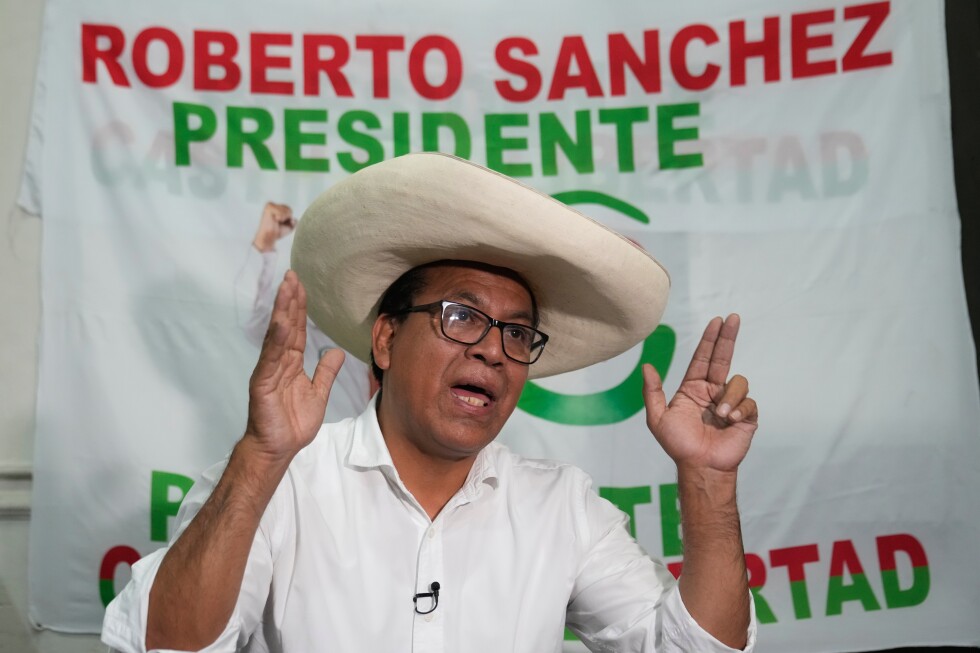
Trailing Fujimori are two politically opposite contenders locked in a historic close race for the second runoff slot. In the most recent count, nationalist congressman Roberto Sánchez – a former cabinet minister under imprisoned ex-president Pedro Castillo – holds 11.97% of the vote, putting him just 0.06 percentage points, or fewer than 8,000 votes, ahead of third-place Rafael López Aliaga, the ultraconservative former mayor of Peru’s capital city Lima.
The two candidates could not differ more sharply in their policy platforms. Sánchez, who is rarely seen without his signature wide-brimmed peasant hat, has campaigned on a platform of sweeping left-wing economic overhaul, including a massive expansion of public sector spending, a complete restructuring of Peru’s national tax system, and partial nationalization of the country’s lucrative natural resource sector. López Aliaga, by contrast, has built his campaign on a hardline right-wing security agenda: he has proposed constructing new maximum-security prisons in Peru’s remote Amazon region, granting anonymous identity protection to sitting judges, and mass expulsion of undocumented immigrants residing in the country. He has also drawn international attention for his promise to reinstate the death penalty in Peru.
The razor-thin margin between the two contenders is further complicated by thousands of unprocessed and disputed ballots. Roughly 1,600 uncounted tally sheets remain to be processed from remote rural villages and polling stations for Peruvians living abroad. In addition, more than 5,000 completed tally sheets have been formally challenged by political campaigns over alleged irregularities or mathematical errors, triggering a mandatory appeals process overseen by Peru’s specialized electoral courts.
Álvaro Henzler, president of Transparencia, Peru’s leading independent democracy watchdog that deployed 4,000 election observers across the country to monitor the vote, explained that the appeals process is standard, but its outcome is far more consequential this cycle than in past elections. “In Peru, a share of tally sheets are always challenged due to potential counting errors, and when that happens, they are sent to 60 special electoral boards for review,” Henzler noted.
A comparison to the 2021 election illustrates how unusual this level of suspense is. Three years ago, Peru’s electoral tribunal took 37 days to formalize first-round results after the April vote, even though the gap between the second and third place candidates started at more than 238,000 votes, eliminating any real doubt about the final ranking. “In this case, since the race is so tight, the contested tally sheets could end up altering the final standings; that is why it is taking so much longer,” Henzler added.
Peru’s turbulent recent political history sets high stakes for the final outcome. The winner of the June runoff will become the country’s ninth president in just 10 years, taking office from interim president José María Balcázar, who was appointed in February following the ousting of the previous interim leader over corruption allegations just four months into his term.
For Fujimori, this election marks her fourth attempt to win the presidency, and she has centered her campaign on promises to crack down on Peru’s rising violent crime rates. Still, her platform has faced scrutiny from legal experts, who point to laws supported by Fujimori’s political bloc in recent years that have made it far harder to prosecute organized crime: the laws eliminated the option of preliminary detention for certain offenses and raised the legal threshold for law enforcement to seize assets connected to criminal activity.
AP’s full coverage of Latin American and Caribbean politics can be found at https://apnews.com/hub/latin-america