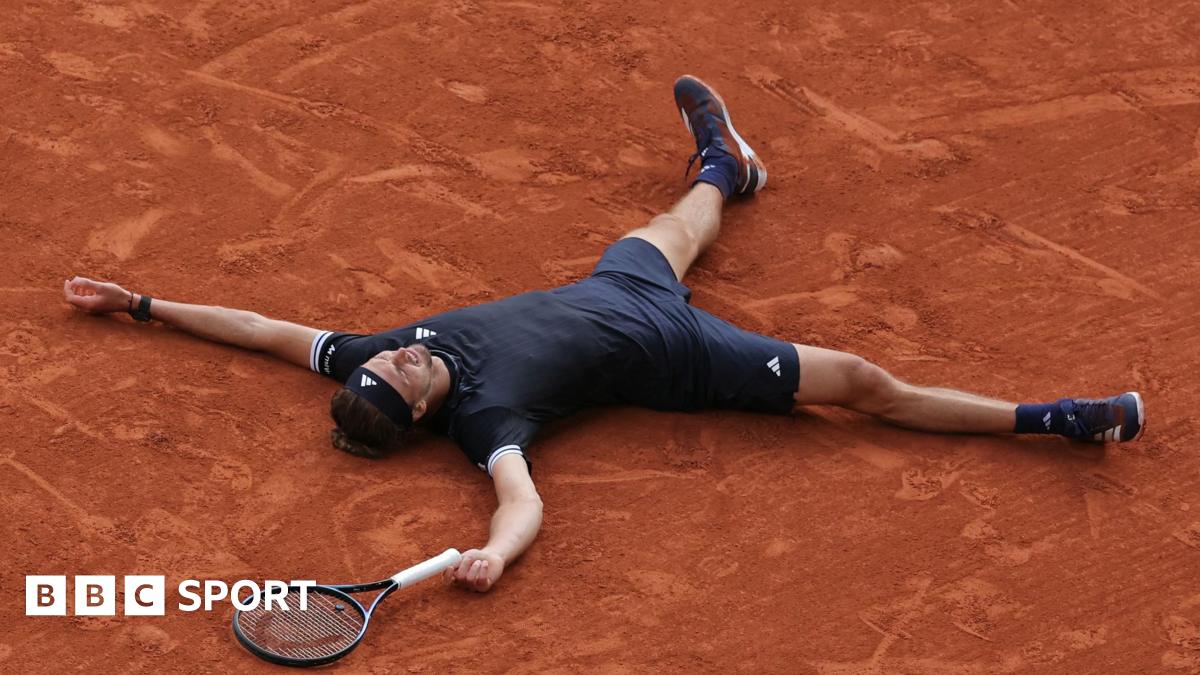
After three heartbreaks in major finals and years of near-misses, 29-year-old Alexander Zverev has fulfilled a lifetime of expectation, capturing his maiden Grand Slam singles title at the 2025 French Open with a tense 6-1 4-6 6-4 6-7(5-7) 6-1 victory over first-time finalist Flavio Cobolli on Parisian clay. The landmark win makes Zverev the first German man to lift a Grand Slam singles trophy since Boris Becker claimed the 1996 Australian Open, and ends a two-year streak of major titles being split exclusively between Carlos Alcaraz and Jannik Sinner.
Entering the final as the overwhelming betting favorite following Sinner’s shocking second-round exit and Alcaraz’s injury-related withdrawal, Zverev carried the heavy weight of expectation into his fourth major championship match. The German got off to a blistering start, dropping just one game in the opening 35 minutes as his powerful baseline groundstrokes exploited a nervous Cobolli, who had never advanced past the French Open third round before this breakout tournament. When Cobolli settled into the match and snatched the second set with a late break of serve, Zverev quickly regained control, breaking the Italian in the tenth game of the third set to move two sets to one.
The match’s dramatic turning point came in a chaotic fourth set that tested Zverev’s mental and physical stamina to breaking point. The second seed twice dropped his serve, coughed up a string of costly double faults, and required medical attention to treat cramping with electrolyte injections, forcing him to dig deep to stay in the contest. Serving for the set at 5-4, Cobolli failed to close out the win, then wasted his first set point on the tiebreak with a messy forehand volley error before bouncing back to force a deciding fifth set.
Both players struggled with nerves in the decider, with the match swinging between thrilling baseline exchanges and tense, error-prone exchanges that left spectators on the edge of their seats. Zverev managed to limit his unforced errors just enough to grab an early double break, jumping out to a 3-0 lead as the 24-year-old Cobolli, playing in the biggest match of his career by far, ran out of competitive gas. When Cobolli sent a closing smash long on Zverev’s second match point, the German collapsed backwards onto the red clay, burying his face in his hands to release years of pent-up emotion after three previous final losses.
Zverev’s path to tennis stardom was written nearly from birth. Born into a family of professional tennis players, he grew up touring alongside his older brother Mischa, a 2017 Australian Open quarterfinalist, and caught the attention of all-time great Roger Federer as a precocious teen talent. He has ranked consistently inside the world top 10 for nearly a decade, collecting dozens of top ATP Tour titles, but a Grand Slam win always eluded him: early in his career, he was blocked by the enduring dominance of the Big Three of Federer, Rafael Nadal, and Novak Djokovic, before the emergence of Sinner and Alcaraz created a new barrier to major glory. Technical flaws in his second serve and a tendency to play passively against top competition also derailed his previous runs, leaving many analysts questioning whether he would ever break through for his first major.
For Cobolli, a former Roma football academy prospect who switched full-time to tennis as a youngster, the run to the French Open final marks a stunning breakthrough that few predicted. Despite the tough final loss, the 10th seed framed his run as just the opening chapter of his career, saying, “I started playing when I was young and I never expected this kind of result. Now that I’m here, I just want to make something special possible. For me, it’s not done, it’s only the start.” With a powerful baseline game, deft touch at the net, and elite athleticism, the Italian has already proven he can compete with the best of the men’s game, and his breakout performance in Paris signals the arrival of a new contender in men’s tennis.