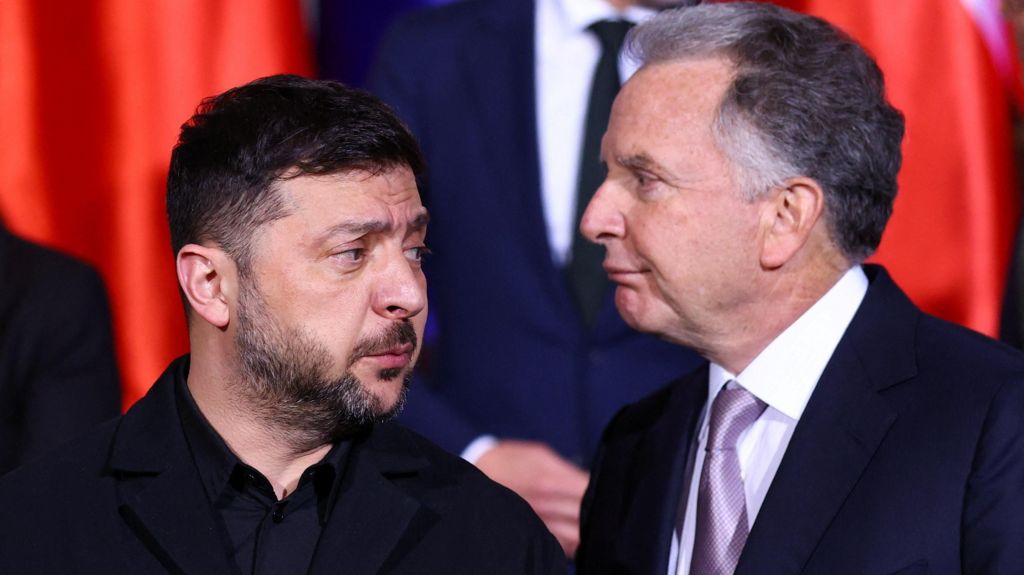
Nearly four and a half years after Russia launched its full-scale invasion of Ukraine, peace negotiations to end the devastating conflict remain stuck in a deadlock, and a new diplomatic controversy has added friction to the process. Ukrainian President Volodymyr Zelensky has publicly criticized two senior U.S. negotiators — special envoy Steve Witkoff and presidential son-in-law Jared Kushner — for repeatedly traveling to Moscow for talks without ever making an official visit to Kyiv, calling the pattern of engagement deeply disrespectful.
The two U.S. representatives first traveled to the Russian capital in late 2025, when ceasefire negotiations gained new momentum after months of stalled discussion, and returned for a second round of talks in January 2026. Witkoff, a former real estate developer and close ally of U.S. President Donald Trump, has now made eight trips to Moscow and held multiple face-to-face meetings with Russian President Vladimir Putin. Despite this extensive engagement with Moscow, neither Witkoff nor Kushner has ever traveled to Kyiv in an official negotiating capacity.
In an interview with a Ukrainian media outlet, Zelensky emphasized that the unilateral focus on Moscow cannot be justified, even amid Ukraine’s challenging wartime logistics. “It’s disrespectful [for them] to come to Moscow and not Kyiv, it’s just disrespectful,” Zelensky said. The Ukrainian leader added that Kyiv is flexible on meeting locations, noting, “If they don’t want to, we can meet in other countries.”
Earlier this April, Zelensky confirmed that the two envoys had been expected to visit Ukraine, but the planned trip was scrapped after the U.S. and Israel launched military strikes against Iran, shifting the entirety of Washington’s diplomatic and military focus to the Middle East. Currently, Witkoff and Kushner are part of a U.S. delegation traveling to Pakistan for ceasefire negotiations with Iran, a reality Zelensky acknowledged. Even so, he reaffirmed Kyiv’s commitment to maintaining close cooperation with Washington on ending the war.
Ceasefire talks gained significant momentum in autumn 2025, after details emerged of a draft peace deal worked out behind closed doors by Russian and U.S. officials that included multiple provisions unfavorable to Ukraine. Kyiv pushed aggressively to be included in formal negotiations, leading to a series of multilateral meetings that culminated in a trilateral Russia-U.S.-Ukraine summit in mid-February 2026. By the end of that summit, both Moscow and Kyiv announced they had reached preliminary agreement on core military issues, including the demarcation of the current front line and frameworks for monitoring a potential ceasefire.
However, several critical sticking points remain unresolved, keeping the talks at an impasse. Key unresolved issues include Kyiv’s demand that Russia repatriate the thousands of Ukrainian children forcibly deported to Russia since the start of the invasion, and Russia’s non-negotiable demand for a full regime change in Kyiv. The most contentious issue, though, remains the status of Ukraine’s eastern Donbas region, where Russia claims sovereignty over large swathes of Ukrainian territory that it currently occupies. Kyiv has repeatedly rejected any territorial concessions to end the war, and neither side has shown willingness to back down from their core positions on the Donbas.
“We are looking for a compromise between two completely polar positions,” Kyrylo Budanov, Zelensky’s chief of staff, told reporters in February. “We have not yet found it.” Budanov added that the two sides face a stark choice: “Either we find a solution and end this war, or we all equally take responsibility for admitting that we didn’t find a solution and continue to kill one another — something we do quite efficiently and professionally.”
Over more than four years of full-scale war, constant violence has become an everyday reality for millions of Ukrainians. Russia currently controls large portions of eastern and southern Ukraine, and daily artillery and infantry clashes continue along the thousand-kilometer front line stretching from the northeastern Luhansk region to the southern Kherson region. Ukrainian cities face regular large-scale aerial attacks, with Russia launching waves of drones and missiles that kill civilian bystanders and destroy critical civilian infrastructure.
Just last week, for example, Russia launched a massive multi-wave attack involving more than 700 drones and missiles across Ukraine that killed at least 18 civilians, according to Ukrainian officials. In response, Ukraine has ramped up its own long-range drone attacks on Russian energy and industrial infrastructure deep inside Russian territory, targeting ports, military depots, factories, and oil export terminals. Calculations from Reuters show that as of early April 2026, at least 20 percent of Russia’s total oil export capacity has been taken offline by these attacks.
Paradoxically, the global energy market disruption sparked by the U.S.-Iran conflict has delivered unexpected financial gains for Russia, boosting the country’s oil export revenue in recent months despite the export infrastructure damage. Even so, long-term economic indicators show Russia’s gross domestic product continues to contract amid sustained international sanctions and wartime economic pressures.