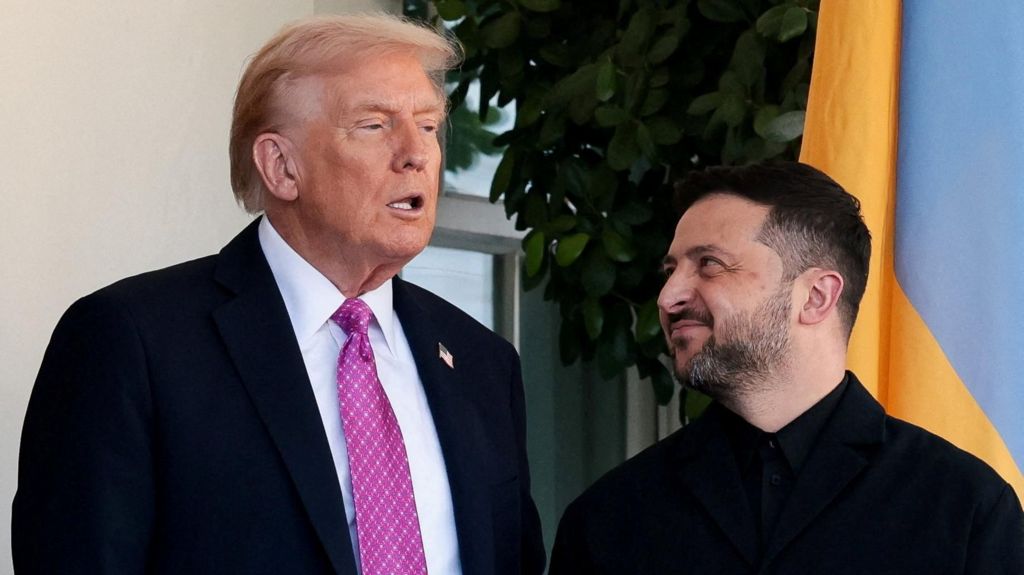
Ukrainian President Volodymyr Zelensky has expressed willingness to participate in a proposed summit involving US President Donald Trump and Russian President Vladimir Putin in Hungary, provided he receives an invitation. The announcement of the planned talks, aimed at addressing the ongoing war in Ukraine, was made by Trump and Putin on Thursday, with Budapest as the potential venue in the coming weeks. Zelensky, in comments released on Monday, indicated his readiness to engage in a three-way dialogue or shuttle diplomacy format, emphasizing his commitment to a just peace rather than a hasty resolution.
However, recent reports suggest that Zelensky’s meeting with Trump at the White House last Friday was far from cordial, with accounts of a heated exchange. The US reportedly urged Ukraine to accept Russia’s terms to end the conflict, a stance Zelensky firmly opposes. During his first press briefing since the talks, Zelensky described the meeting as frank but highlighted significant disagreements between the two sides. He criticized Hungary as the location for the Trump-Putin talks, questioning Prime Minister Viktor Orban’s ability to contribute positively to Ukraine’s interests.
Trump, when asked about Zelensky’s involvement in the Budapest meeting, stated his intention to make the talks ‘comfortable for everybody,’ suggesting a possible separation of discussions. Zelensky had hoped to secure US Tomahawk missiles during the talks but left empty-handed as Trump remained non-committal. Media reports on Monday revealed that the atmosphere during the US-Ukraine leaders’ meeting was more acrimonious than previously understood, with Trump allegedly warning Zelensky that Putin would ‘destroy’ Ukraine if it did not agree to Russia’s terms.
Trump’s shifting stance on the war has added complexity to the situation. Last month, he suggested that Ukraine could ‘win all of Ukraine back in its original form,’ a departure from his earlier position that Ukraine might need to cede territory. Trump has also been pressuring NATO nations, China, and India to halt purchases of Russian oil to increase economic pressure on Moscow. Despite threats of tougher sanctions, he has not followed through on these measures.
The relationship between Trump and Zelensky has seen ups and downs, with a notable improvement since a contentious Oval Office meeting in February. During his re-election campaign, Trump claimed he could end the war in Ukraine within days but has since acknowledged the conflict’s complexity, describing it as one of the most challenging issues he has faced since returning to office.