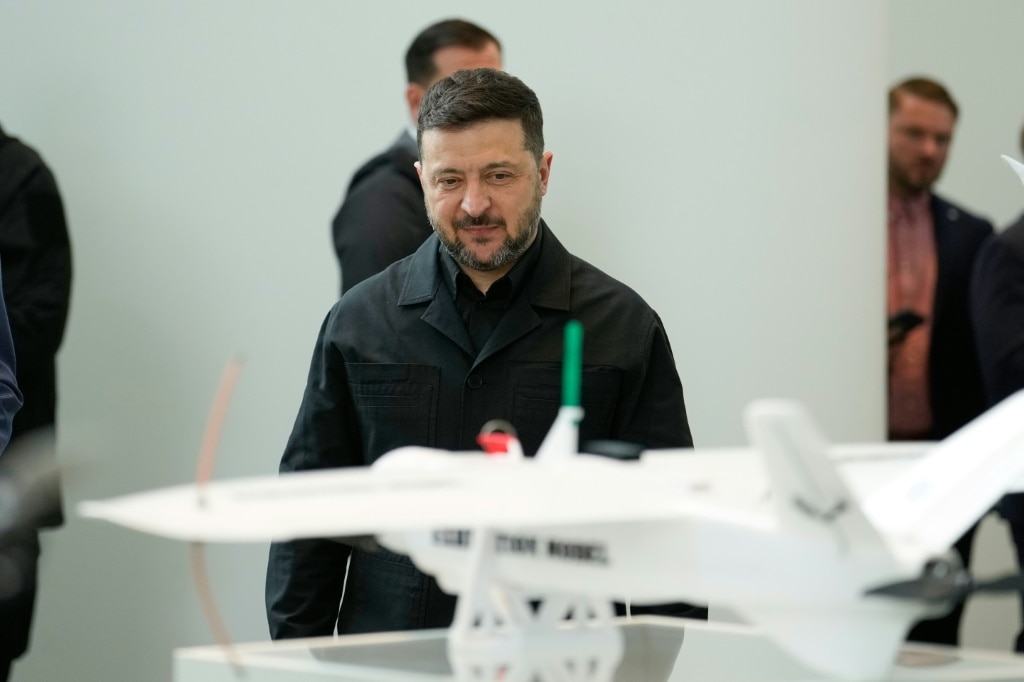
Ukrainian President Volodymyr Zelensky touched down in Berlin on Tuesday for high-stakes military talks with German Chancellor Friedrich Merz, with drone production collaboration set as a core agenda item. The trip comes as Germany has solidified its position as Kyiv’s largest military backer, following a drawdown in security assistance from the United States, and Berlin is eager to leverage Ukraine’s hard-won frontline experience with unmanned aerial systems. This diplomatic engagement also unfolds against a backdrop of stalled U.S.-brokered peace negotiations between Ukraine and Russia, where Kyiv has rejected any proposals that would require it to cede sovereign territory to Moscow. Adding to broader transatlantic tensions, U.S. President Donald Trump has publicly criticized European NATO allies for declining to join the U.S.-Israeli campaign against Iran and take on patrol duties in the Strait of Hormuz.
In a follow-up event scheduled for Wednesday, the Ukraine Defence Contact Group—bringing together defense ministers from nations supporting Kyiv and NATO Secretary General Mark Rutte—will convene in Berlin to continue coordinated planning for Ukraine’s defense needs. The ongoing full-scale Russian invasion of Ukraine is now in its fifth year, and the battlefield landscape has shifted dramatically as low-cost, highly effective drones with extended ranges have emerged as indispensable tactical weapons. Over years of frontline combat, Ukraine’s armed forces have built unparalleled practical expertise in developing, deploying, and countering these systems.
The concurrent conflict in the Middle East has opened a new opportunity for Kyiv to demonstrate its capabilities: Zelensky has already deployed anti-drone specialists to nations targeted by attacks from Iran, a key Russian military ally, and personally visited those affected regions. For Germany, which has allocated hundreds of billions of euros to revitalize its armed forces to deter potential Russian aggression, harnessing Ukraine’s hands-on drone expertise is a strategic priority.
This cooperation is already well underway. Back in February, Zelensky toured a Munich-based drone manufacturing facility operated by a German-Ukrainian joint venture that produces equipment for Ukraine’s military. The joint venture, named Quantum Frontless Industries (QFI), was launched in December by Germany’s Quantum Systems and Ukraine’s Frontline Robotics. On Tuesday, Quantum Systems announced it would unveil two new joint projects with Ukrainian manufacturers during Zelensky’s Berlin visit.
Matthias Lehna, managing director of QFI, highlighted the speed and impact of the existing partnership: “Our existing joint venture QFI demonstrates that production capacity in Germany can be established within weeks, with operational systems delivered to Ukraine. We are convinced that this cooperation will form the core of Europe’s future defence capabilities.” The initiative is part of a broader push to scale up European defense manufacturing for Ukraine and long-term regional security.
Beyond military collaboration, the talks come as new momentum has emerged for unlocking the European Union’s long-blocked €90 billion ($105 billion) aid package for Ukraine. The proposed loan, agreed by EU leaders in December, had been held up by Hungarian nationalist Prime Minister Viktor Orban’s veto. But Orban’s unexpected election defeat last weekend to conservative challenger Peter Magyar has cleared a path for the package to move forward. German government spokesman Stefan Kornelius signaled Berlin’s urgency on Monday, stating he hoped the aid would be made available to Ukraine “very quickly.”
Beyond defense and funding, the visit also addressed the ongoing humanitarian situation for Ukrainians who have fled the war. Germany has already welcomed hundreds of thousands of Ukrainian refugees since the full-scale invasion began. To kick off Tuesday’s schedule of engagements, Ukrainian Social Minister Denys Uliutin met German Interior Minister Alexander Dobrindt at a new support center branded the “Unity Hub.”
In an official statement, the German Interior Ministry explained the hub’s dual mission: it will serve as a centralized point of contact for Ukrainians who have resettled in Germany, providing guidance on employment search and integration into German society. At the same time, the center will also work to encourage refugees to return to Ukraine once conditions allow them to do so safely.