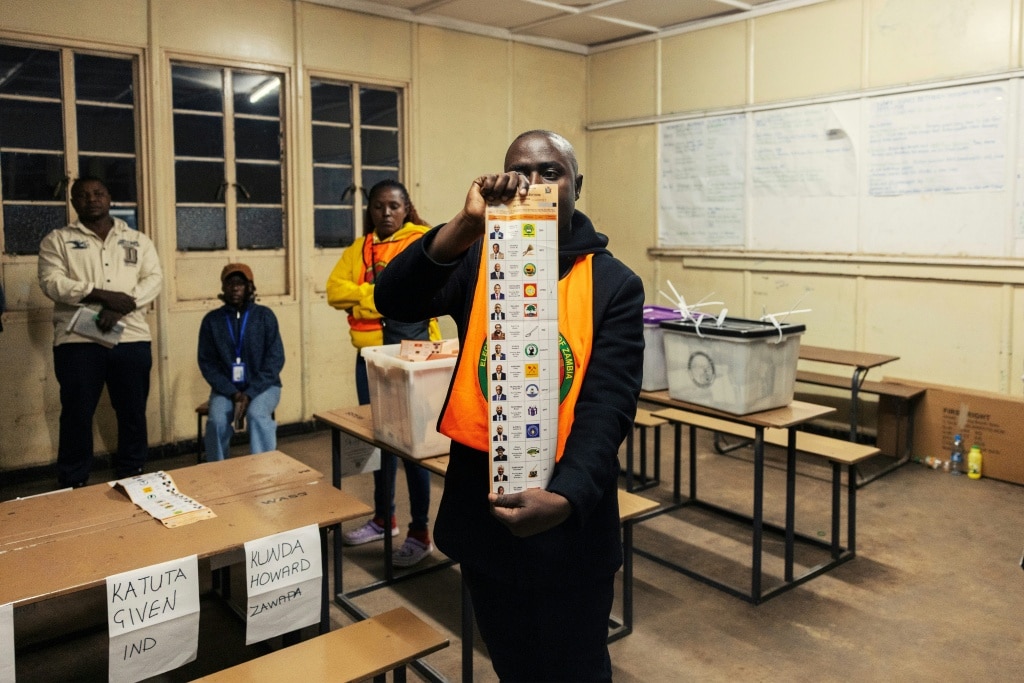
The Electoral Commission of Zambia announced a nationwide suspension of presidential and parliamentary vote counting on Friday, just one day after the country held its general election, following widespread reports of election-related violence across multiple districts. The copper-rich southern African nation, which has been grappling with deep-seated economic hardship that dominated the election campaign, now faces an unexpected delay in finalizing official results that were originally scheduled for release by Monday.
Fourteen candidates contested the presidency, with incumbent Hakainde Hichilema, who has held office since 2021, facing off against main opposition challenger Brian Mundubile, a 55-year-old former minister from the previous Patriotic Front administration. Brown Kasaro, Zambia’s chief electoral officer, explained the abrupt suspension, noting that the violence has specifically targeted election workers, and in several cases, perpetrators have stolen marked ballots from sealed ballot boxes. Kasaro added that the electoral commission will re-evaluate the suspension within a 24-hour window to determine next steps for resuming the counting process.
Even before official results could be tabulated, both leading candidates made competing claims about the outcome of the vote. Mundubile, who ran under the banner of the newly formed National Restoration Party for Unity and Progress (NRPUP) backed by a coalition of opposition groups, declared an outright first-round victory on Friday. “We have won this election both at presidential level and majority seats in parliament,” Mundubile stated, adding that his campaign views the ongoing delay to the transparent announcement and verification of presidential results with grave concern. For his part, Hichilema said his campaign team has received encouraging early voting trends, and took to social media to urge all Zambian citizens to “remain peaceful, patient and patriotic as we await the official outcome from those entrusted with managing the vote.”
Alongside the presidential race, Zambian voters also cast ballots for 226 parliamentary seats, and counting for that contest has also been suspended. Around 8.7 million voters were registered to participate in this election cycle.
The election comes against a backdrop of both Zambia’s long democratic history and growing concerns over political space. Zambia has a proud track record of peaceful democratic power transfers, with every change of the presidency since the return of multi-party politics in 1991 achieved through free and fair elections. However, the Hichilema administration has faced increased international scrutiny over claims that it has narrowed space for political dissent, even as it pursues commitments to robust economic recovery. On the eve of voting, Zambia’s Human Rights Commission announced it was “actively monitoring arrests and detentions involving political candidates, supporters, journalists and other actors” to prevent election-related rights abuses.
In pre-election security operations, Zambian interior ministry confirmed that security forces had already arrested multiple suspects accused of plotting to interfere with the electoral process. While authorities did not disclose the total number of arrests, they confirmed three former senior government officials are in custody, charged with providing technical services aimed at disrupting the electoral system. A 56-year-old Kenyan national was also detained in connection with the plot. Additionally, three other individuals, including a former provincial minister, were found in possession of more than 7.3 million kwacha (approximately $388,000) in unaccounted funds and have been summoned to assist with ongoing investigations.
Economically, Zambia remains one of the world’s richest countries in mineral reserves, holding abundant deposits of not just copper but also cobalt, nickel and manganese, yet it continues to face persistent systemic challenges including widespread poverty, chronic unemployment, and skyrocketing food prices. According to World Bank data, more than 70 percent of Zambia’s 22 million population survives on less than three U.S. dollars per day. The previous administration under late former president Edgar Lungu left the country in sovereign default after years of unsustainable heavy borrowing. Since taking office, Hichilema’s government has secured a landmark international debt restructuring deal, restored a suspended International Monetary Fund lending program, and returned the country to positive economic growth, earning broad praise from global lenders and international investors. Hichilema, a 64-year-old former business tycoon who won the presidency on his sixth electoral attempt, campaigned on a platform of continued job creation and an ambitious national infrastructure expansion drive to secure a second and final five-year term. Mundubile entered the presidential race only in May, a late entry that injected significant uncertainty into a contest that long been viewed as likely to end in an incumbent victory, as his party draws its core support from the ranks of the former ruling Patriotic Front.