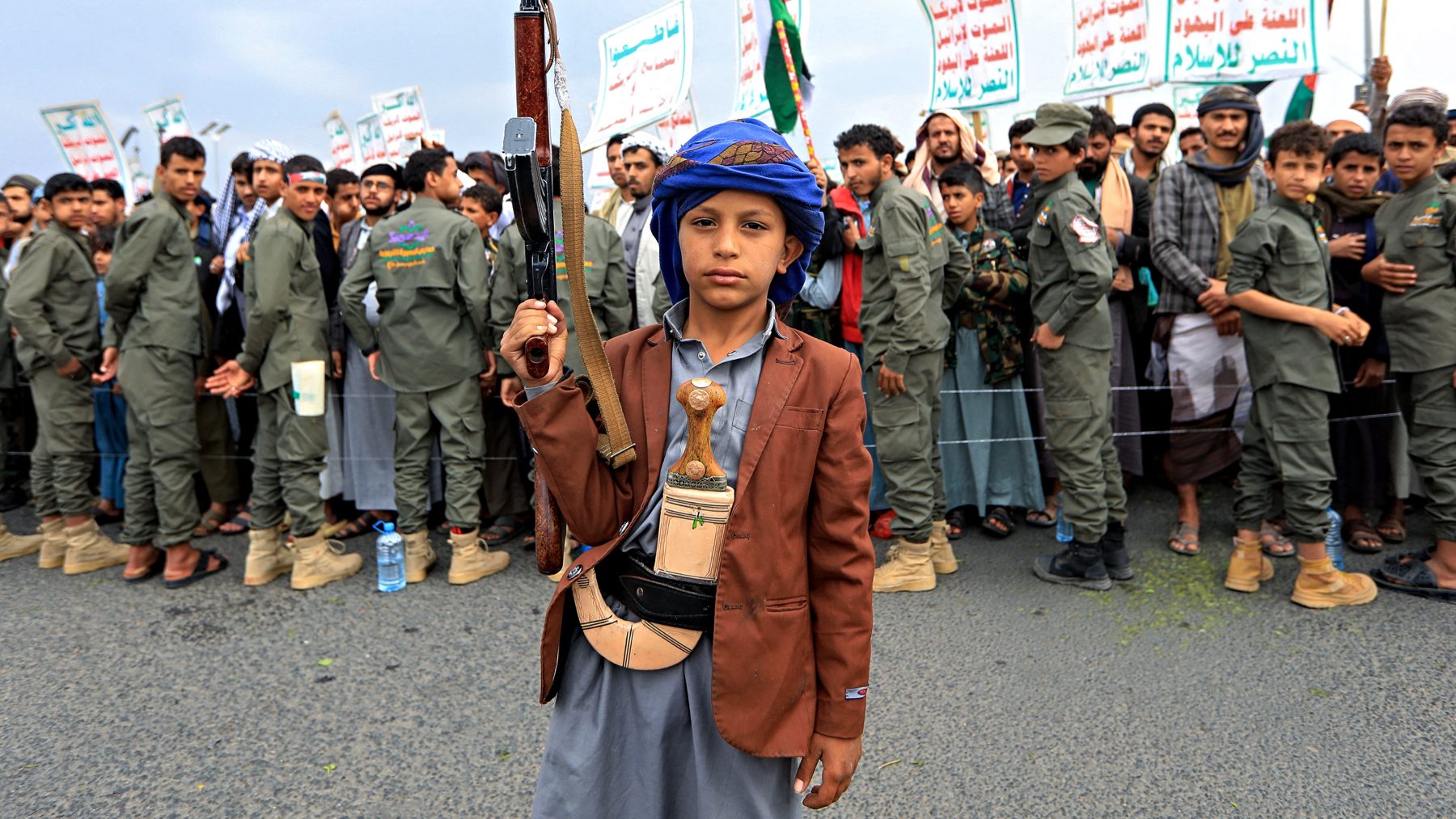
At just 17 years old, Ibrahim possesses a skill that no teenager should ever need to master: he can operate a Kalashnikov rifle with confidence. Though he is never formally enlisted in Yemeni government-aligned troops, he stands alongside his older brother and male cousins to fight against Houthi forces that advanced on his home village.
When Houthi fighters moved toward the community, Ibrahim grabbed his father’s personal rifle and joined local pro-government resistance ranks. Growing up in Yemen, he says familiarity with firearms is common, even for young people. “We keep a Kalashnikov at home, and I have fired it at weddings and other local gatherings,” Ibrahim explained in an interview with Middle East Eye. Unlike many adult combatants, he has no ambition to build a military career. For Ibrahim, this fight is strictly temporary: once his village is retaken, he plans to lay down his rifle and return to school to pursue his dream of becoming an automotive engineer. “We joined only to take back our home,” he said. “Once that goal is met, we will stop fighting.”
Ibrahim’s story is far from unique. Since the latest round of conflict erupted in Yemen, child combatants have reemerged on front lines across the country, with both major warring parties repeatedly trading accusations that the other illegally recruits and deploys minors. While neither side has formally admitted to recruiting underage fighters, independent investigations, United Nations data and international media reports have consistently confirmed that the practice occurs on both sides of the conflict.
A March 2025 report from the UN Secretary-General focused on children and armed conflict documented 564 verified cases of child recruitment and deployment in Yemen between 2021 and 2023. Of these confirmed cases, 345 were linked to Houthi forces, while 210 were attributed to Yemen’s official armed forces and their affiliated armed groups. The remaining small number of cases were assigned to unidentified actors and the Yemen-based affiliate of the Islamic State of Iraq and the Levant. The UN confirmed that recruited children range in age from 8 to 17 years old. Of the verified cases, 293 children were deployed directly in combat roles, while 187 served in support positions including military checkpoint guards, informants, and drivers. Twenty-seven of the children used in active combat were under the age of 15.
Ahmed, Ibrahim’s 41-year-old cousin, pushed back against claims that the teen serves in frontline combat. He explained that Ibrahim carries out support duties behind the main line of troops, a role his physical size and experience allow him to fill. “Frontline fighting requires real combat experience — it is not something any untrained person can step into,” Ahmed told Middle East Eye. “Young fighters like Ibrahim provide critical backup to main force units, and their contribution matters a great deal in these desperate circumstances.”
Weeks prior, as fighting between Houthi and government-aligned forces escalated in the Taiz region, a BBC investigation broadcast an interview with a 16-year-old pro-government fighter who claimed he had participated in active frontline combat. In response to the BBC report, Colonel Abdul Basit al-Bahr, deputy head of the Moral Guidance Department at the Taiz Axis Command, told Middle East Eye that the teenager was only accompanying his father and was never enrolled as an official combatant for government forces.
“We in the armed forces maintain a clear policy on child recruitment: it is strictly forbidden, and children are never accepted into our ranks or forced to take part in military operations,” al-Bahr said. Even so, he acknowledged that government forces regularly encounter children on battlefields, some as young as 10 years old. “We implement appropriate legal and humanitarian measures for these children, and refer them to relevant authorities to resolve their situations in line with Yemeni law,” he added, noting that minors captured while fighting alongside Houthi forces are treated as vulnerable children rather than adult enemy combatants.
Independent Yemeni human rights group SAM Organisation for Rights and Liberties has documented a far larger scale of child recruitment: between 2014, when full-scale conflict resumed in Yemen, and February 2023, the group recorded 11,310 cases of recruited children, more than half of whom — 6,269 — were between the ages of 8 and 11.
SAM president Tawfeeq al-Homaidi explained that years of catastrophic economic collapse have created fertile conditions for armed groups to exploit children and their families. “When a family loses its only source of income, when the breadwinner stops getting a salary, when a child is pulled out of school because no one can pay fees, the small cash payment, food ration, or monthly stipend an armed group offers becomes a matter of basic survival, not a free choice,” al-Homaidi said.
In a joint public statement released September 26, 2026, the Yemeni Network for Rights and Freedom joined 266 Yemeni human rights and civil society organizations to condemn the Houthi movement’s exploitation of children. The statement emphasized that armed groups have weaponized extreme economic hardship to force minors onto battlefields, noting that “children bear the worst of these violations: forced recruitment, deployment to active battlefields, and exploitation of their own needs and their families’ poverty through ideological and military indoctrination.”
Even so, al-Homaidi warned against framing child recruitment as solely a product of poverty, noting a broader web of driving factors. “It is wrong to reduce this problem only to poverty,” he said. “There are many other causes: ideological mobilization, exploitation of school and summer camp programs, social and tribal pressure, the allure of status, weapons and cash, interrupted education, and in some cases, direct physical coercion.”
A recent Al Jazeera English investigation from Houthi-controlled northern Yemen revealed how armed groups lure children to front lines with tangible incentives: promises of a personal Kalashnikov rifle, a one-month military training course, and a monthly stipend worth roughly $94 (50,000 Yemeni riyals). Al-Homaidi added that recent UN statements have raised sharp alarms about Houthi-run summer camps, where thousands of children are exposed to military training and sectarian ideological indoctrination.
While Houthi forces have faced the bulk of international scrutiny for child recruitment and indoctrination, the practice is not limited to their ranks. “Child recruitment is not confined only to areas under Houthi control,” al-Homaidi stressed. “UN data confirms cases among government forces and their affiliated armed groups too, though the numbers are far smaller, and coercion is rarely used.”
According to 2026 estimates from the UN Office for the Coordination of Humanitarian Affairs (OCHA), more than 22 million Yemenis — over two-thirds of the country’s population — still require urgent humanitarian assistance and protection services, including 5.2 million people internally displaced by years of conflict. This ongoing humanitarian catastrophe, paired with newly intensified fighting, has created new openings for armed groups to draw children into conflict, whether through formal recruitment, local militia mobilization, family pressure, or economic desperation.
The UN’s definition of child recruitment extends far beyond formal military enlistment, encompassing any use of children in combat or support roles. For Ibrahim, however, these technical labels hold little meaning. Regardless of formal status, he carries a rifle, and he says he is fighting only to take back his home.
To protect the identities of vulnerable minors, the names of child soldiers featured in this reporting have been changed at the request of sources.