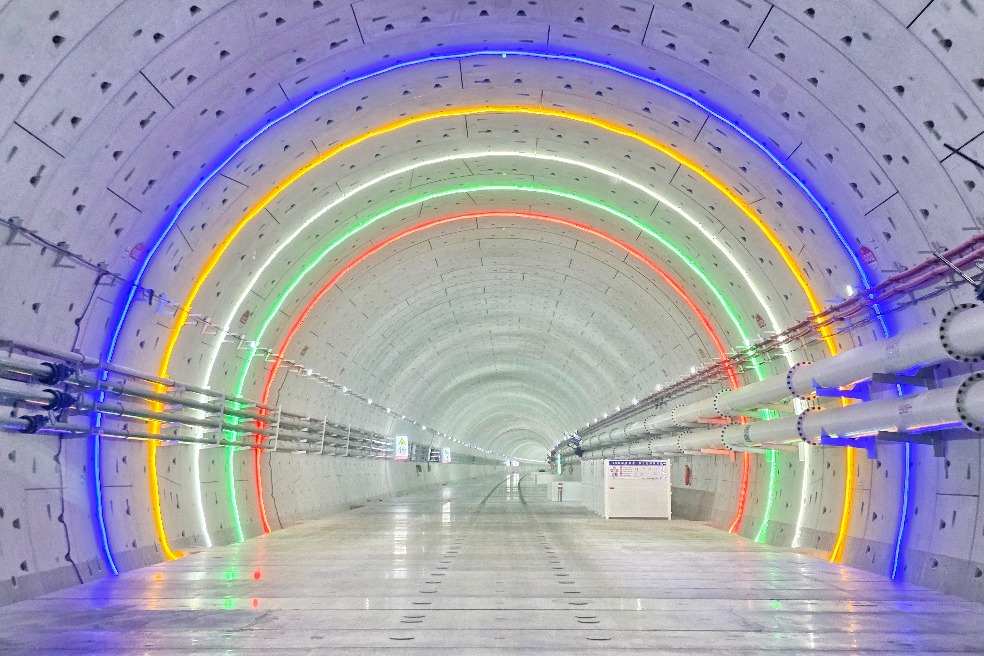
A major milestone in China’s expanding high-speed rail network has captured public attention across Chinese social media, as the landmark Shanghai-Chongqing-Chengdu high-speed railway’s Yangtze River underwater tunnel hits a critical construction benchmark.
Over the weekend following the late-March breakthrough, discussions of the cross-river tunnel project dominated national social platforms, with the topic “China to launch high-speed railway under the Yangtze River” trending on China’s leading microblogging platform Weibo at the end of March. As a core national infrastructure project listed in China’s 15th Five-Year Plan (2026-2030) outline, the full 2,000-kilometer high-speed rail corridor carries a total investment of 500 billion yuan, equal to approximately $72.8 billion.
On March 29, after 23 consecutive months of safe, steady excavation, the domestically built “Linghang” shield tunneling machine completed a record 11.18-kilometer underwater digging run, successfully passing beneath the Yangtze River’s southern embankment. The tunnel in question, stretching between Chongming district in Shanghai and Taicang city in Jiangsu province, is the longest and largest high-speed rail cross-river tunnel ever built in China, with a total planned length of 14.25 kilometers. It is a central segment of the Shanghai-Chongqing-Chengdu high-speed railway, a key backbone route in China’s national “eight vertical and eight horizontal” high-speed rail network. Project estimates cited by China Central Television suggest the full corridor will generate up to 1.5 trillion yuan in added value across its entire industrial chain, delivering tangible economic benefits to more than 20 small and medium-sized cities along the route.
The Linghang machine’s single-drive excavation run marks a new global engineering achievement. The project requires a 11.325-kilometer uninterrupted single-drive digging distance, with the machine’s cutter head measuring 15.4 meters in diameter and the tunnel reaching a maximum depth of 89 meters below the riverbed. Designed to accommodate high-speed trains operating at speeds up to 350 kilometers per hour, the tunnel will allow trains to cross the Yangtze River without reducing speed, a feat that demands extraordinary engineering precision.
“At a speed of 350 km/h, the required construction precision falls within the millimeter range,” explained Wang Yi, deputy equipment manager for the project, in an interview with ThePaper.cn. Wang noted that underwater tunnel construction faces unique challenges from variable river water pressure, natural geological settlement, and other environmental factors. Even a minor alignment deviation can compromise operational safety and passenger comfort, placing extremely strict requirements on structural precision, track smoothness, and resistance to external interference.
This milestone is far more than a technical breakthrough, Wang emphasized. It cements China’s global leading position in high-speed rail underwater tunnel construction and proves the country has fully mastered core technologies for ultra-high-speed underwater tunnel projects, creating replicable, scalable expertise that can be applied to similar infrastructure projects worldwide in the future.
Shield tunneling machines, which require highly complex integrated systems and extreme manufacturing precision, are widely recognized as a key benchmark of a country’s advanced manufacturing capacity. A single Linghang-class machine is made up of more than 20,000 individual components, and its development tells a broader story of China’s decades-long progress in heavy manufacturing: from relying entirely on imported machinery 30 years ago to becoming a global industry leader.
China’s journey to domestic shield machine development began in 2002, when research and development of the technology was added to a national key scientific research program, launching the country’s localization push. Just two years later, in 2004, China’s first domestically built metro shield machine was unveiled in Shanghai and deployed successfully for soft soil excavation. Over the subsequent two decades, Chinese-developed shield tunneling machines have achieved continuous technological breakthroughs, with rising levels of independent innovation and intelligent integration. Today, Chinese-made shield machines are exported to more than 40 countries and regions around the world, holding roughly 70 percent of the global market share.
Once the full Shanghai-Chongqing-Chengdu high-speed railway is completed, it will drastically cut travel times between the Yangtze River Delta region in eastern China and the Chengdu-Chongqing economic hub in southwestern China, strengthening economic connectivity, facilitating regional integration, and driving balanced growth across the entire Yangtze River Economic Belt.