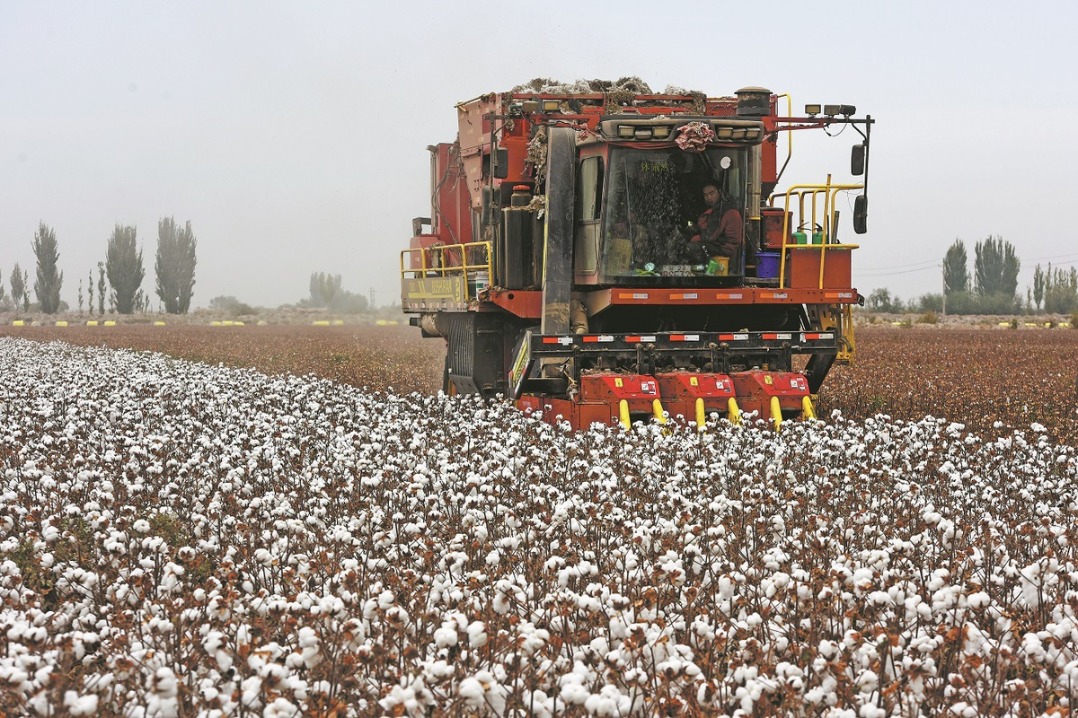
China’s Xinjiang Uygur Autonomous Region has shattered production records in both cotton and grain harvests for 2025, marking a significant advancement in agricultural productivity. The remarkable yields have been propelled by comprehensive modernization initiatives including large-scale mechanization, enhanced farming techniques, and superior crop varieties.
Official statistics reveal cotton production reached an unprecedented 6.17 million metric tons, surpassing the 6 million ton threshold for the first time and constituting 92.8% of China’s total output. Simultaneously, grain yields climbed to 8,291.9 kilograms per hectare, maintaining Xinjiang’s position as the national leader for the second consecutive year.
Wei Fenghua, an official from the National Bureau of Statistics, attributed this agricultural success to multiple factors including extensive mechanized farming operations and sustained favorable cotton market prices that have encouraged continued cultivation expansion. The region’s cotton yield per hectare reached 2,379 kg, exceeding the national average by 150 kg, benefiting from optimal climatic conditions, abundant sunlight, sophisticated field management practices, and genetically improved seed varieties.
The mechanization revolution has been particularly transformative. In Awat county, Aksu prefecture, the Yuhao Farmers’ Cooperative has automated over 80% of cotton operations from planting to harvesting. Cooperative manager Wang Hongwei explained how land leveling and adoption of high-yield, disease-resistant cotton varieties have enabled large-scale equipment deployment.
Domestic agricultural machinery has played a crucial role in this transformation. Self-propelled cotton harvesters, predominantly manufactured domestically, can now process 10 hectares daily—equivalent to approximately 100 manual laborers. Local data indicates domestic machinery accounted for over 80% of cotton harvesters in Aksu’s Awat and Shaya counties.
Agricultural equipment operators have increasingly embraced Chinese-made machinery, noting advantages in maintenance speed, warranty support, and training tailored to local conditions. Hao Jiangshan, who transitioned from imported to domestic harvesters after five years, exemplifies this shift. Yue Xingchun, manager at Shaya Boshiran Intelligent Agricultural Machinery Co, confirmed domestic equipment now matches imported models in performance while being specifically designed for Chinese field dimensions and operational requirements.
Grain production similarly demonstrated robust growth, with total output reaching 24.32 million tons—an increase of 1.02 million tons from 2024. Over the past five years, Xinjiang’s annual grain output has expanded by 8.49 million tons, contributing 18.7% of China’s total growth during this period—the largest regional increase nationwide.
Xinjiang’s agriculture department highlighted how approximately 4 million hectares of high-standard farmland have facilitated these achievements through technologies including rational dense planting and precision water-fertilizer regulation. Future plans involve concentrating cotton cultivation in mechanization-friendly zones, expanding local processing capabilities for wheat, corn, and cotton, and continuing yield optimization through technological innovation and improved farming practices.