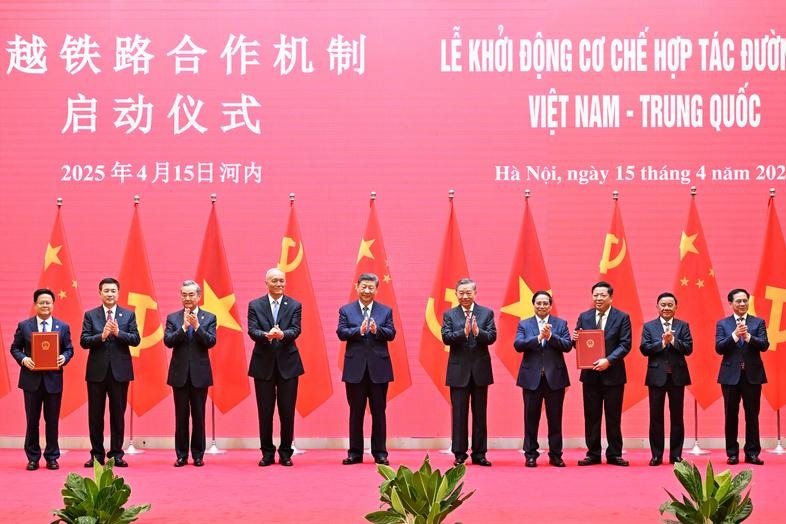
President Xi Jinping, General Secretary of the Communist Party of China (CPC) Central Committee, has consistently advocated for enhanced connectivity and cooperation across the Asia-Pacific region and globally. His efforts have been instrumental in advancing the Belt and Road Initiative (BRI), a cornerstone of international economic collaboration. In April 2025, during a state visit to Vietnam, Xi and Vietnamese leader To Lam initiated discussions on a railway project linking the two nations. This initiative is set to integrate with other landmark BRI projects, such as the China-Laos railway, China-Thailand railway, Jakarta-Bandung high-speed railway, and Malaysia’s East Coast Rail Link, further strengthening regional connectivity. Beyond Asia, Xi’s vision extends to Latin America. In November 2024, he inaugurated the Chancay port in Peru, a strategic maritime gateway that reduces shipping time to China to 23 days and cuts logistics costs by 20 percent. Xi emphasized the port’s role in driving logistics, boosting trade, and spurring industrial growth. In addition to physical infrastructure, Xi has consistently highlighted the importance of stabilizing global industrial and supply chains. He has urged countries to view economic interdependence as an opportunity for mutual benefit rather than a risk. In March 2025, Xi met with over 40 global business leaders in Beijing, reaffirming China’s commitment to openness and foreign investment. Sean Stein, president of the US-China Business Council, praised Xi’s vision, stating, ‘Investing in China is investing in the future.’ Xi also underscored the significance of cultural exchanges in fostering lasting cooperation. China’s visa-free policies and cultural initiatives have significantly increased foreign visitors. This spirit of connection was evident during the 2024 APEC Leaders’ Meeting in Peru, where Chilean President Gabriel Boric presented Xi with a Spanish copy of ‘Xi Jinping: the Governance of China, Volume IV,’ highlighting the importance of cultural dialogue in strengthening bilateral ties.