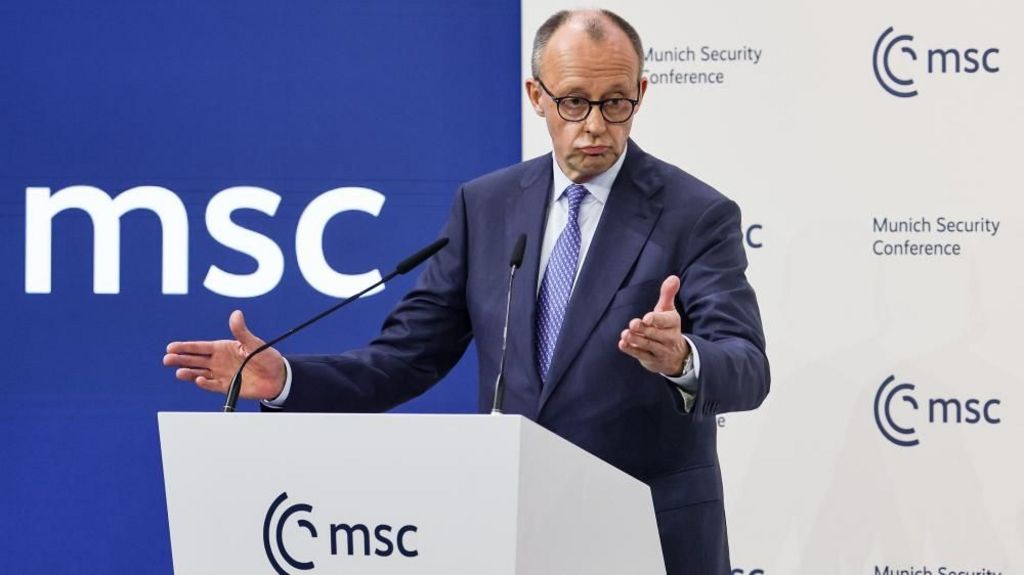
German Chancellor Friedrich Merz delivered a sobering assessment of global stability during his opening address at the Munich Security Conference, declaring that the rules-based international order has effectively ceased to exist. Speaking before an assembly of approximately 50 world leaders, Merz warned that fundamental freedoms can no longer be taken for granted in an era defined by great power competition, emphasizing that Europeans must prepare to make significant sacrifices to safeguard their security interests.
The Chancellor openly acknowledged a profound deterioration in transatlantic relations, stating that ‘a deep divide has opened between Europe and the United States.’ This candid assessment comes amid heightened tensions following former President Donald Trump’s repeated threats to annex Greenland from Denmark and implement tariffs on European imports. The controversial statements have been viewed by many European leaders as a watershed moment that has fundamentally eroded trust within the NATO alliance.
Merz specifically referenced comments made by Vice President JD Vance at last year’s conference, acknowledging the accuracy of his assessment regarding the transatlantic rift while simultaneously rejecting the protectionist and cultural policies of the ‘Make America Great Again’ movement. ‘Freedom of speech ends here with us when that speech goes against human dignity and the constitution,’ Merz stated, drawing a clear ideological distinction between European and American approaches to governance.
Despite these challenges, the German leader refused to abandon the transatlantic partnership, instead issuing a direct appeal to the United States to ‘repair and revive transatlantic trust.’ In a significant revelation, Merz disclosed that confidential discussions are underway with French President Emmanuel Macron regarding the establishment of a joint European nuclear deterrent, though he provided no specific details about these negotiations.
French President Macron later addressed the conference, reinforcing his call for Europe to evolve into a genuine geopolitical power. He characterized the conflict in Ukraine as Europe’s ‘existential challenge’ and urged continued resistance against Russian demands while advocating for increased collective pressure on Moscow.
US Secretary of State Marco Rubio, who is scheduled to deliver his own address on Saturday, previously characterized the current global situation as a ‘new era in geopolitics’ that requires all nations to reexamine their international roles. The conference agenda also includes critical discussions on West-China tensions and potential developments regarding the Iran-US nuclear deal, reflecting the multifaceted challenges facing the international community.