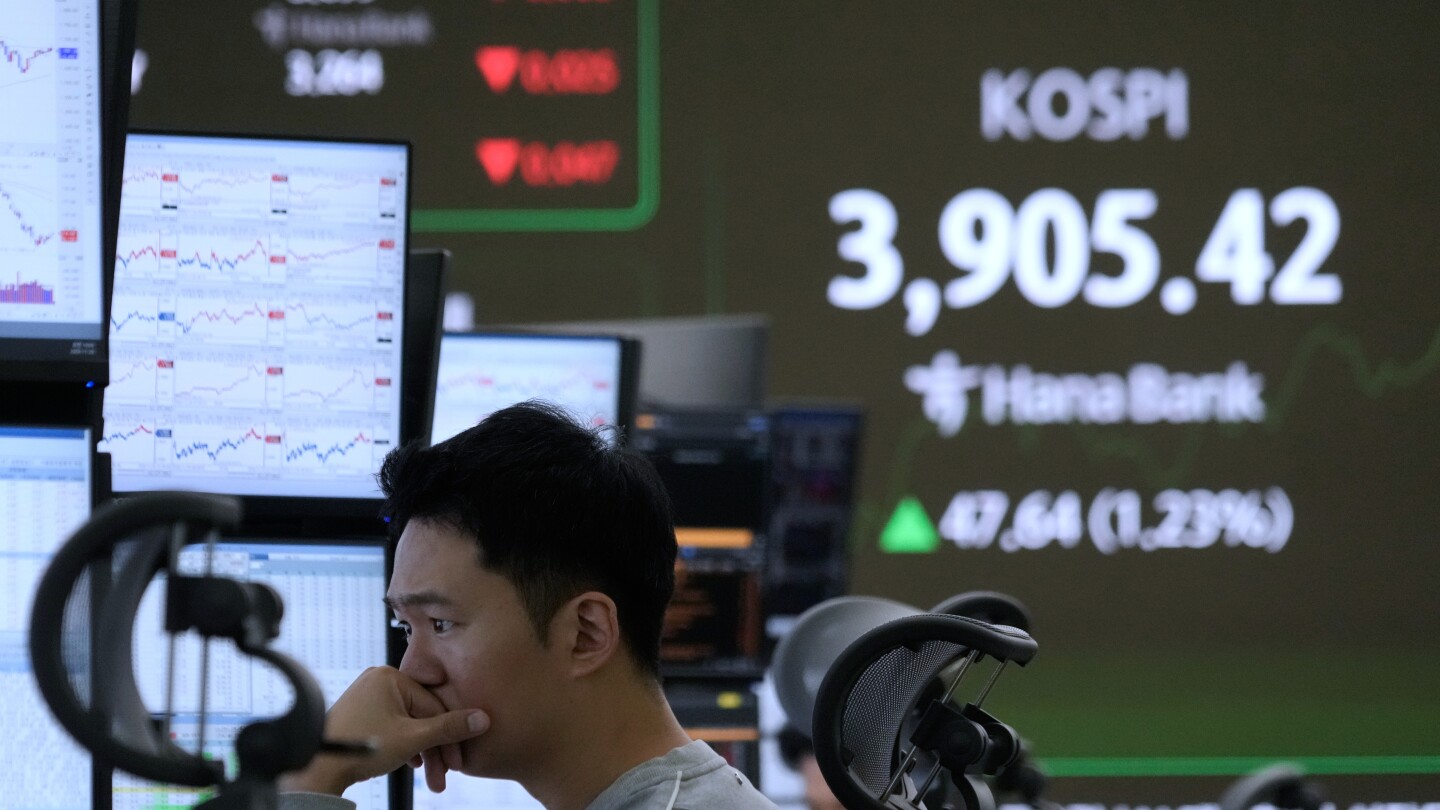
Stock markets across Europe and Asia experienced notable gains on Wednesday, driven by optimism that the Federal Reserve may soon reduce interest rates. This sentiment followed a strong performance on Wall Street, where benchmarks surged in anticipation of potential rate cuts. In early European trading, Germany’s DAX climbed 0.2% to 23,500.98, while France’s CAC 40 also rose 0.2% to 9,623.22. The UK’s FTSE 100 saw a modest increase of 0.1%. In Asia, Tokyo’s Nikkei 225 soared 1.9% to 49,559.07, supported by gains in major exporters and technology shares. However, Kioxia’s shares plummeted 14.9% amid reports that Bain Capital plans to sell $2.3 billion of its shares. South Korea’s Kospi surged 2.7% to 3,960.87, buoyed by a 3.5% rise in Samsung Electronics, the market’s largest player. SK Hynix, a leading computer chip maker, also saw a 1% increase. Taiwan’s Taiex jumped 1.9%, while Chinese markets showed mixed results. Hong Kong’s Hang Seng edged up 0.1% to 25,928.08, but the Shanghai Composite slipped 0.2% to 3,864.18. Alibaba, the Chinese e-commerce and technology giant, fell 1.9% after its U.S.-traded shares dropped 2.3% on Tuesday due to weaker-than-expected profits, despite stronger revenue. Australia’s S&P/ASX 200 rose 0.8% to 8,606.50, and New Zealand’s S&P/NZX 50 added 0.6% after the central bank cut its official cash rate to 2.25%. U.S. markets are set for a shortened trading week due to the Thanksgiving holiday, with closures on Thursday and reduced hours on Friday. On Tuesday, the S&P 500 gained 0.9%, the Dow Jones Industrial Average rallied 1.4%, and the Nasdaq composite rose 0.7%. The Russell 2000 index, which tracks smaller U.S. companies, led the market with a 2.1% jump. Mixed economic data has left traders betting on an 83% probability of a Fed rate cut in December. Retail sales in September fell short of expectations, and consumer confidence worsened more than anticipated in November, signaling the economy could benefit from lower interest rates. While easier rates can stimulate borrowing and investment, they may also exacerbate inflation, a key concern for the Fed. U.S. benchmark crude oil rose 5 cents to $58.00 per barrel, while Brent crude increased 8 cents to $61.88. The U.S. dollar strengthened to 156.46 Japanese yen, and the euro rose to $1.1575.