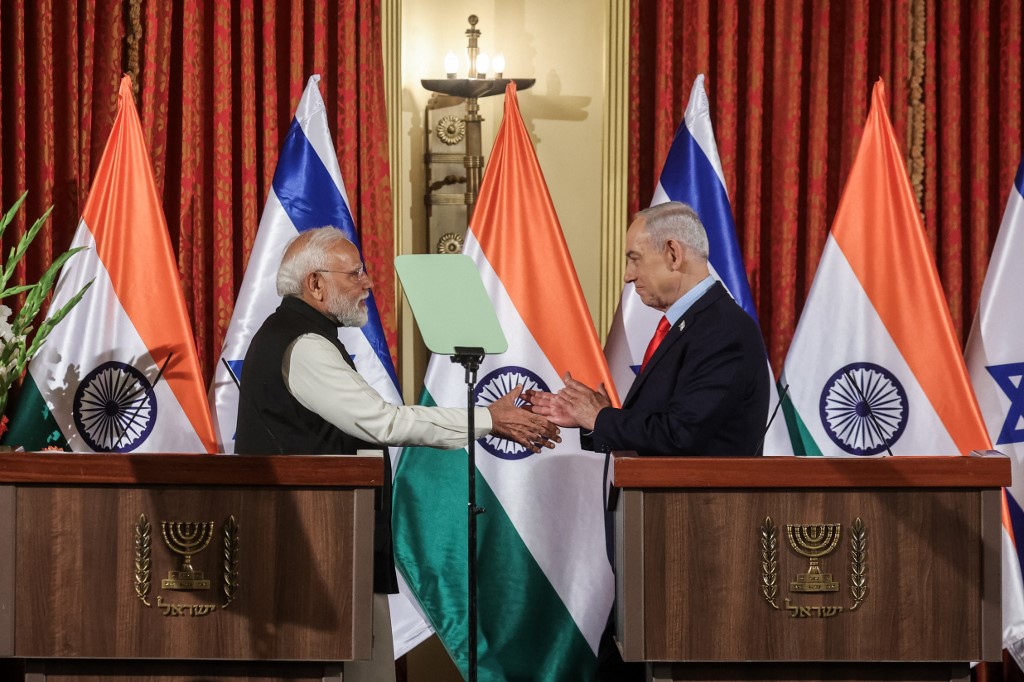
In a significant geopolitical development, Indian Prime Minister Narendra Modi’s diplomatic engagement with Israel has sparked intense scrutiny regarding New Delhi’s strategic positioning amid escalating Middle Eastern tensions. The timing of Modi’s visit to Israel, occurring just days before joint US-Israeli military operations against Iran, has raised critical questions about India’s foreign policy orientation and its implications for regional stability.
The context of this diplomatic maneuver unfolds against the backdrop of devastating conflict in Iran, where approximately 1,000 casualties have been reported alongside widespread disruption throughout the Gulf region. This confrontation represents one of the most consequential Middle Eastern military engagements in recent decades, pitting Iran against what it perceives as Israeli expansionist ambitions.
During Modi’s high-profile meeting with Israeli Prime Minister Benjamin Netanyahu, bilateral relations were elevated to a ‘Special Strategic Partnership for Peace, Innovation and Prosperity.’ The Indian leader received a specially created Knesset medal recognizing his service to Israel, raising questions about prior knowledge of impending military actions. India’s subsequent response—or lack thereof—to the assassination of Iranian Supreme Leader Ayatollah Ali Khamenei and the torpedoing of an Iranian naval vessel by US forces has drawn criticism from diplomatic circles, with former officials describing these developments as ‘strategic embarrassments’ damaging to India’s regional credibility.
This geopolitical repositioning reflects deeper ideological transformations within India’s political landscape. Since assuming power in 2014, the Modi administration has progressively advanced the concept of Hindu Rashtra (Hindu state), a vision supported by the ideological framework of the Rashtriya Swayamsevak Sangh (RSS). Analysts observe that this domestic transformation has corresponding international dimensions, particularly in shaping India’s Middle East policy.
Author and political analyst Suchitra Vijayan notes: ‘New Delhi increasingly frames its interests through a civilizational, anti-terror lens that aligns with US and Israeli security discourses. Islamophobia has become institutionalized in foreign policy, effectively replacing non-alignment with a principle of strategic annihilation of Muslims.’
This philosophical shift manifests in practical cooperation: Indian delegations frequently study Israeli approaches to governance, dissent management, and security commodification. Israeli tactical methodologies are increasingly visible in India’s domestic security operations, including protest suppression in Haryana, surveillance of political figures in Delhi, and demolition operations in Kashmir.
India’s stance on Iran must be contextualized within its broader position on Gaza. Over the past thirty months, during which approximately 200,000 Palestinians have been killed or injured, India has provided military equipment (including combat drones), labor replacement for Palestinian workers, and consistent diplomatic protection for Israel at the United Nations. New Delhi initially hesitated to endorse the Gaza ceasefire resolution and declined to support arms embargo measures, citing national interest considerations.
External Affairs Minister Subrahmanyam Jaishankar defended this orientation: ‘Israel represents a nation with which we maintain robust national security cooperation. It has consistently supported India during periods of national security vulnerability.’
This alignment carries significant economic implications. With Iran restricting maritime movement through the Strait of Hormuz, India faces energy security challenges given its limited emergency reserves. Approximately nine million Indian workers in Gulf states (particularly UAE, Qatar, Saudi Arabia, and Kuwait) face uncertain prospects, potentially disrupting remittance flows critical to India’s economy.
Despite these risks, India appears to be hedging its strategic bets. The US recently granted India a 30-day waiver for Russian oil purchases, while New Delhi has gradually distanced itself from initiatives like the Chabahar Port project in Iran following American pressure. Major Indian conglomerates—including those led by Adani, Ambani, and Tata—maintain deep infrastructure, logistics, and defense partnerships with Israel, positioning them to capitalize on potential post-conflict economic opportunities.
India’s integration into US-Israeli strategic frameworks continues through participation in the I2U2 grouping (India, Israel, UAE, US) and the India-Middle East-Europe Economic Corridor. Prime Minister Netanyahu’s announcement of a ‘hexagon alliance’ against ‘radical axes’ reportedly includes India as a key participant alongside Greece, Cyprus, and unspecified Arab, African, and Asian states.
While this foreign policy orientation has drawn criticism from opposition parties, independent media, and activist organizations, the absence of robust political challenges to the government’s Hindu nationalist agenda suggests continuity in India’s strategic alignment. As Vijayan concludes: ‘Very few nations demonstrate both governmental and popular anti-Palestinian and anti-Muslim sentiment simultaneously. India represents one such case.’