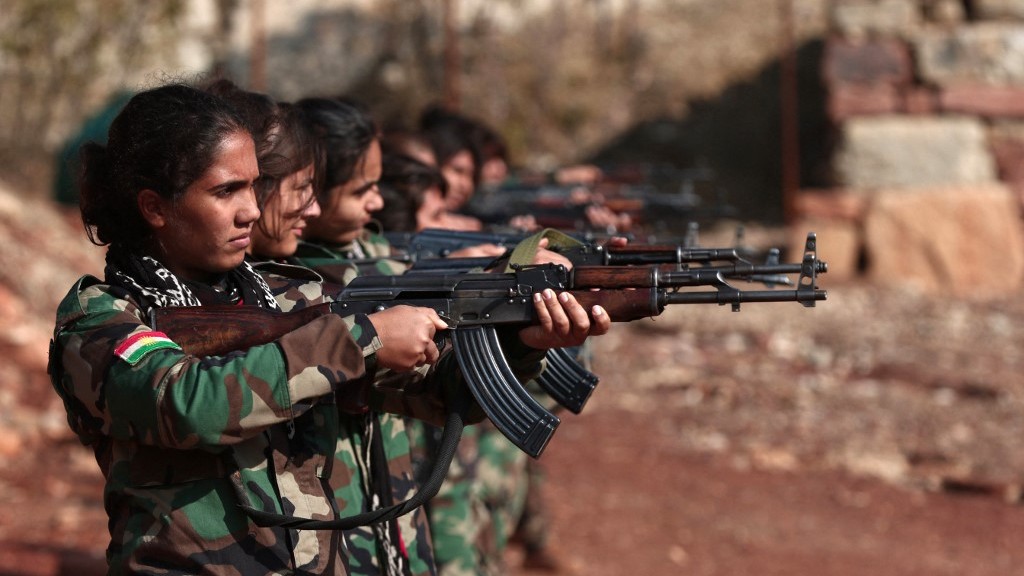
Amid the ongoing military confrontation between the United States and Iran, the Islamic Republic has expanded its retaliatory operations across the Gulf region, targeting U.S. strategic assets while turning its attention to Iranian Kurdish opposition groups based in northern Iraq. The cross-border strikes have deepened regional instability and sparked new debate over the nature of the threat Tehran perceives from these exiled Kurdish factions.
Keywan Faramarzi, international relations representative for the Komala Party of Iranian Kurdistan, confirmed to Middle East Eye that recent weeks of attacks on Komala bases and operational hubs in Iraqi Kurdistan have left 10 fighters dead. While no group has formally taken responsibility for the strikes, Faramarzi explicitly pinned the blame on the Iranian government, framing the violence as part of a long-standing state policy to eliminate Iranian Kurdish opposition organizations operating beyond Iran’s official borders.
Komala is not alone in facing this escalation. Multiple other Iranian Kurdish opposition groups have reported similar attacks both in northern Iraq and inside Kurdish-populated regions of Iran itself.
The latest surge in Iranian strikes follows unconfirmed reports from Israeli media claiming Turkey pressured the U.S. to scrap a planned operation that would have deployed Iranian Kurdish fighters across the border to overthrow Tehran’s government. Since the U.S.-Israeli military campaign against Iran launched in February, rumors of a Kurdish incursion into Iran have circulated repeatedly, but this most recent proposal was said to carry greater strategic ambitions – and the Iranian leadership has treated the threat with clear seriousness.
In a public statement released July 19, Iranian Foreign Minister Abbas Araghchi accused the U.S. and Israel of plotting to fragment Iran using Kurdish opposition groups as proxies. “I made clear that if any threat emerges against us from Iraqi Kurdistan, we will respond without question,” he said.
Despite Tehran’s claims, all major Iraqi-based Iranian Kurdish parties have flatly denied any involvement in internal Iranian armed conflict, and reject assertions that former U.S. President Donald Trump ever proposed a cross-border ground operation to them. “We have no knowledge of any such plan, and no verifiable evidence exists to support these allegations,” Faramarzi said. “These reports read as nothing more than media speculation that does not align with on-the-ground realities.”
Hana Yazdanpanah, a representative for the Kurdistan Freedom Party (PAK), echoed that denial. “We hold no such intention,” she told Middle East Eye. Yazdanpanah acknowledged that PAK supported and defended Kurdish communities in Iranian Kurdistan during the January anti-government protests, but dismissed all claims of involvement in a regime-change operation as baseless. “Neither the Kurdistan Region of Iraq, our party PAK, nor any other Iranian Kurdish party have taken part in any such operation, nor have we received any weapons or military supplies from foreign actors,” she added.
Even with these consistent denials, Iran’s unbroken campaign of strikes confirms that Tehran still views the exiled Kurdish factions as a meaningful threat. Middle East Eye reached out to the Iranian Foreign Ministry for additional comment, but received no response prior to publication.
As demographic data cited by Minority Rights Group International shows, Kurds make up roughly 10 percent of Iran’s total population, concentrated primarily in the country’s western provinces of Kurdistan, Kermanshah, West Azerbaijan, and Ilam. For decades, several Iranian Kurdish opposition movements – which Tehran designates as terrorist organizations – have maintained operational bases in the semi-autonomous Kurdistan Region of northern Iraq. These groups include Komala, PAK, the Kurdistan Democratic Party-Iran (PKDI), Khabat, and the Kurdistan Free Life Party (PJAK), the latter of which holds ties to the Turkey-based Kurdistan Workers Party (PKK).
While the groups hold a range of distinct ideological positions, most are united around two core goals: the self-defense of Kurdish communities inside Iran, and the eventual achievement of self-determination for Iranian Kurdistan. In late February of this year, the major factions announced a new formal coalition, with an explicit stated mission of coordinating efforts “to overthrow the Islamic Republic of Iran.”
In April, former U.S. President Donald Trump claimed his administration had supplied large quantities of firearms to anti-government protesters in Iran, and that Kurdish groups had taken possession of the weapons – a claim the Kurdish parties have repeatedly denied.
“We have formed this alliance to strengthen and escalate our struggle in East Kurdistan [Iranian Kurdistan] and across Iran against the Islamic Republic,” Yazdanpanah said. “In this struggle, we utilize every available method of resistance.” Even so, she emphasized that the coalition has “openly maintained and declared its neutrality” in the ongoing U.S.-Iran conflict.
Estimates of the coalition’s collective military strength put it far below the capacity of Iran’s state security forces. PAK reported roughly 1,000 members in 2019, while PDKI, Komala, and Khabat are believed to have similar troop counts. PJAK officials have claimed as many as 3,000 active fighters. Combined, the entire coalition’s fighting force pales in comparison to Iran’s hundreds of thousands of Islamic Revolutionary Guard Corps (IRGC) personnel, plus an additional hundreds of thousands of volunteers in the Basij militia network.
This military imbalance has led most independent analysts to conclude the Kurdish coalition lacks the raw power to overthrow Iran’s government on its own. The repeated claims of foreign-backed regime change have also sparked growing frustration among the Kurdish parties themselves.
Winthrop Rodgers, an associate fellow at the London-based Chatham House think tank, noted that the Kurdish parties have approached the ongoing U.S.-Iran war with significant caution, a choice that reflects their own clear assessment of their limited capabilities and the current strategic context. “This caution likely disappointed the expectations of some reckless U.S. and Israeli planners, who failed to grasp the complex dynamics at play on the ground,” Rodgers explained.
Even so, Iran’s continued targeting of Kurdish positions in northern Iraq makes clear that the opposition groups remain a persistent concern for Tehran, even if they do not pose an immediate existential threat. Faramarzi argued that Komala’s core work focuses on building political power, not large-scale conventional military invasion. “Our main role is organizing, supporting, and strengthening civil society and protest movements across Iran – and that is what the government fears,” he said. “Through these attacks, the Islamic Republic is trying to erode our political and organizational capacity, while also sending a warning to all opposition forces across the country.”