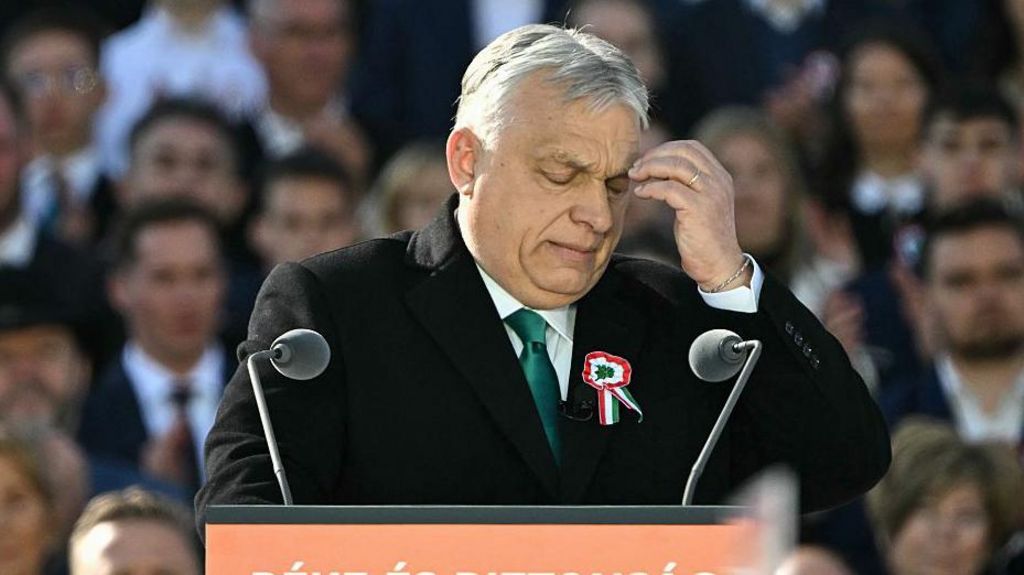
As the longest-serving incumbent head of government in the European Union, 62-year-old Viktor Orbán is bracing for the greatest political challenge of his decades-long career, with Hungary’s general election set to take place on April 12. After holding power for 16 consecutive years, most pre-election opinion polls point to a potential defeat at the hands of Péter Magyar, a former insider from Orbán’s own ruling Fidesz party, marking a potential turning point for both Hungary and its relationship with the EU.
Orbán’s political journey stretches back to the final days of Soviet-backed communist rule in Central Europe. Born in 1963 in the small village of Felcsút an hour west of Budapest, he grew up in a working-class household with no running water, the eldest of three sons. As a young law student in Budapest in the late 1980s, he first rose to national prominence as a pro-democracy activist, founding the Fidesz party (the Alliance of Young Democrats) and delivering an explosive 1989 speech to a quarter of a million Hungarians gathered at Budapest’s Heroes’ Square, calling for an end to communist dictatorship and the establishment of a free, independent democratic Hungary. In that moment, he was hailed as one of the brightest young hopes for post-authoritarian democracy in the region.
What followed has been a dramatic ideological and political transformation that has reshaped Hungary and put it at odds with much of the European Union. After early stints as a liberal pro-democracy leader and a short period of study at the University of Oxford funded by Hungarian-born philanthropist George Soros, Orbán gradually shifted his ideology to the nationalist hard right through the 1990s. He won his first term as prime minister in 1998, led Hungary into NATO, and after two election defeats in 2002 and 2006, he swept back into power amid the 2010 global economic crisis. He has won four consecutive elections since, securing a two-thirds parliamentary supermajority each time, allowing him to rewrite Hungary’s constitution and pass more than 40 sweeping “cardinal laws” that restructured state institutions, election rules, the media landscape and the national economy.
Since 2010, Orbán has rebranded his governing model with terms including “illiberal democracy” and “Christian liberty”, while allies in the U.S. MAGA movement frame it as “national conservatism”. The European Parliament has formally condemned the system as a “hybrid regime of electoral autocracy”, and political analysts widely note it as the only case of a former consolidated liberal democracy within the EU backsliding into non-democratic rule. Transparency International has repeatedly ranked Hungary as the most corrupt country in the EU, with critics alleging that billions in state contracts and infrastructure projects have been awarded to Orbán’s close family and inner circle, while independent media has been almost entirely pushed out of the market, replaced by Fidesz-aligned outlets. Billions of euros in EU development funding have been frozen over persistent rule of law concerns.
On the international stage, Orbán has emerged as Vladimir Putin’s closest ally within the EU, and has repeatedly clashed with Brussels over the war in Ukraine. He has repeatedly vetoed vital EU funding packages for Kyiv, claiming that supporting Ukraine risks dragging Hungary into direct conflict with Russia. Most recently, his foreign minister Péter Szijjártó admitted sharing confidential details of closed-door EU meetings with his Russian counterpart Sergei Lavrov, dismissing the disclosure as standard “everyday diplomacy” – a comment that drew sharp condemnation from other EU leaders, with Polish Prime Minister Donald Tusk noting that “Orbán and his foreign minister left Europe long ago”. Orbán has also positioned Ukraine as a core campaign enemy this election cycle, falsely claiming Ukrainian President Volodymyr Zelenskyy has blocked Hungary’s oil supplies and accusing opposition parties of planning to send Hungarian public funds to Kyiv. For years, he centered his political messaging on opposition to billionaire philanthropist George Soros and irregular migration, running a widely criticized anti-Soros poster campaign that opponents condemned as antisemitic, forcing the Soros-founded Central European University to relocate most of its operations to Vienna in 2019. In 2015, he built a border fence on Hungary’s Serbian frontier to block migrant arrivals and criminalized aid to irregular migrants, a policy that the EU’s top court ruled violated EU obligations.
Despite his long grip on power, Orbán now faces an uphill battle to secure a fifth consecutive term. His populist anti-Brussels rhetoric still resonates with many conservative Hungarian voters, but polling shows widespread fatigue after 16 years of rule, with growing public anger over persistent corruption allegations linked to his party and inner circle. Even his signature personal charisma, a key driver of his past political success, appears to be faltering: he was visibly rattled by boos from the crowd during a recent campaign rally in the northwestern town of Győr, a far cry from the quick-thinking, confident leader that longtime observers have described.
Orbán has not lost an election since 2006, and he has powerful international backings: former U.S. President Donald Trump has publicly endorsed his re-election bid, and he retains close political and economic ties to the Kremlin. But going into the April 12 vote, he faces the most serious electoral challenge of his decades in power, with the future of Hungarian democracy and Hungary’s place in the European Union hanging in the balance.