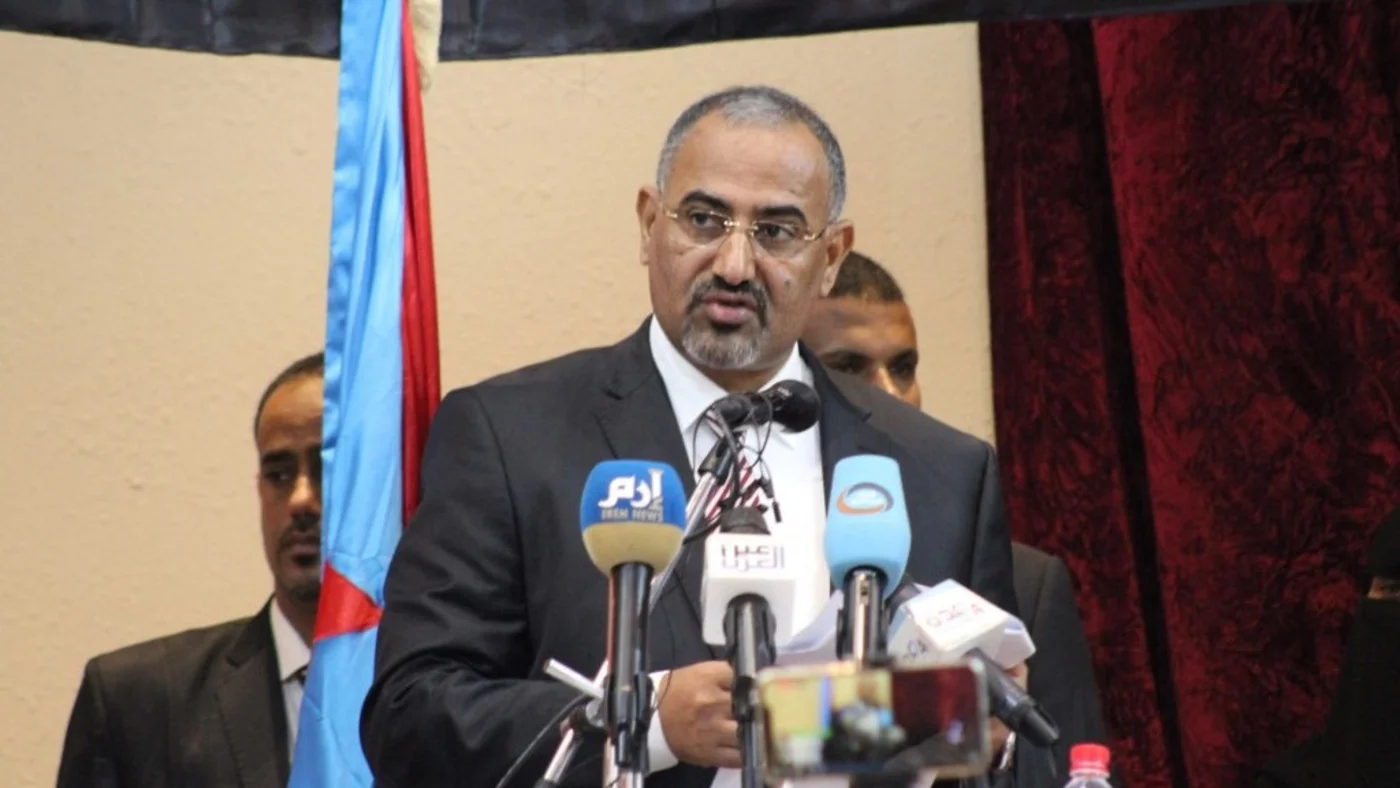
In a dramatic political upheaval, Yemen’s internationally recognized Presidential Leadership Council (PLC) has formally expelled Aidarous al-Zubaidi, head of the UAE-backed Southern Transitional Council (STC), charging him with high treason. The PLC announced on Wednesday that Zubaidi was personally—not the STC collectively—responsible for actions damaging Yemen’s political and military standing, including forming unauthorized armed groups, committing civilian atrocities, and sabotaging military installations.
Zubaidi, among Yemen’s most polarizing figures, has long championed southern secession. His political trajectory reached its zenith when appointed Aden’s governor in 2015, surviving two assassination attempts shortly thereafter. He established the STC in 2017, consolidating southern separatist ambitions, and secured a vice-presidential role within the PLC upon its 2022 formation—a position now revoked.
The immediate catalyst appears to be Zubaidi’s unilateral January 2nd ‘constitutional declaration’ proposing a two-year transition toward an independence referendum. This move exacerbated tensions already heightened by STC forces claiming control over Hadhramaut and al-Mahra governorates in December after Saudi-backed troops withdrew from Aden bases.
Saudi Arabia, leading the coalition opposing Houthi rebels, had summoned Zubaidi to Riyadh for crisis talks regarding escalating violence. However, coalition spokesman Major General Turki al-Maliki reported Zubaidi avoided the scheduled flight, instead ‘fleeing to an unknown location’ after distributing weapons in Aden.
Zubaidi’s ideological stance—advocating popular sovereignty contrary to the Houthis’ theocratic governance vision—and his 2023 remarks to Middle East Eye describing the PLC as a fragile ‘coalition of different agendas’ underscore the profound divisions. His recent controversial expression of willingness to join the Abraham Accords with Israel conditional on southern independence further illustrates his contentious international posture.
Born in 1967 during Yemen’s partition era, Zubaidi consistently opposed unification, leading armed group ‘Hatm’ post-1994 civil war to ‘defend the south.’ His removal signals critical fractures within the anti-Houthi alliance, threatening to destabilize Yemen’s precarious political equilibrium further.