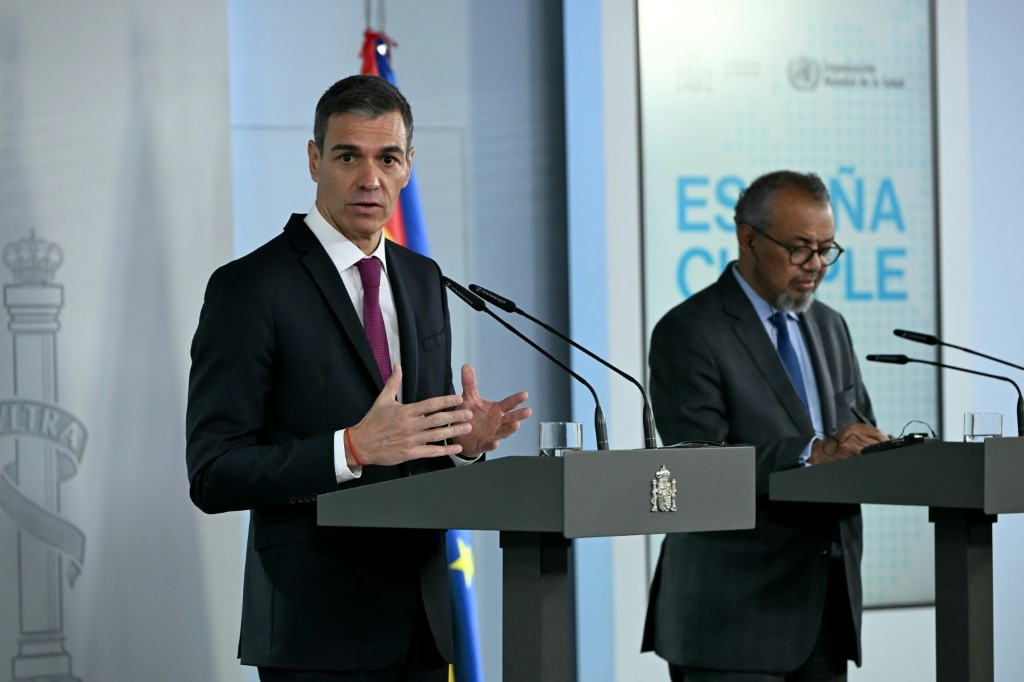
In the wake of a deadly hantavirus outbreak that killed three passengers on the cruise ship MV Hondius and triggered a multinational evacuation off Spain’s Canary Islands, World Health Organization Director-General Tedros Adhanom Ghebreyesus has warned that containment efforts are far from complete. The rare Andes variant of hantavirus — which can spread between humans and has no licensed vaccine or targeted cure — has sparked global unease after emerging on the Atlantic cruise, but public health leaders have moved quickly to dismiss comparisons to the early days of the Covid-19 pandemic, noting the current global risk remains low.
Speaking at a joint press briefing with Spanish Prime Minister Pedro Sanchez in Madrid on Tuesday, following his oversight of the evacuation operation, Tedros emphasized that there is currently no evidence to suggest a large-scale global outbreak is imminent. “But of course the situation could change, and given the long incubation period of the virus, it’s possible we might see more cases in the coming weeks,” he added. As of the latest official counts compiled by Agence France-Presse, seven confirmed cases and one probable case remain among surviving passengers and crew members on the vessel, with affected individuals holding citizenship from six nations: the United States, United Kingdom, France, Spain, Switzerland, and the Netherlands.
More than 120 passengers and crew members were repatriated from the Canary Islands over Sunday and Monday, with each country implementing its own public health measures aligned with WHO guidance. The UN health body’s recommendations call for a 42-day quarantine and continuous monitoring for high-risk contacts, matching the virus’s maximum six-week incubation period. Tedros urged all nations receiving evacuees to adhere to the organization’s guidance, while acknowledging that countries retain full authority to set their own public health protocols. On Tuesday, French Prime Minister Sebastien Lecornu added his voice to the conversation, calling for tighter coordination of health safety rules across the European Union to manage the situation.
The MV Hondius outbreak has already created unexpected diplomatic strains, as nations negotiated over responsibility for hosting and treating the infected vessel. Initially, Cape Verde refused entry to the cruise ship, which was forced to anchor off the capital Praia while three critically ill patients were airlifted to Europe last week. Spain ultimately agreed to allow the vessel to anchor off the Canary Islands to complete the full evacuation of all passengers and crew, but the regional government of the Atlantic archipelago strongly pushed back against the decision. Defending his administration’s choice to accept the ship, Sanchez stressed that “the world does not need more selfishness or more fear. What it needs are countries that show solidarity and want to step forward.”
After the evacuation wrapped up, the MV Hondius departed Tenerife on Monday with only a minimal skeleton crew on board. It is scheduled to arrive in the Netherlands, its home country, this Sunday, where it will undergo full professional disinfection. Hantavirus is typically transmitted to humans through contact with the urine, feces, and saliva of infected rodents, and the Andes variant is endemic to parts of South America. The MV Hondius began its transatlantic cruise from Argentina on April 1, bound for Cape Verde before the outbreak was detected.