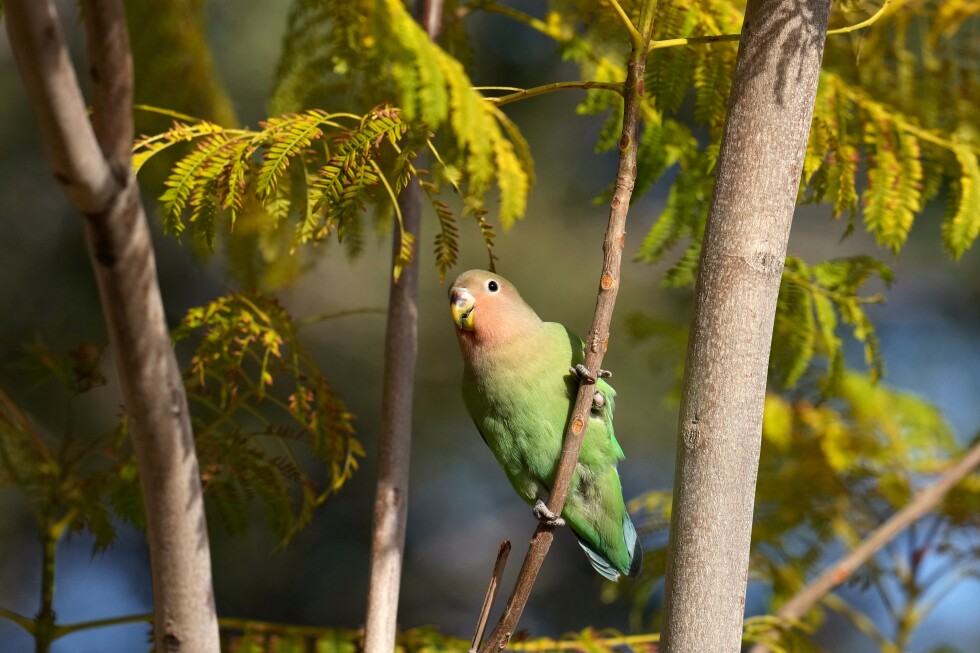
PHOENIX — An extraordinary avian phenomenon has taken root in the heart of Arizona’s capital, where vibrant green flashes streak across the sky accompanied by distinctive chattering calls. The metropolitan area now hosts North America’s largest established colony of rosy-faced lovebirds (Agapornis roseicollis) outside their native southwestern African habitat, with approximately 2,000 of these resilient parrots adapting remarkably to urban desert living.
Originating from the arid Namib Desert spanning Angola, Namibia and South Africa, these non-native birds descended from escaped or released pets first documented in Phoenix during the 1980s. According to Robert Carter of the Maricopa Bird Alliance, while their precise colonization history remains uncertain, the population has demonstrated extraordinary ecological plasticity by thriving in an environment characterized by extreme summer temperatures that regularly exceed 100°F (38°C).
The lovebirds employ ingenious survival strategies including nesting in cactus cavities and palm tree crevices while strategically positioning themselves near air conditioning exhaust vents during peak heat periods—particularly noticeable at Arizona State University’s science building. Their behavioral adaptations extend beyond temperature management to sophisticated social structures characterized by lifelong pair bonding.
Ornithological experts including Kenn Kaufman, field editor for Audubon magazine, note that while smaller populations exist in Hawaii’s Big Island and Maui, plus a Fischer’s lovebird colony in southern Portugal, Phoenix’s colony represents the most significant established population beyond Africa. These observations provide valuable insights into avian adaptation mechanisms and the ecological implications of introduced species.
The species’ common name derives from their exceptional pair-bonding behaviors, which include continuous mutual preening—especially of hard-to-reach feathers—and lifelong food-sharing between mates. Dr. Stephanie Lamb, avian specialist at the Arizona Exotic Animal Hospital, notes that lovebirds demonstrate measurable distress when separated from partners, including reduced activity and altered vocalizations.
Their affectionate displays include beak-to-beak food transfer resembling human kissing (though involving regurgitation), and despite occasional conflicts requiring temporary separation, they consistently reunite through reconciliation behaviors. With lifespans approaching two decades, these resilient birds offer scientists ongoing opportunities to study tropical species adaptation to desert environments alongside their complex social dynamics.