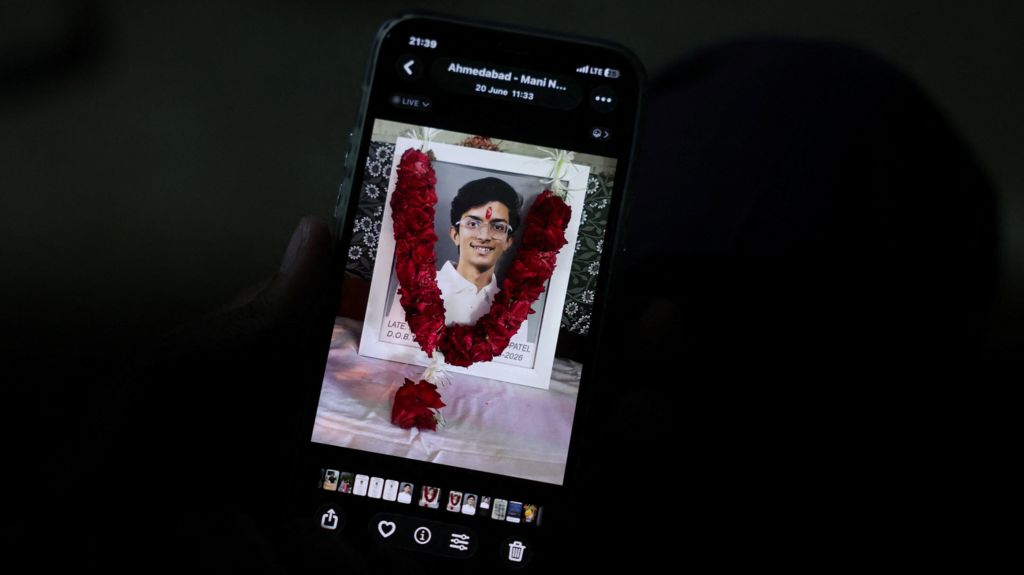
Across the diverse social landscape of India, two young lives with one shared ambition met identical devastating ends, laying bare the human cost of systemic failure in the country’s high-stakes medical entrance examination process. In Ahmedabad, just three days before he was set to sit a rescheduled National Eligibility cum Entrance Test (NEET), 17-year-old Kahaan Patel jumped from the sixth floor of his family’s apartment building in the early hours of June 18. When his family entered his study bedroom after his death, every trace of his short, ambitious life remained: his laptop was still open, textbooks and stationery scattered across his bed and desk, his headphones still on where he had left them before the jump. In one corner stood his electric guitar, plugged into an amplifier, while his bookshelves held everything from Harry Potter and Goosebumps novels to a biography of Elon Musk, alongside a trophy he won for consistent academic performance. The only thing missing, his father Prashant Patel says quietly, was Kahaan.
Kahaan was far from alone. He is one of at least 21 students who died by suicide after this year’s NEET exam was canceled over a widespread question paper leak, forcing nearly 2 million aspirants to retake the test. These tragic deaths became the emotional heart of an extraordinary youth-led uprising that spilled onto Delhi’s streets in July, as thousands of protesters demanded accountability for repeated government failures in managing national entrance examinations. After weeks of demonstrations organized by the satirical activist group Cockroach Janta Party, India’s education minister Dharmendra Pradhan stepped down. But behind the political upheaval are grieving families, left to piece together how an exam scandal escalated into a loss of life.
For Prashant Patel, Kahaan’s story begins with a dream, not a funeral. After earning top marks in his secondary school leaving exams, Kahaan told his family he wanted to become a doctor – a goal no one in their family had ever pursued. The entire family restructured their lives around that ambition, relocating from Surat, a busy diamond and textile hub, to Ahmedabad, Gujarat’s largest city, so Kahaan could access a better secondary school and focused test preparation. Prashant, a lawyer, purchased an apartment close to both the city’s high court and Kahaan’s school, commuting between the two cities weekly while Kahaan lived in Ahmedabad with his mother Veena and younger brother Rihaan. “He took that decision himself,” his father says. “We only supported him.”
Contrary to the stereotype of the singularly focused test aspirant, Kahaan was a well-rounded teenager with a wide range of passions. He played football for his school team, devoured fantasy and adventure novels, loved science fiction films, and spent hours teaching himself to play hard rock guitar riffs. He had even secured a U.S. visitor visa and was planning a trip back to Disneyland after his exam, excited to revisit a spot he first visited on a family trip 12 years earlier.
Kahaan had already proven his skill: after the 2024 NEET leak, he took the exam as a practice run, and his score convinced both him and his teachers he was on track to secure a spot in a top medical college. When he exited the May 3 exam hall this year, he called his father giddy with relief. “Daddy, I am so happy. I am feeling free, relaxed. I’m going for dinner with my friends. I’m enjoying,” he told his father, who replied, “This is your time. Enjoy.”
That joy shattered just days later, when reports of a widespread question paper leak broke. Kahaan’s parents tried to shield him from the news, but it spread quickly among his coaching classmates. He cut short a holiday with friends at a farmhouse, rushing home to retrieve study materials he had already given away to younger students, just in case a retest was ordered. Within days, the government officially announced the exam would be canceled and all candidates would have to retake it.
“That was when he became angry,” his father recalls. “He kept asking me: ‘Is this a system? Is this how it works? What is my fault? What is the fault of students who gave the exam honestly? Why is the government taking it so casually?’” Prashant tried to reassure his son, telling him the broken system was out of their control. Now, he wonders if his words came off as resignation rather than comfort. “Maybe he was disappointed. Maybe he was suffering inside,” he says.
There were few obvious warning signs. The evening before his death, Kahaan chatted cheerfully with his grandfather, who had just landed in Melbourne to visit family, and asked him to bring back Puma football boots and Levi’s denim. Later that night, he spoke to his father, who ended the call with one final reassurance: “You proved yourself once. You don’t have to prove yourself again.” Just hours later, he was dead. Only after his death did friends tell Prashant how deeply the scandal had shaken his son’s trust in the system.
770 kilometers away in Rajasthan’s Jhunjhunu district, another grieving father asks the same unanswered questions. 23-year-old Pradeep Kumar, the only student from his small village preparing for NEET, dreamed of becoming a doctor – a milestone that would have lifted his entire working-poor family into the professional middle class. Pradeep’s father Rajesh, a 45-year-old small-scale farmer, left school as a child, and Pradeep’s mother never attended school at all. “He would tell me, ‘I want to serve people so much that they will remember me,’” Rajesh says.
To pay for Pradeep’s coaching – the key to securing a good NEET rank – Rajesh sold part of his family land and took out a 1 million rupee ($10,480) bank loan. In 2022, Pradeep moved to Sikar, one of India’s largest entrance exam coaching hubs, sharing a small rented room with his older sister Babita, who was preparing for police recruitment exams. After two attempts, his rank improved steadily, and a spot at a government medical college finally seemed within reach.
Pradeep dedicated every moment of his life to that goal, following a relentless 16-hour daily routine: waking at 4:30 a.m., attending coaching classes, studying independently until 9 p.m., then sleeping, repeating the cycle day after day. He refused to own a mobile phone, telling his father, “I’ll buy one after I’m selected. Phones distract me.” His only small indulgence was a collection of 10 cheap wristwatches he bought from roadside vendors during trips home.
When he walked out of the May 3 exam, he was smiling, telling his father, “This time my selection is guaranteed.” The family planned to leave Sikar and return to their village to celebrate. Instead, the paper leak news broke, and a retest was ordered, meaning Pradeep would have to attempt NEET for a fourth time. He accepted the news stoically, telling his father they would just have to prepare again.
On the morning of May 15, Rajesh sent his son his daily delivery of fresh milk and homemade curd on the local bus, as he had done almost every day for four years. Pradeep called to confirm it had arrived, then bought fresh okra from a roadside vendor and told his sister to go bathe, saying they would cook the okra together when she returned. When she came back half an hour later, the door was locked. In that short window, Pradeep had taken his own life. “He never told me anything,” Rajesh says. “He seemed happy.”
Speaking about the leak, his voice hardens with anger and grief. “I sold my land to educate him. Those who have money buy question papers. Those who study honestly are left behind. The government snatched away my son. If the paper had not leaked, Pradeep would be alive today. He would have been celebrating.”
Kahaan and Pradeep came from vastly different worlds: one was the son of a middle-class lawyer, the other the child of a small farmer who mortgaged his future to fund his son’s dream. One planned a trip to Disneyland after his exam, the other postponed buying a mobile phone until he secured his medical seat. Yet both fathers are left grappling with the same devastating question: how did children who worked tirelessly to earn their future lose all faith in the system designed to reward their hard work?
Weeks after Kahaan’s funeral, Prashant was pulled out of his crippling grief by the student protest movement. He traveled to Delhi twice to join the July demonstrations, saying he did not go for government compensation – he went to demand accountability. The weeks of protests ultimately forced Pradhan’s resignation on July 25, and the government issued statements of sympathy for the bereaved families, promising maximum compensation per existing regulations. But for Prashant, the real impact of the movement is far deeper.
After watching students return to the streets despite a violent police crackdown on July 20, he says, “I wanted to thank them because they had become Kahaan’s voice. If these children can come back after being beaten and still fight for justice, that gives me strength.” His son never found the courage to speak out before he died, Prashant says: “Kahaan didn’t speak out. Instead, he took his own life. The other children spoke.” He leaves a message he wishes every parent and every government official would hear: “Our duty is to hear the voices of the young before they fall silent.”