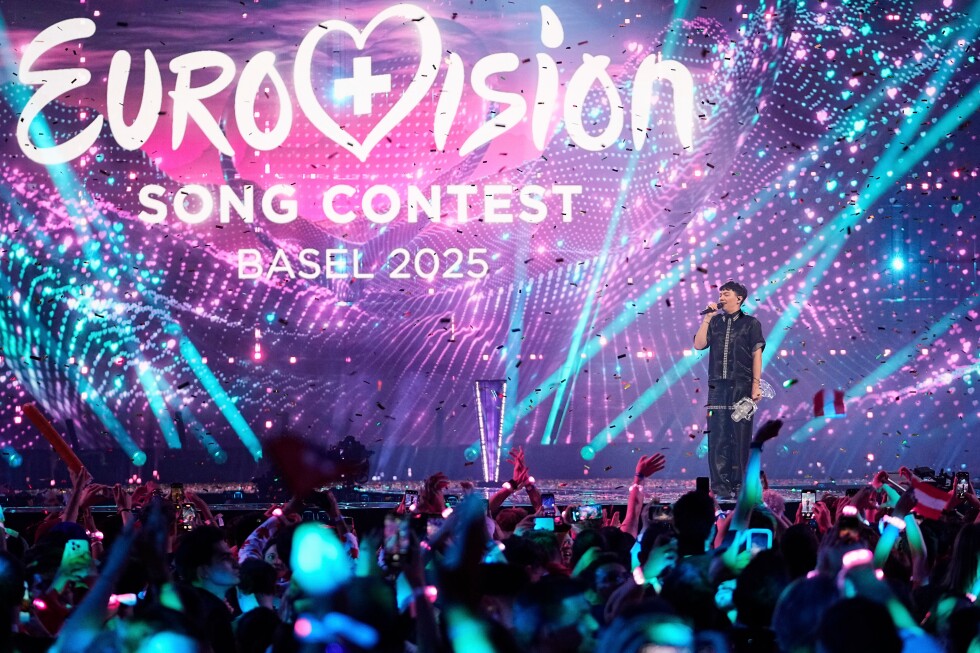
As the Eurovision Song Contest marks its 70th anniversary this year, the iconic, glitter-fueled global musical gathering is balancing its long-running celebration of cross-cultural connection with growing political tensions ahead of its 2026 installment in Vienna, Austria. Running from May 12 to 16, this year’s event will bring 35 competing acts from across Europe and beyond to the stage, but the gathering is overshadowed by a high-profile boycott led by five nations protesting Israel’s eligibility to compete amid the ongoing Israel-Hamas war in Gaza.
Founded in 1956 in the aftermath of World War II, Eurovision was originally conceived to test emerging live broadcast technology and rebuild continental unity across a war-scarred Europe. What began as a small contest with just seven competing nations has expanded into a global cultural phenomenon, now welcoming dozens of entries from across Europe and even non-European participants including Israel and Australia.
Widely described as the “Olympics of pop music,” the contest has cultivated a massive global fanbase by blending campy theatricality, unapologetic pop joy, and unfiltered national pride. Last year’s installment drew a global audience of 162 million viewers, and organizers confirm fans from 75 countries have already purchased tickets for this year’s live shows at Vienna’s Wiener Stadthalle. Over its seven-decade history, Eurovision has launched the careers of some of the world’s biggest music stars, from 1974 winners ABBA to Celine Dion, who claimed victory for Switzerland in 1988, to more recent standouts including 2014 winner Conchita Wurst, 2021 champions Måneskin and 2022 winners Kalush Orchestra. Even its most famously silly entries, such as early winners “La, La, La” and “Boom Bang-a-Bang,” have become beloved parts of the contest’s quirky legacy.
Though the contest’s official motto remains “United by Music,” politics have repeatedly intruded on its celebration in recent years. In 2022, Russia was expelled from the competition following its full-scale invasion of Ukraine, and the 2024 contest in Malmö and 2025 event in Basel both saw widespread pro-Palestinian demonstrations calling for Israel’s removal from the contest over its military campaign in Gaza and allegations of voting manipulation.
Tensions boiled over in December 2025, when five countries – Iceland, Ireland, the Netherlands, Slovenia and Spain – announced their withdrawals from the 2026 contest after the European Broadcasting Union (EBU), which runs Eurovision, reaffirmed Israel’s eligibility to compete. Slovenia’s national broadcaster even went so far as to announce it would not broadcast this year’s contest in solidarity with the boycott. While Bulgaria, Moldova and Romania have rejoined the competition after skipping recent installments for financial or artistic reasons, the total number of 2026 participants sits at 35, down from 37 in 2025. Multiple pro-Palestinian protests are already scheduled to take place across Vienna during contest week.
For fans focused on the music, this year’s lineup features a diverse range of acts spanning pop-opera, folk-infused dance, high-energy rock, and soulful ballads. Oddsmakers currently peg Finland’s “Liekinheitin” (“Flamethrower”), a high-octane collaboration between violinist Linda Lampenius and pop singer Pete Parkkonen, as the frontrunner to take home the trophy. Other top contenders include 17-year-old French singer Monroe’s pop-operatic ballad “Regarde!”, Denmark’s sultry jazz-tinged entry “Før Vi Går Hjem” (“Before We Go Home”), and Greece’s fan-favorite party-rap track “Ferto” (“Bring It”). Australia, a long-time enthusiastic non-European participant, has sent acclaimed star Delta Goodrem with the polished mid-tempo ballad “Eclipse,” while Cyprus’ folk-influenced dance-pop entry “Jalla” by Antigoni has already gone viral on YouTube and earned a positive nod from Eurovision experts. Israeli crooner Noam Bettan will compete with his ballad “Michelle,” while tiny San Marino’s entry “Superstar” features a surprise guest appearance from 1980s pop icon Boy George.
Eurovision expert Paul Jordan, known professionally as Dr. Eurovision, notes that the contest has long outgrown its old reputation for formulaic cheesy pop. “There’s not a lot of cheesy pop numbers this year,” he explained. “There’s such diversity that I don’t think there is such a thing as a ‘Eurovision sound’ anymore.”
Following longstanding tradition, 2026’s contest is hosted by 2025’s winner, Austrian singer JJ, marking the third time Vienna has hosted the event. The competition kicks off with two semi-finals on May 12 and 14, which will narrow the field to 25 finalists who will compete in the grand final on May 16, hosted by Austrian singer and business heir Victoria Swarovski and actor Michael Ostrowski. The contest will broadcast on national public broadcasters across participating countries, stream on Peacock in the United States, and air via the official Eurovision YouTube channel in many other regions.
Voting, which combines public votes and scores from national expert juries, has been updated this year to address repeated allegations of vote rigging. The EBU has cut the maximum number of votes per purchase in half to 10 and implemented new safeguards to block suspicious or coordinated voting activity. Viewers in participating countries can vote via phone or text during the live final (though they are prohibited from voting for their home country’s act), while fans in non-participating nations including the U.S. can cast votes online via the official Eurovision voting website. After all votes are tallied, the act with the highest combined score claims the win, with the slow, dramatic reveal of scores keeping global audiences on the edge of their seats.
The 2026 boycott has sparked new questions about Eurovision’s future, particularly at a time when many European public broadcasters face crippling funding cuts and younger audiences increasingly turn to social media for entertainment. The withdrawal of two longstanding core participants – seven-time winner Ireland and Spain, one of the five largest funding contributors to the contest – is a significant blow to the event’s stability. Still, Eurovision leadership is looking to expand globally, with the first-ever Eurovision Song Contest Asia scheduled to launch in Bangkok this November.
Jordan remains optimistic that the 70-year-old institution can weather this latest period of tension. “At 70, Eurovision is part of our European culture,” he said. “It still gets people talking. It still brings us all together. It still gets huge viewing figures, it’s still creating hits. At a time when broadcasting is changing, people still make a date with their television set on that Saturday night.”