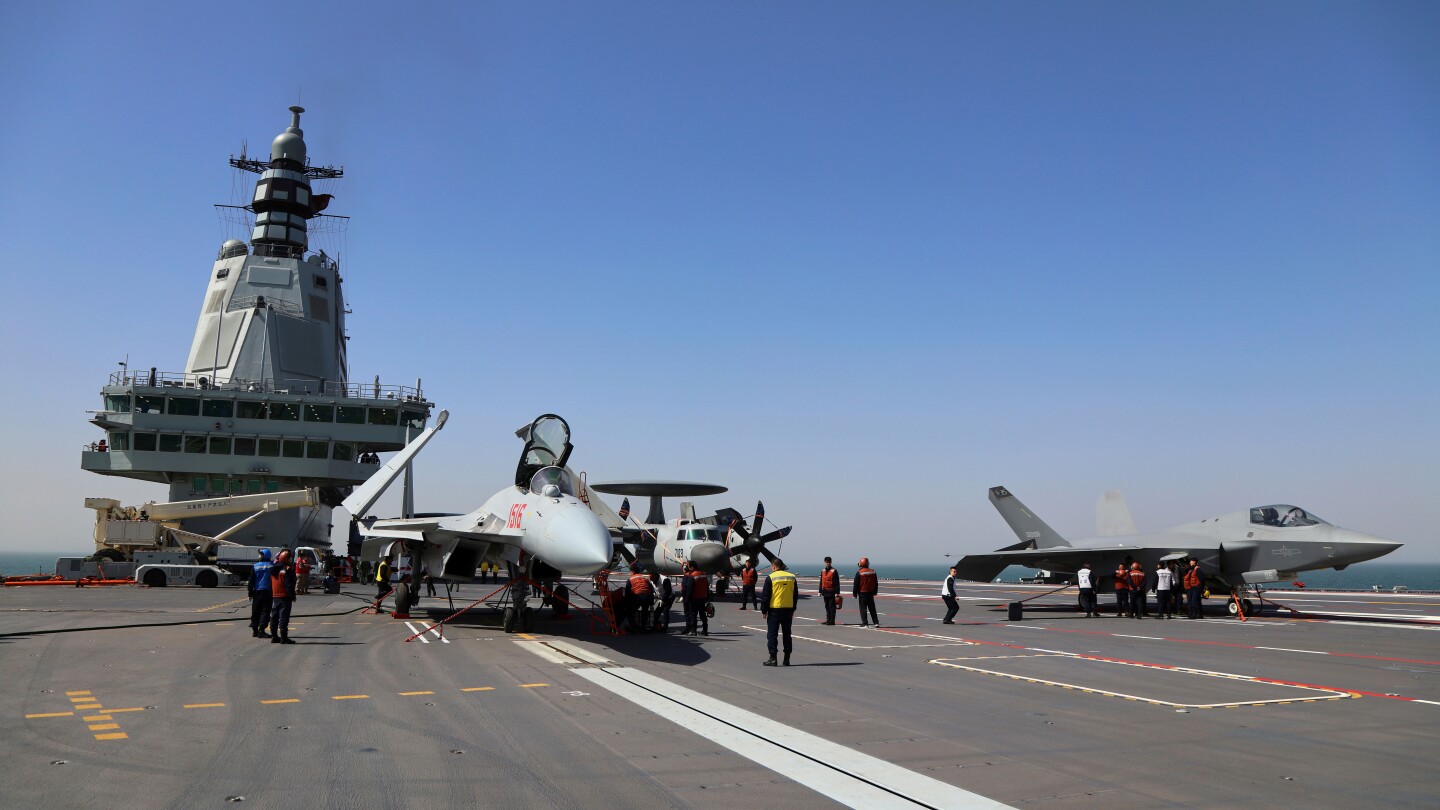
China has officially commissioned its third aircraft carrier, the Fujian, solidifying its position as the nation with the second-largest carrier fleet globally, trailing only the United States. The Fujian, unveiled in a ceremony attended by President Xi Jinping, represents a significant technological leap with its electromagnetic catapult launch system. This innovation enhances the carrier’s ability to project power across the Pacific, particularly in contested regions like the East China Sea, the Taiwan Strait, and the South China Sea. The Fujian is China’s first domestically designed carrier, distinguishing it from its predecessors, the Liaoning and Shandong, which were based on Soviet designs. The Fujian’s advanced catapult system allows it to launch heavier, fully-loaded aircraft, including early-warning and control planes, extending its operational range and firepower. While China’s carrier fleet now surpasses those of India, the UK, and Italy, it still lags behind the U.S., which operates 11 nuclear-powered carriers. The Fujian’s electromagnetic catapult system, second only to the U.S. Navy’s USS Gerald R. Ford, offers greater efficiency and flexibility, enabling the launch of a wider range of aircraft. However, the Fujian’s non-nuclear propulsion limits its operational range compared to U.S. carriers. China is reportedly developing nuclear propulsion for future carriers, though the timeline remains uncertain. Despite its advancements, the Fujian is smaller than U.S. carriers, with a displacement of over 80,000 tons and an estimated capacity of 40 to 60 aircraft, compared to the 60 to 70 planes on U.S. carriers. The Fujian’s commissioning underscores China’s growing naval ambitions, though it still faces significant gaps in carrier technology and capacity compared to the U.S.