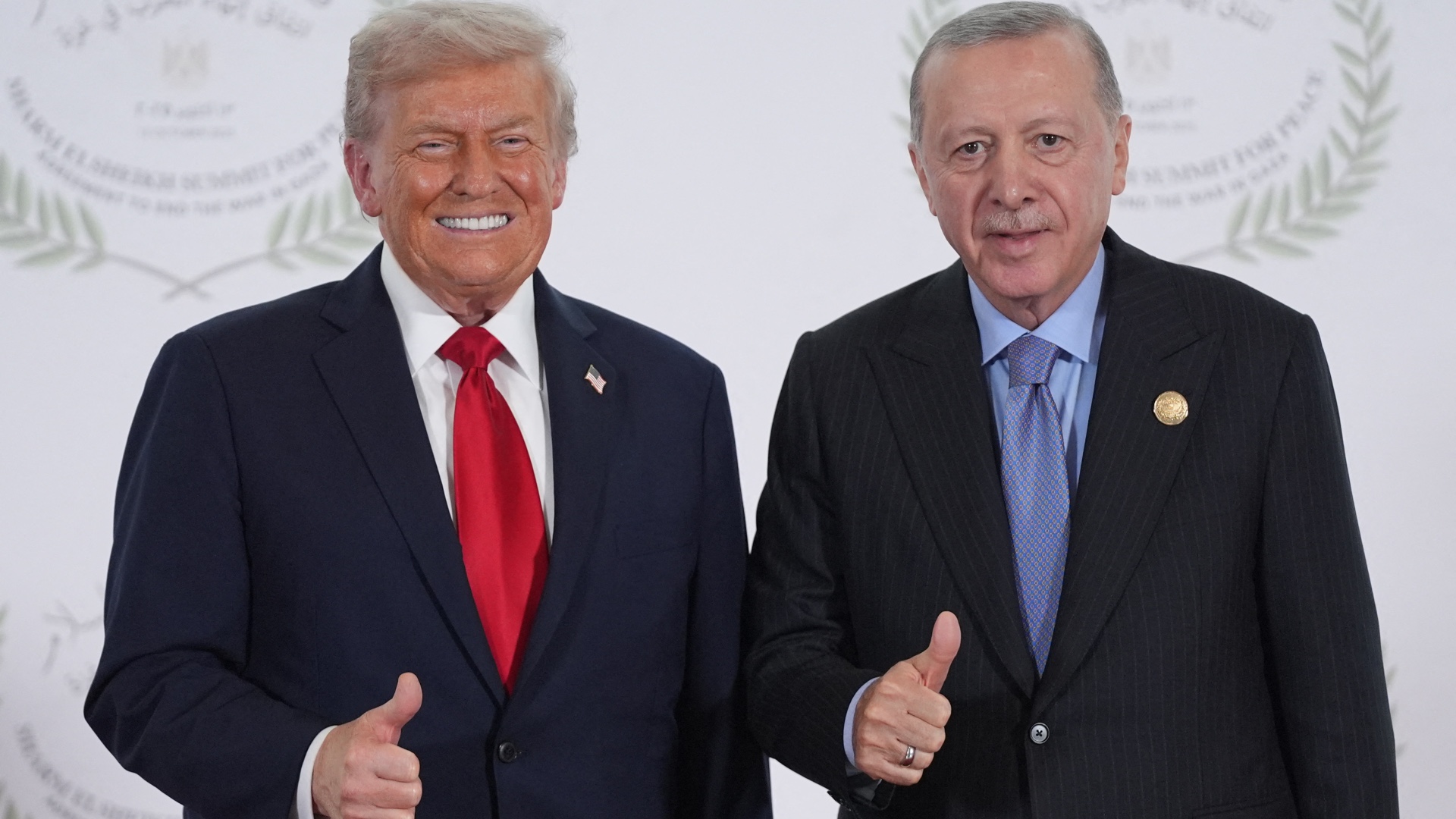
As U.S. President Donald Trump prepares to depart for Turkey to attend the annual NATO summit this Tuesday, his schedule is already shaping up to be defined by high-stakes bilateral diplomacy that breaks with decades of bipartisan U.S. foreign policy. The trip will open with a one-on-one meeting with Turkish President Recep Tayyip Erdogan, and conclude with a much-anticipated sit-down with new Syrian President Ahmed al-Sharaa on Wednesday — a pair of encounters that highlight Trump’s signature approach to foreign policy, which prioritizes personal rapport over longstanding ideological constraints.
Trump has openly positioned this personalized diplomacy as a corrective to what he frames as missteps by his predecessor Joe Biden, and has made no secret of his public admiration for both Erdogan and Sharaa. He has described Erdogan as a “strong” leader and Sharaa as “tough”, and has even publicly credited Erdogan with facilitating Sharaa’s rise to the Syrian presidency following former leader Bashar al-Assad’s flight to Moscow in December 2024.
This warm posture represents a sharp break from longstanding U.S. policy held by both major American political parties. For years, both Republicans and Democrats have raised sharp concerns over Erdogan’s domestic crackdown on political dissent and Turkey’s open support for Palestinian factions in the ongoing Gaza conflict. For Sharaa, the break is even more stark: he was formally designated a terrorist by the U.S. government for decades, a label the current administration has set aside in its push for closer ties.
In contrast to his friendly overtures to Erdogan and Sharaa, Trump has adopted a sharply critical tone toward most European leaders set to attend this week’s summit, setting a tense tone for the broader alliance gathering.
Regional analysts broadly view the burgeoning personal rapport between Trump and Erdogan as a potential strategic gain for U.S. interests in the Middle East. Alper Coskun, a former Turkish diplomat now based at the Carnegie Endowment for International Peace, told Middle East Eye that the quiet solidarity between the two leaders is likely to work in Trump’s favor. “He will find an increasingly willing actor on the part of Turkey to pursue a more aligned policy with the United States in the broader Middle East,” Coskun noted, adding that even on the contentious issue of Gaza, Turkish officials have publicly emphasized growing alignment between Ankara and Washington. Turkish Foreign Minister Hakan Fidan already attended the inaugural meeting of Trump’s Gaza Board of Peace, though Israeli pushback blocked Ankara’s bid to deploy Turkish troops as part of a proposed international stabilization force for the enclave.
That Israeli opposition extends far beyond the question of peacekeeping troops. Israeli Prime Minister Benjamin Netanyahu used a Monday interview with Fox News to double down on his criticism of the U.S.-Turkey rapprochement, particularly any potential move to readmit Turkey to the U.S.-led F-35 stealth fighter program. Netanyahu argued that only Israel should hold the military advantage provided by F-35s, and attacked Erdogan’s ruling AKP as “a regime infected by the Muslim Brotherhood, an extreme movement that hates America and chants death to America from that side of the spectrum.” “I don’t think they should be given F-35 or the engines for their fighter jets, because that’ll upset the power balance in the Middle East, which is ultimately guaranteed by Israeli air superiority,” he added.
Controversy around the F-35 program extends well beyond regional political tensions. Israel has relied heavily on F-35s for its military operations in Gaza, and manufacturing facilities producing F-35 components across NATO member states have repeatedly been targeted by anti-war protests in recent months.
Turkey was originally removed from the F-35 program and hit with U.S. sanctions in 2019, after Ankara proceeded with a deal to acquire Russia’s S-400 air defense system. Washington has long argued that coexistence of the S-400 and F-35 puts sensitive U.S. stealth technology at risk of exposure to Russian intelligence. In a confidence-building move that stops short of full readmission to the F-35 program, the Trump administration notified Congress late last month of a planned $700 million military arms sale to Turkey, including General Electric F110 turbofan engines to power Ankara’s domestically developed Kaan fighter jet.
While Ankara has maintained relatively warm ties with Moscow even as it remains a core NATO member, Turkish officials have sought to ease U.S. concerns by noting that the S-400 system has never been activated, leaving room for negotiated compromise. Even so, analysts caution that an immediate resolution of the sanctions dispute remains unlikely. While there is growing optimism in Ankara that the personal bond between Trump and Erdogan could lead to sanctions relief, Coskun notes that few observers are willing to bet that Trump will expend significant political capital with Congress to advance the issue. “I don’t expect an immediate solution, because of the very difficult obstacle in terms of dispossession of the S-400s, which is a requirement for Turkey,” he explained.
Gina Abercrombie-Winstanley, a non-resident fellow at The Atlantic Council, emphasized that while Trump prioritizes personal warmth in his diplomatic engagements, U.S. officials still need to push for core strategic priorities from Ankara. “[Trump] puts a great deal of emphasis on… warmth and conviviality, but hopefully somebody at the Department of State is talking about the things that we need from Turkey, which is to help ensure NATO sticks with their increased commitments for defence spending,” she told Middle East Eye.
One of the most striking foreign policy shifts of Trump’s second term has been his rapid embrace of Sharaa, Syria’s new leader. Previously known as Abu Mohammed al-Jolani, the former head of an al-Qaeda offshoot has rebranded as a secular statesman over the past year, backed by Turkish political support and Gulf Arab financial investment. Saudi Crown Prince Mohammed bin Salman first introduced Trump to Sharaa on the sidelines of the May 2025 Riyadh summit, shortly after Trump made the groundbreaking announcement that the U.S. would lift decades of sweeping economic sanctions on Syria. By November 2025, Sharaa was in the Oval Office exchanging gifts with Trump, and earlier this year he publicly thanked the U.S. president on social media for a delivery of Trump-branded fragrance.
Analysts say this quick rapprochement has already delivered tangible benefits for Syria’s new government. Will Todman, chief of staff of the Geopolitics and Foreign Policy Department at the Center for Strategic and International Studies, noted that Trump’s personal attention has already elevated Syria’s standing internationally. “That relationship has really delivered remarkable dividends, I think, for Syria, so far as it relates to the level of political attention that Trump has devoted” to the country, Todman said. “The fact that Trump has been so willing to see Syria in a new light, and to see the potential for Syria” is alone a win for the Syrians, he added.
The next major milestone for the U.S.-Syria rapprochement is expected to be the removal of Syria from the U.S. list of state sponsors of terrorism, a top policy priority for Damascus that is already gaining bipartisan support in Congress. Last week, a bipartisan group of lawmakers wrote to Secretary of State Marco Rubio arguing that the original legal justification for the designation no longer holds, and that the listing remains a major barrier to Syria’s political and economic recovery. “While Syria does need to make more progress in a variety of areas… the grounds for the SST designation in US law no longer apply and the listing remains a significant barrier to achieving the Administration and congressional priority of giving Syria a chance to succeed,” the lawmakers wrote.
Even as the relationship advances, analysts have pushed back on one of Trump’s most provocative recent proposals: the idea that Sharaa’s government could take on the task of disarming the Lebanese militant group Hezbollah. Abercrombie-Winstanley called the suggestion implausible. “I couldn’t believe it when I heard it,” she said. “I do expect Sharaa to be diplomatic with it, but [it’s] very clear that this is not something that should be welcomed by anyone, Syrian, Lebanese, or otherwise.”
Todman noted that Sharaa has no incentive to take on such a fraught mission, particularly as he works to consolidate control over a fractured Syria still reeling from decades of civil war. “Sharaa has no interest whatsoever in getting involved in Lebanon militarily — especially when his own country is still so fractured,” Todman explained. “It would immediately echo the past Syrian occupation of Lebanon, which would conjure up very negative feelings among Lebanese. In terms of capacity, he’s still struggling with the security situation in Syria. He’s not in control of all of Syrian territory.”
Following his meeting with Sharaa, Trump is scheduled to hold a press conference in Ankara Wednesday before returning to Washington. Consistent with his past practice, observers expect the president to share unscripted details of his closed-door discussions with leaders on the summit’s sidelines.
This report was originally published by Middle East Eye, an independent media outlet focused on coverage of the Middle East, North Africa and global affairs.