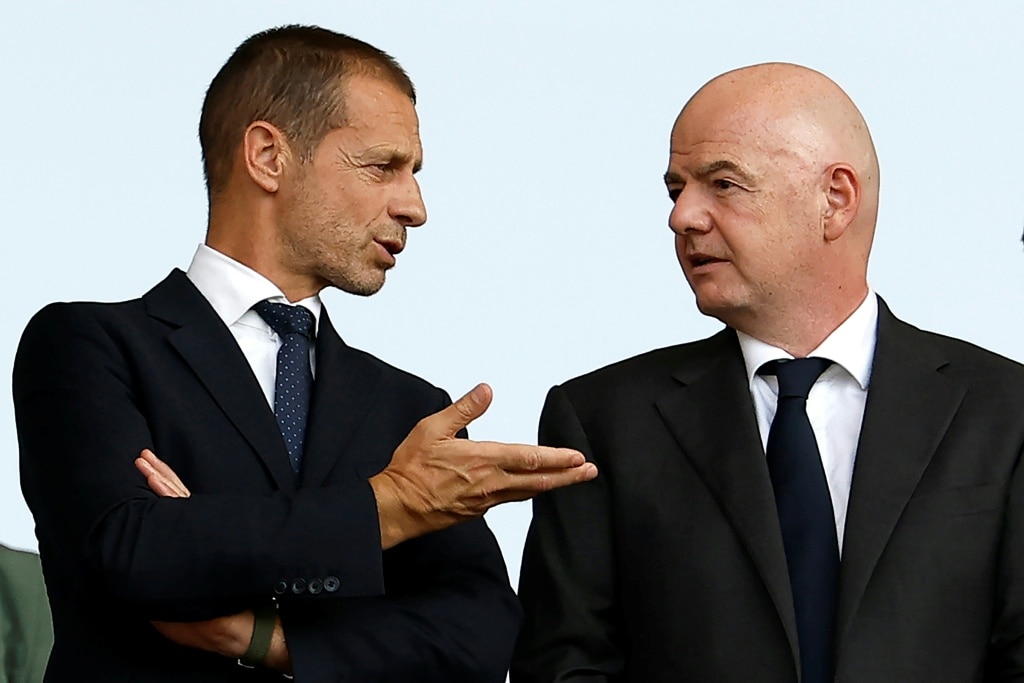
Gianni Infantino’s bid to weather growing criticism and retain control of global football’s governing body suffered a fresh blow this week, after three of FIFA’s six regional confederations launched an unprecedented coordinated attack on the FIFA president’s leadership just days after he backed away from a controversial commercial restructuring plan.
It has been more than seven days since Infantino was forced to abandon his proposal for FIFA Forward Enterprise (FFE), a private-investment-backed commercial subsidiary that would have taken over management of World Cup commercial operations. The plan drew fierce pushback from member associations and confederations over its lack of transparency and concentrated power in the hands of senior FIFA leadership.
Infantino had gambled that a combative public statement decrying a “concerted and ongoing effort” to undermine his authority would calm tensions and win time to shore up support. Instead, the move backfired spectacularly on Monday, when UEFA (European football’s governing body), CONCACAF (North and Central America and the Caribbean), and the AFC (Asian Football Confederation) published an open letter that laid bare their complete lack of confidence in Infantino’s leadership. While all sides publicly pay lip service to the need for unity within FIFA, deep divides over how the organization should be governed have made any compromise unlikely for the foreseeable future.
AFP Sport has broken down the current state of play, mapping out where blocs of support stand and what possible outcomes could unfold in the coming months:
### Who Stands With Infantino?
The 56-year-old Swiss incumbent has built a solid base of support over 10 years in office, largely through expanded development funding distributed to FIFA’s 211 member associations—a strategy that has paid dividends in loyalty.
The Confederation of African Football (CAF), whose member Morocco will co-host the 2030 men’s World Cup, has remained unwavering in its backing. Last week, CAF’s executive committee issued a statement “unanimously reconfirm[ing] its support for FIFA President Gianni Infantino and thanked him for his support for African football, over the years.”
South America’s governing body CONMEBOL has also retained its support, though it did join critics in condemning the sloppy planning and lack of consultation around the scrapped FFE plan. CONMEBOL has insisted that Infantino’s future should only be decided at the scheduled presidential election in Rabat next March, rather than through any early intervention.
A number of individual member associations have even broken ranks with their own regional confederations to back the incumbent. These include Mexico (a 2026 World Cup co-host that belongs to CONCACAF), and Kuwait and Qatar (AFC members that have both publicly voiced support for Infantino).
### The Growing Opposition Bloc
UEFA, CONCACAF, and AFC doubled down on their scathing rejection of Infantino’s leadership in Monday’s open letter, branding the scrapped FFE plan a “shabby, opaque, backroom deal.”
UEFA’s explicit threat to boycott all FIFA competitions—including the men’s and women’s World Cup—is widely credited as the decisive pressure that forced Infantino to abandon the FFE plan in a humiliating climbdown. The confederation reiterated that boycott threat last week, just one day after the FIFA senior leadership issued a statement of full backing for Infantino. At that time, CONCACAF and the AFC had not yet joined the public criticism, leaving UEFA isolated. Monday’s open letter made clear that the opposition is now a coordinated three-confederation bloc.
“When trust is broken through deception, when an individual places himself above the collective that entrusted him with authority, that duty has been abandoned,” the three confederations wrote in their joint statement.
UEFA’s boycott threat will face its first real test as early as September, when the Women’s Under-20 World Cup is scheduled to kick off in Poland.
The calls for Infantino to step down immediately have grown louder in recent days: Lise Klaveness, the outspoken president of the Norwegian Football Federation and one of Infantino’s most prominent critics, publicly called for his resignation last Friday. A growing number of European national associations have also publicly withdrawn their backing for his re-election, including Denmark, Finland, Sweden, Serbia and Wales.
### What Could Happen Next?
Infantino is currently standing for a fourth and final four-year term as president, with the election scheduled to take place at the FIFA Congress in Rabat on March 18 next year. The deadline for any rival candidate to officially register their candidacy is November 18.
Historical precedent favors incumbents in FIFA presidential votes: the last time a sitting president was unseated was in 1974, when Brazil’s Joao Havelange defeated incumbent Stanley Rous of England. That means unseating Infantino at the scheduled ballot would be an uphill battle for opponents.
However, critics who want to remove Infantino before next March do have a procedural path to force an early vote. The most likely option is a motion of no confidence, which requires support from 20 percent of FIFA’s member associations—equal to 43 national bodies—to trigger an emergency FIFA Congress to vote on the motion.
Every member association holds one equal vote at FIFA congresses, meaning a small football federation like Gabon has the same voting weight as the German Football Association. It remains unclear whether a simple majority would be enough to remove Infantino from office early.
### Who Could Challenge Infantino?
While Klaveness has been the most vocal critic of the incumbent, she is not seen as a likely candidate. FIFA’s electorate has historically favored a non-European president to balance the leadership of the global body, and no European has held the FIFA presidency only since 1998 (Sepp Blatter, followed by Infantino, with African football chief Issa Hayatou serving as caretaker between Blatter’s 2015 resignation and Infantino’s election). Even after Kirsty Coventry’s historic election as IOC president last year, the prospect of a woman leading FIFA remains remote for now.
UEFA president Aleksander Ceferin has repeatedly ruled himself out of the running, which narrows the field of credible potential challengers considerably. Two high-profile confederation leaders are seen as the most likely candidates to stand against Infantino:
* **Victor Montagliani**: The president of CONCACAF was once viewed as a close ally of Infantino, but the two have fallen out completely over the FFE plan, with CONCACAF now calling for “a comprehensive reckoning with this presidency.” The 60-year-old Canadian is a charismatic administrator who played a key role in delivering the successful 2026 World Cup hosting process, and counts legendary football figure Carlo Ancelotti among his close contacts in the global game.
* **Sheikh Salman bin Ibrahim al-Khalifa**: The AFC president previously ran for the FIFA presidency in 2016, when the vacancy opened up after Blatter’s resignation. He finished second behind Infantino in that vote. Now 60, Sheikh Salman has led Asian football since 2013, and his fourth term as AFC president ends next year, leading to widespread speculation that he will launch a second bid for the top FIFA job.