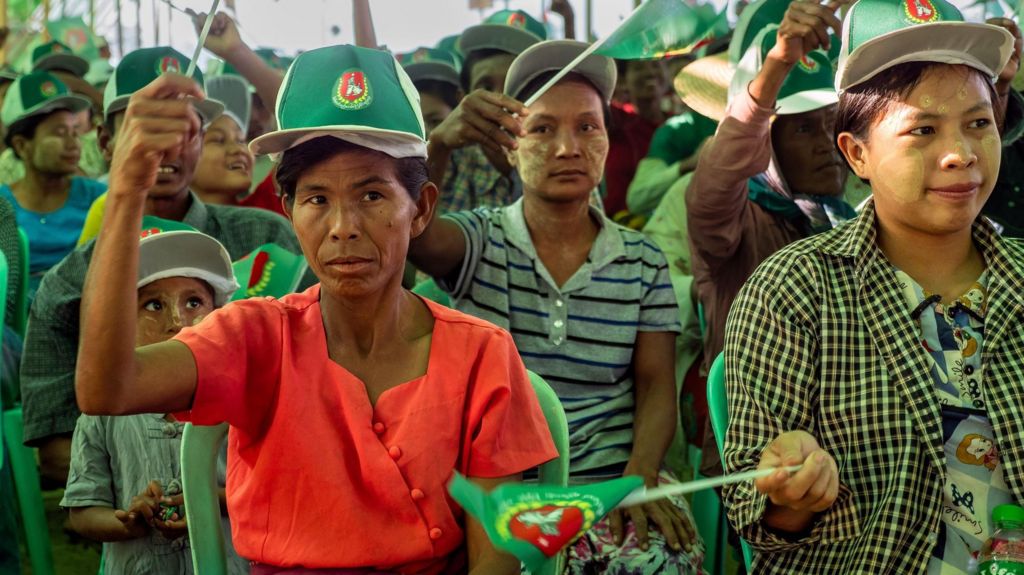
In a carefully staged political performance ahead of Myanmar’s December 28 election, retired Lieutenant-General Tayza Kyaw attempted to generate enthusiasm among a modest crowd in Mandalay. The military-backed Union Solidarity and Development Party (USDP) candidate addressed approximately 300-400 attendees, many of whom were earthquake victims seeking assistance rather than political engagement. The event exposed the profound challenges facing what international observers have universally condemned as a illegitimate electoral process.
This marks Myanmar’s first voting opportunity since the military seized power nearly five years ago, triggering a devastating civil war that has claimed approximately 90,000 lives according to ACLED data analysis. The election proceeds under circumstances that fundamentally undermine its credibility: the popular National League for Democracy has been dissolved, its leader Aung San Suu Kyi remains imprisoned, and voting cannot occur in extensive regions still engulfed in conflict.
The climate of intimidation permeates every aspect of the process. When BBC journalists attempted to gather opinions at the rally, party officials intervened, citing concerns about attendees “saying the wrong thing.” This apprehension stems from the visible presence of plain-clothes intelligence officers and draconian laws that criminalize dissent. A July statute prohibits any speech or action deemed destructive to the electoral process, with violators facing extreme penalties—three Yangon residents recently received 42-49 year sentences for merely posting stickers combining bullet and ballot box imagery.
Despite these conditions, junta leader Min Aung Hlaing appears confident the election will provide the legitimacy that has eluded him during five catastrophic years of rule. His confidence stems from several factors: diplomatic support from China, which is providing technical and financial assistance despite being a one-party state itself; recent military gains achieved with Chinese and Russian weapons; and the elimination of meaningful political opposition.
The reality on the ground reveals a nation deeply fractured. Even near Mandalay’s apparent normality, the conflict’s scars remain visible. Areas like the spectacular Mingun temple complex, once a tourist destination, have become contested territory where volunteer People’s Defence Forces control villages and ambush military convoys. A young police commander interviewed by the BBC revealed the constant danger facing security forces, describing shoot-on-sight relationships with guerrilla groups.
General Tayza Kyaw, when confronted about civilian casualties and air strikes against schools and hospitals, deflected responsibility entirely onto those resisting military rule, labeling them “terrorists” rather than citizens. This rhetoric reflects the regime’s uncompromising position and explains why many Burmese will participate in the election not out of conviction but fear. As one woman summarized: “We will vote, but not with our hearts.”