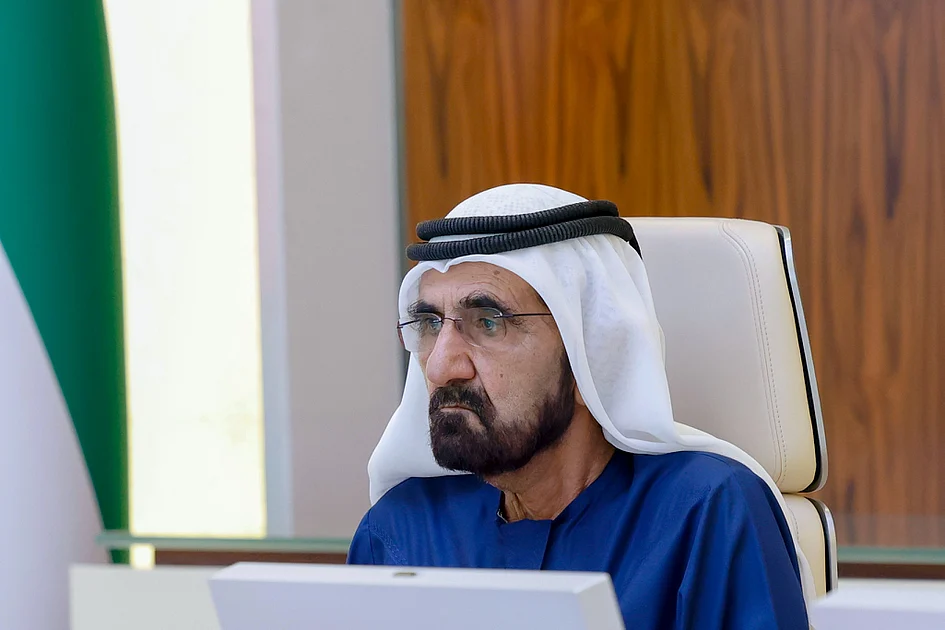
ABU DHABI – The United Arab Emirates marked a significant milestone this week as the nation commemorated 20 years of transformative governance under the leadership of Sheikh Mohammed bin Rashid Al Maktoum, Vice President and Prime Minister of the UAE and Ruler of Dubai.
During a landmark Cabinet meeting at Qasr Al Watan on Monday, Sheikh Mohammed reflected on the nation’s extraordinary journey since he assumed office in January 2006, revealing that the federal government had enacted over 16,000 resolutions and managed budgets exceeding Dh1.1 trillion to fundamentally redesign government operations.
“Two decades ago, we set our sights on achieving first place globally,” Sheikh Mohammed stated. “While some expressed skepticism at the time, today—by God’s grace—the UAE has evolved into a developmental model that nations worldwide seek to emulate.”
The comprehensive review highlighted how the UAE has emerged as a global benchmark across multiple sectors, currently ranking first in more than 280 international indicators spanning quality of life, education, healthcare, and housing. The nation has also strengthened its position as a crucial economic bridge between Eastern and Western markets, with particular dominance in trade, artificial intelligence, space industries, sovereign investments, and talent attraction.
The governance transformation included several strategic pillars: streamlining public services, modernizing legislative frameworks, upgrading national infrastructure, and developing advanced digital systems. This systematic overhaul began with the UAE’s inaugural Comprehensive Strategy in 2007 and the implementation of a Government Performance System in 2008, which introduced data-driven planning and accountability mechanisms across all ministries.
Six national strategic cycles have been successfully implemented, each meticulously aligned with federal budgets to ensure policy and financial resources moved in concert. Long-term planning became a defining characteristic of Emirati governance, exemplified by initiatives including UAE Vision 2021, the Centennial 2071 plan, and the more recent “We the UAE 2031” agenda.
Innovation emerged as a central governance pillar, manifested through initiatives such as the World Governments Summit, regulatory laboratories, and government accelerators. The establishment of the world’s first Ministry of Artificial Intelligence in 2017 demonstrated the UAE’s commitment to technological leadership, while the UAE legislation platform—hosting over 2,500 laws and regulations—has become an essential digital resource attracting approximately one million monthly visits.
The economic impact of these reforms has been substantial: real GDP surged 94 percent to exceed Dh1.77 trillion in 2024, while non-oil foreign trade expanded nearly sixfold to approximately Dh3 trillion. Non-oil exports witnessed extraordinary growth, multiplying more than eighteen times to reach Dh559 billion. The labor market experienced parallel expansion, with workforce numbers doubling and female participation rates more than doubling over the past twenty years.
The Cabinet also approved several forward-looking initiatives, including a national strategy for registering additional UAE heritage elements on UNESCO lists between 2026 and 2036, updates to the Circular Economy Policy 2031, and a new healthcare framework designed to provide personalized, lifelong care for People of Determination. International cooperation agreements with Tajikistan and Slovakia were ratified, while negotiations were authorized for 21 additional international agreements and memoranda of understanding.