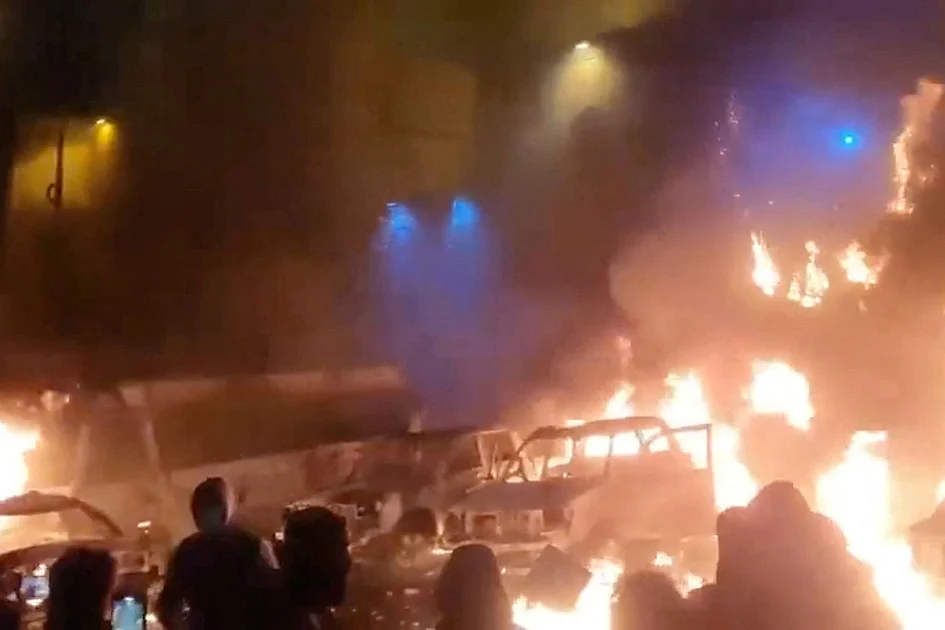
Iran experienced its most significant wave of civil unrest in recent years on Friday night as widespread protests swept across multiple cities despite government-imposed internet restrictions. The demonstrations, now entering their second week, initially sparked by economic grievances but have since evolved into broader anti-government sentiment.
Verified footage shows substantial crowds gathering along Tehran’s Ayatollah Kashani Boulevard, with vehicles honking in solidarity with protesters. The movement has expanded beyond the capital to include major urban centers such as Tabriz in the north, Mashhad in the east, and Kermanshah in the predominantly Kurdish western regions.
In a notable escalation, protesters targeted symbolic government institutions. Visual evidence indicates the regional state television building in Isfahan sustained damage from fires set at its entrance, while the governor’s complex in Shazand, Markazi province, also showed signs of arson. These actions represent a direct challenge to state authority.
The government response included implementing a comprehensive internet blackout beginning Thursday evening, with connectivity remaining severed for over twelve hours according to internet monitoring organization Netblocks. This digital suppression tactic mirrors previous strategies employed during the 2022-2023 demonstrations that followed Mahsa Amini’s tragic death in custody.
International attention has intensified as Reza Pahlavi, US-based son of Iran’s deposed monarch, publicly endorsed the protests. In video statements, Pahlavi characterized Thursday’s demonstrations as successfully forcing security forces to retreat and called for expanded participation to further weaken governmental control.
Human rights organizations have raised concerns about potential lethal force being used against protesters in earlier clashes, though Friday’s footage from Tehran notably lacked visible security force intervention. The evolving situation continues to develop amid limited information flow due to communication restrictions.