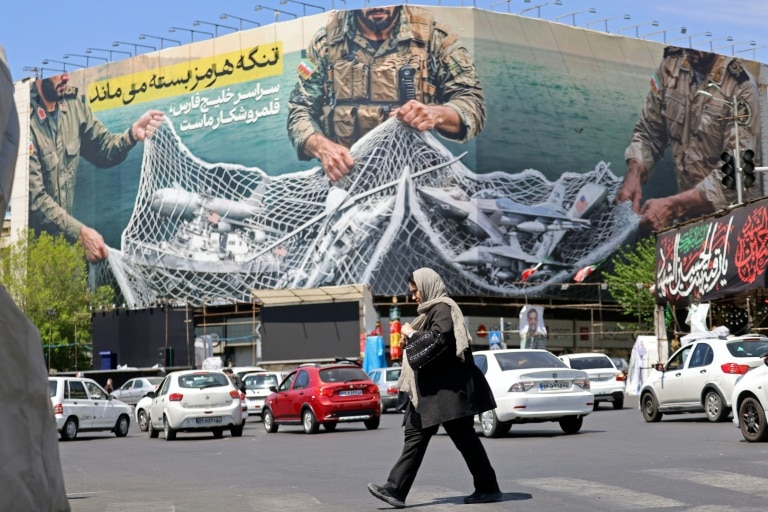
As the clock ticks down to a planned U.S. naval blockade of Iranian ports scheduled to take effect Monday at 1400 GMT, the Middle East is facing one of its most volatile moments in recent years, with multiple global powers rushing to navigate a crisis that threatens global energy supplies and regional stability. At the heart of the standoff is the Strait of Hormuz, the critical chokepoint through which roughly one-fifth of the world’s daily oil supply passes. In Tehran’s Revolution Square, a towering billboard sums up the Islamic Republic’s defiant posture: “The Strait of Hormuz remains closed” to any hostile incursion.
Iran’s top military command has issued a scathing rebuke of the planned U.S. action, labeling the proposed restriction on maritime navigation through international waters as an illegal act of outright piracy. If Washington follows through on its threat to blockade Iranian ports, the Iranian military warned in a statement broadcast on state television, no ports across the Persian Gulf will be safe from retaliation. Parliament Speaker Mohammad Bagher Ghalibaf, who led Iranian delegations in failed weekend peace talks hosted in Pakistan, doubled down on Tehran’s refusal to concede to external pressure. “We will not bow to any threats,” Ghalibaf stated, adding “If they fight, we will fight, and if they come forward with logic, we will deal with logic.” Iran’s Revolutionary Guards reinforced this stance, confirming that Iranian security forces maintain full control over the strait and warning that any “wrong move” by adversarial powers will leave them trapped in a “deadly vortex.”
U.S. Central Command clarified the parameters of the coming blockade in a post on X, noting that the measure will be enforced evenly against all vessels entering or exiting Iranian ports along both the Arabian Gulf and Gulf of Oman, but will not block transit through the strait for ships traveling to and from non-Iranian ports. For his part, U.S. President Donald Trump has adopted a cavalier attitude toward the prospect of renewed diplomatic talks with Tehran, telling reporters “I don’t care if they come back or not. If they don’t come back, I’m fine.” Trump also issued a sharp new threat to China over unsubstantiated claims that Beijing plans to supply weapons to Iran, threatening to impose a staggering 50% tariff on Chinese imports if the allegations prove true. China’s foreign ministry spokesperson Guo Jiakun rejected those claims as “baseless smears” during a recent press briefing, and joined the global call for unimpeded commercial navigation through the strait. Guo also urged both Washington and Tehran to return to diplomatic dialogue and honor existing ceasefire agreements, following the collapse of last weekend’s peace negotiations in Pakistan.
Russia has put forward a potential confidence-building measure to support future diplomacy: Kremlin spokesperson Dmitry Peskov confirmed that President Vladimir Putin’s long-standing offer to take in Iran’s enriched uranium as part of a broader U.S.-Iran peace deal remains on the table, though no progress has been made to implement the proposal. Across Europe, leaders are grappling with the looming economic fallout of the crisis. German Chancellor Friedrich Merz warned that Europe’s largest economy will feel the impact of the war-driven energy shock “for a long time to come, even after it is over.” In response, his government has rolled out new relief measures including a cut to fuel taxes. Spanish Defense Minister Margarita Robles called Trump’s planned blockade “makes no sense.” Meanwhile, French President Emmanuel Macron announced that Paris and London will collaborate to organize a conference in the coming days to launch a “peaceful multinational mission” separate from the warring parties, aimed at restoring unobstructed navigation through the strait. The Vatican also found itself drawn into the crossfire: after Pope Leo XIV issued a public plea for peace, Trump said he was “not a big fan” of the pontiff and called him “very liberal.” The Pope responded simply, saying he had “no intention to debate” with the U.S. president.
On the ground in Lebanon, the Israeli military reported a significant advance in its ongoing invasion of the country’s southern region, confirming that troops have surrounded the key strategic town of Bint Jbeil and launched a ground assault on the area. Over the past week, Israeli forces say they have killed more than 100 fighters from the Iran-backed militant group Hezbollah in the surrounding area.
The escalating crisis has already sent shockwaves through global energy markets. After the collapse of peace talks and the announcement of the U.S. blockade, oil prices rebounded sharply above the $100 per barrel threshold in Monday trading. West Texas Intermediate, the U.S. oil benchmark for May delivery, climbed roughly 7% to settle at $103.55 per barrel, while Brent crude, the international benchmark for June delivery, also gained 7% to reach $101.83 per barrel.