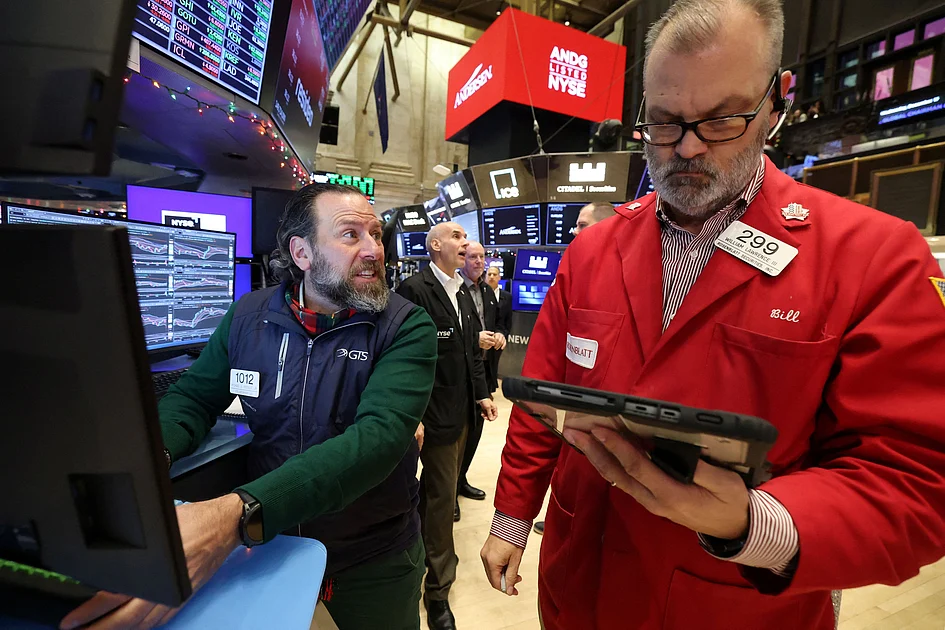
Wall Street investors anticipating traditional year-end market gains are navigating unexpected turbulence as December’s performance defies historical patterns. Despite heading toward double-digit percentage gains for 2025, the S&P 500 has registered modest declines this month, contrasting with its typical strong December performance.
Market volatility in recent weeks has been driven by two primary factors: increasing scrutiny of massive corporate investments in artificial intelligence infrastructure and evolving expectations regarding Federal Reserve interest rate policies for 2026. Technology stocks, particularly those tied to AI development, faced pressure following concerns about Oracle’s data-center project, while encouraging inflation data provided temporary relief.
According to Angelo Kourkafas, senior global investment strategist at Edward Jones, recent economic indicators reinforce expectations that the Fed will maintain a rate-cutting bias. While profit-taking after a strong year may create selling pressure, Kourkafas suggests the latest data ‘likely provide a green light for the Santa Claus rally to take place this year.’
Historical data from the Stock Trader’s Almanac shows that since 1950, the S&P 500 has averaged a 1.3% gain during the period encompassing the last five trading days of the year and the first two January sessions. This year’s critical window runs from December 24 through January 5.
Investors have been processing a backlog of economic data delayed by the recent 43-day federal government shutdown. November employment figures revealed rebounding job growth alongside a 4.6% unemployment rate—the highest level in over four years. Concurrently, consumer price index data indicated milder-than-expected inflation growth, though analysts caution about potential distortions from delayed data collection and seasonal retail discounts.
The Federal Reserve has implemented rate cuts at three consecutive meetings, leaving market participants to decipher economic signals for clues about future monetary policy adjustments in 2026.
Trevor Slaven, global head of asset allocation at Barings, notes the particular challenge of interpreting shutdown-affected data: ‘There’s this unsettled argument between the direction of travel for these major central banks, the direction of travel for inflation at a time when it does look like there’s more softness in the labor market data.’
While AI-driven stocks have propelled market gains throughout 2025—with the S&P 500 achieving over 15% growth—recent skepticism about returns on massive infrastructure investments has tempered enthusiasm for technology sectors. This development is particularly significant given technology’s substantial weighting in major indexes.
Mark Luschini, chief investment strategist at Janney Montgomery Scott, observes that ‘skepticism around the AI spend is becoming more prominent,’ contributing to pressure on cap-weighted indexes. However, previously lagging sectors including transportation, financial services, and small-cap stocks have demonstrated strength in December, providing market stability amid technology sector volatility.
Kourkafas concludes that while money has rotated away from technology, ‘other areas have stepped up and have helped keep markets mostly range-bound,’ suggesting a broader market participation beyond the AI narrative that dominated most of 2025.