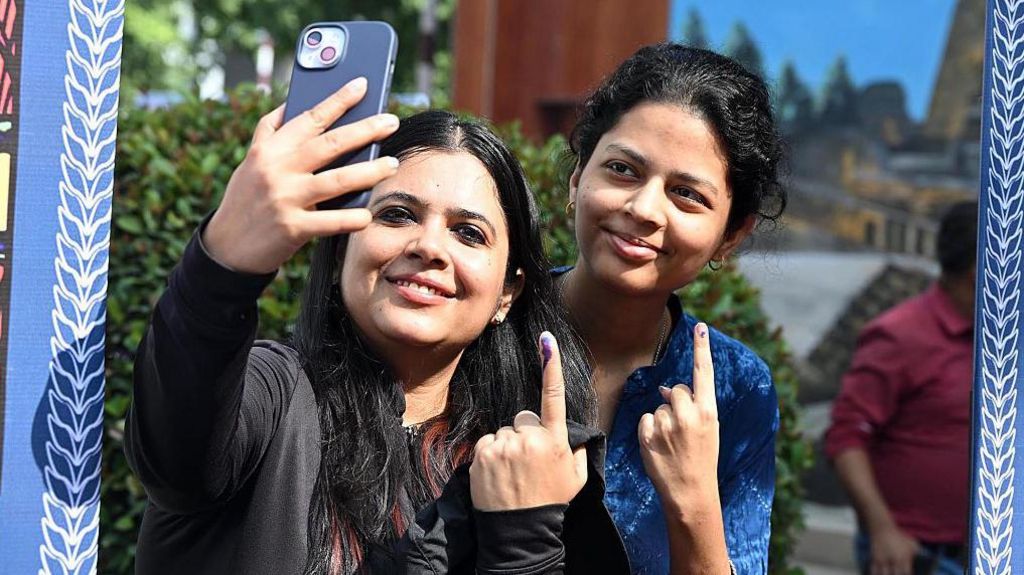
The eastern Indian state of Bihar is currently in the spotlight as votes are being counted in a closely contested election that could shape the political landscape of the region. Prime Minister Narendra Modi’s Bharatiya Janata Party (BJP), in alliance with the Janata Dal (United) (JD(U)), is vying to retain power in a state where it has never managed to form a government independently. The election, held in two phases on November 6 and 11, saw a record-breaking voter turnout of 66.91%, the highest since Bihar’s first elections in 1951, according to India’s Election Commission (EC).
Several exit polls suggest a victory for the BJP-led alliance, though such predictions have been unreliable in the past. The election was conducted following a contentious revision of electoral rolls, which the opposition claims was designed to exclude genuine voters and favor the BJP. Both the BJP and the EC have denied these allegations.
The counting of votes began at 08:00 local time on Friday, with trends expected to emerge by noon and final results anticipated by evening. The outcome of the Bihar polls is seen as a precursor to several other crucial state elections next year in West Bengal, Kerala, and Tamil Nadu, where the BJP has struggled to gain a foothold.
Bihar, India’s poorest state with over 74 million voters, has witnessed significant migration for employment opportunities. The outgoing government was a coalition between the BJP and JD(U), while the main opposition Congress party allied with the regional Rashtriya Janata Dal (RJD) and smaller parties. The election also marked the debut of a new political party led by Prashant Kishor, a former political strategist who has worked with both the BJP and Congress.
This election is particularly significant as it could be the last to feature two veteran leaders, JD(U)’s Nitish Kumar and RJD’s Lalu Prasad Yadav, who have dominated Bihar’s politics for nearly four decades. Both leaders, now in their 70s and reportedly in poor health, have occasionally joined forces to maintain power. Kumar, the incumbent chief minister, has been a central figure in Bihar’s governance for most of the past two decades, while Yadav, currently on bail following corruption convictions, has seen his son Tejashwi emerge as the opposition’s chief ministerial candidate.
Female voters played a pivotal role in this election, with women comprising nearly half of the electorate. The state recorded its highest-ever female voter turnout at 71.6%, prompting both alliances to introduce financial assistance schemes to attract their support.
The election was conducted after a controversial voter list revision by the EC, which removed 4.7 million names from the rolls. This process, now underway in 12 states and federally administered territories, has faced sharp criticism from the opposition, who accuse the EC of disproportionately targeting Muslim voters to benefit the BJP. Both the BJP and the EC have refuted these claims.
As the results unfold, the Bihar election is being closely watched for its implications on India’s political trajectory, particularly in the lead-up to next year’s key state elections.