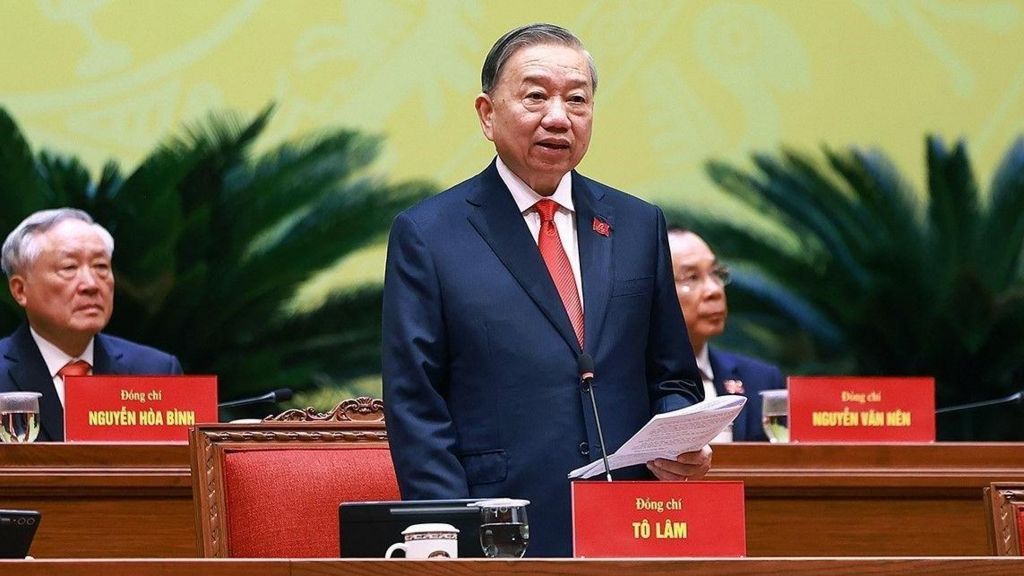
HANOI – Vietnam’s political landscape has entered a definitive new chapter following the conclusion of the Communist Party Congress, which reconfirmed To Lam as General Secretary for a second five-year term. The assembly of nearly 1,600 delegates concluded ahead of schedule on Friday, a move interpreted by observers as either indicating strong consensus or effectively subdued opposition to Lam’s increasingly centralized authority.
Professor Edmund Malesky of Duke University characterized the development as “the strongest concentration of power in one individual that I’ve seen since 1991,” highlighting the unprecedented nature of Lam’s political control.
Since assuming leadership 18 months ago following the death of his predecessor Nguyen Phu Trong, Lam has orchestrated a remarkable pivot from his previous role as head of Vietnam’s powerful Ministry of Public Security, where he led extensive anti-corruption campaigns. Upon reaching the apex of power, he unveiled sweeping economic reforms described as the most ambitious in four decades.
The cornerstone of Lam’s vision emerged through Resolution 68, ratified by the Politburo in May last year, which officially designated the private sector as “the most important driving force of the national economy.” This marked a significant ideological shift in officially socialist Vietnam, where state-owned enterprises have traditionally been celebrated as the economy’s foundation.
The resolution established breathtaking targets: double-digit annual growth, doubling private businesses by 2030, and transforming Vietnam into an upper-income, knowledge-based economy by 2045 – the centenary of independence from French colonial rule. Central to this strategy is cultivating “leading cranes” – privately-owned national champions capable of global competition.
Currently, Vietnam’s economic structure presents substantial challenges. Despite three decades of impressive growth and poverty reduction, state-owned enterprises still account for 29% of GDP through 671 entities that enjoy preferential access to licenses, funding, and resources. Meanwhile, most private companies remain small-scale, with only 2% employing over 200 people.
The reform agenda faces complications from recent political developments. Resolution 79, passed earlier this month, seemingly walked back private sector prioritization by declaring state-owned enterprises could also serve as “leading geese” and setting ambitious targets for their regional dominance.
Vietnam’s economic model faces external challenges as well. The country’s export-dependent manufacturing economy, particularly vulnerable to U.S. tariff policies under the Trump administration, relies heavily on foreign investment, technology, and markets. Lam himself acknowledged this vulnerability in January last year, questioning Vietnam’s position at the “lowest end of the value chain.”
The development of national champions illustrates both promise and pitfalls. While technology firm FPT has achieved international contracts with companies like Airbus, conglomerate Vingroup exemplifies the challenges of global expansion. Despite dominating Vietnam’s domestic market through extensive political connections, its Vinfast electric vehicle subsidiary has struggled internationally, reportedly losing approximately $11 billion since 2021 while failing to gain traction in U.S. and European markets.
Nguyen Khac Giang of the ISEAS–Yusof Ishak Institute in Singapore warned: “The main challenge remains unchanged: how to create globally competitive firms without spawning politically-connected rent-seekers. To Lam’s approach risks replacing one form of rent-seeking with another.”
As Lam consolidates power, his administration must navigate fraught international relations while addressing fundamental structural economic challenges. Vietnam’s renowned “bamboo diplomacy” – maintaining friendships with all and enmity with none – faces severe tests in the emerging Trump II era, particularly given the country’s exceptional reliance on U.S. market access.