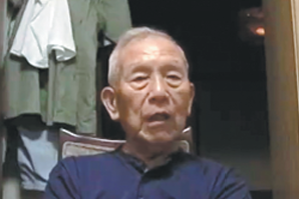
A chilling 38-minute video testimony from a former member of Japan’s infamous Unit 731 has been publicly released by China’s Harbin-based Exhibition Hall of Evidences of Crimes Committed by Unit 731 of the Japanese Imperial Army. The footage, featuring Tsuruo Nishijima’s firsthand account recorded in 1997, was disclosed on the eve of China’s National Memorial Day for Nanjing Massacre Victims, providing unprecedented insight into one of history’s most brutal biological warfare programs.
Nishijima, who joined Unit 731’s meteorological unit in October 1938, offered detailed descriptions of horrific human experimentation methodologies. His testimony reveals how he assisted in measuring wind patterns to optimize the dispersal of bacterial agents and participated in frostbite experiments conducted on human subjects. The video particularly highlights the so-called “shower experiments” where aircraft sprayed bacterial solutions at extremely low altitudes over rows of tethered prisoners, including Chinese, Korean, Mongolian, and Soviet captives.
The former unit member recounted how victims were forced at gunpoint to open their mouths and look upward during these aerial pathogen deployments, noting that “inhaling the solution meant certain death.” After exposure, subjects were transported in refrigerated trucks for continuous observation and data recording. Nishijima’s testimony also mentions instances where Japanese military doctors succumbed to infections despite wearing multiple protective masks, underscoring the extreme lethality of the developed pathogens.
Unit 731, established in 1933 as Japan’s top-secret biological and chemical warfare research center, developed over 50 types of bacteria including typhoid, cholera, plague, anthrax, and glanders. The unit conducted experiments on at least 3,000 people while Japan’s biological weapons claimed over 300,000 lives across China. The testimony further describes Unit 731’s operational deployment during the 1941 Zhejiang-Jiangxi Campaign, where small teams of 30-40 members spread bacteria in civilian areas during Japanese troop withdrawals.
Jin Shicheng, director of the museum’s education department, emphasized that the testimony “provides an insider’s perspective on their atrocities, confirming the crimes against humanity committed by the Japanese Army during the invasion of China.” He further noted that Japanese medical and academic communities actively supported and participated in these crimes, making Unit 731’s operations “a large-scale, organized group crime from top to bottom in Japan.” The video was originally recorded by Japanese scholar Fuyuko Nishisato and donated to the museum in 2019.