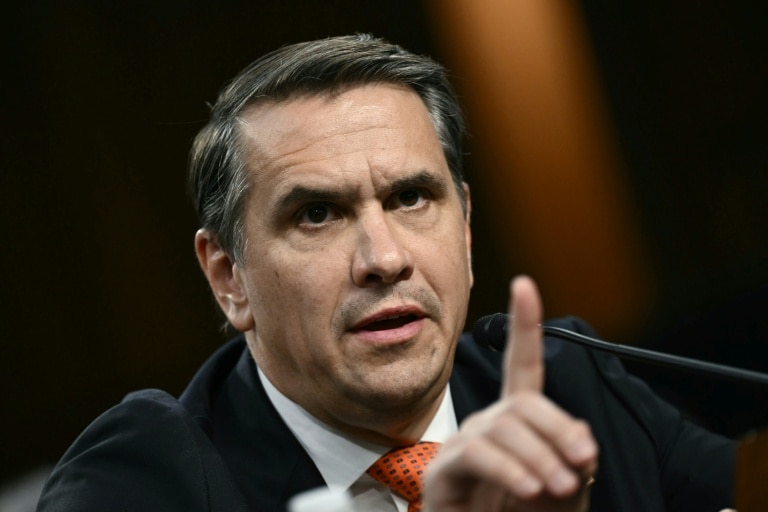
In a closely watched and deeply partisan vote early Saturday, the United States Senate confirmed Todd Blanche, former personal lawyer to President Donald Trump, to serve as the nation’s top law enforcement official as permanent attorney general. The final vote tally ended at 50-49, split almost entirely along party lines, with only two moderate Republican senators — Susan Collins and Lisa Murkowski — breaking with their caucus to join all Democrats in opposing the nomination.
Blanche, who has already led the Department of Justice (DOJ) in an acting capacity since April, when Trump fired former acting attorney general Pam Bondi, carries a long history of representing Trump in high-stakes criminal cases. Prior to his appointment to the acting role, Blanche stood as Trump’s private defense counsel in his 2024 New York hush money trial linked to payments to adult film star Stormy Daniels. He also served on the former president’s legal team in two federal indictments brought by special counsel Jack Smith: one over improper retention of classified documents after Trump left the White House, and a second for his efforts to overturn the results of the 2020 presidential election. Both cases were dismissed immediately following Trump’s victory in the 2024 general election.
From the outset of the confirmation process, Senate Democrats uniformly opposed Blanche’s nomination, raising urgent alarms that Trump intended to transform the traditionally independent DOJ into a political weapon serving his personal interests rather than the American public. Senate Judiciary Committee ranking Democrat Dick Durbin argued that the role of attorney general demands the holder serve as “the people’s lawyer,” not personal counsel to the sitting president. “Mr Blanche continues to operate as the president’s personal lawyer, treating the Justice Department like a law firm serving one client — the president,” Durbin said ahead of the vote.
The nomination faced a last-minute threat from within Republican ranks, after a handful of GOP senators raised objections to two controversial proposals tied to Blanche’s appointment. The first was a plan for a $1.8 billion fund to compensate what Trump labels “victims of politicized prosecutions” — a category widely expected to include hundreds of rioters who participated in the January 6, 2021 insurrection at the U.S. Capitol, a violent attempt to block the certification of Joe Biden’s 2020 election victory over Trump. The second was an unprecedented proposal to grant Trump, his two eldest sons, and the Trump Organization permanent immunity from future federal tax audits.
To shore up support from wavering Republicans, Blanche released a written concession over the weekend that reversed both policies. The controversial “anti-weaponization fund” was scrapped entirely, while the tax immunity agreement was revised to apply only retroactively to past tax filings, with no protections for future returns. The compromise was enough to secure the narrow majority needed for confirmation.
Following the vote, Blanche took to social platform X to express gratitude for the outcome. “I am deeply honored by the trust and confidence President Trump has placed in me to lead the Department of Justice,” he wrote. “I am grateful to the Senate for staying late to complete this process. To the dedicated public servants of the Department of Justice, thank you for your work each day to uphold the law and keep our country safe.”
President Trump has praised Blanche as a “star” throughout the nomination process, framing his appointment as part of a broader effort to bring independent federal agencies under more direct White House control — a shift that has already upended longstanding U.S. political norms. Critics, however, warn that Blanche’s leadership aligns with what Democrats have labeled a Trump “retribution campaign” targeting the president’s political opponents. Blanche has also faced sustained criticism from survivors of convicted sex offender Jeffrey Epstein, who have condemned his oversight of the public release of investigative files tied to the case, given Epstein’s longstanding personal ties to Trump.
The close final vote underscores the intense political sensitivity surrounding the nomination, which has renewed national debate over the separation of powers and the independence of the nation’s top law enforcement agency at the start of Trump’s second term.