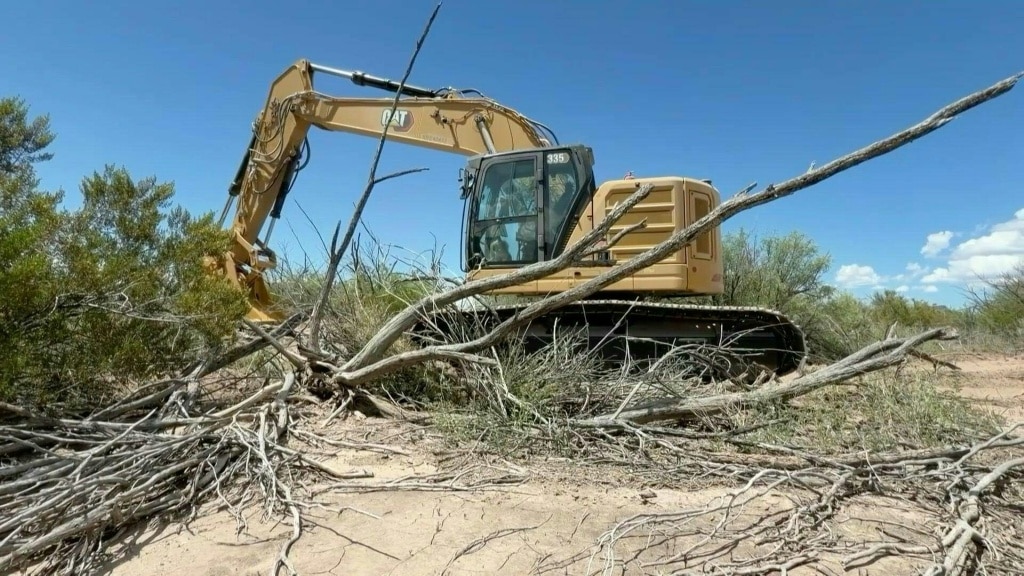
A high-stakes border infrastructure project in one of America’s most ecologically diverse national parks has been put on hold, after days of bipartisan local pushback and growing legal challenges over its potential environmental harm. The $1.7 billion project, pushed forward by the Trump administration as part of its broader border security initiative along the U.S.-Mexico boundary, broke ground earlier this month at Big Bend National Park in southern Texas. On Monday, Customs and Border Protection (CBP) Commissioner Rodney Scott announced the construction pause in a video posted to social platform X.
Big Bend National Park draws visitors from across the globe for its dramatic, one-of-a-kind landscape: it blends arid desert ecosystems, the winding Rio Grande, and towering mountain ranges, including the iconic Santa Elena Canyon. The protected area hosts extraordinary biodiversity, home to hundreds of native bird species, bobcats, black bears, and dozens of other threatened and endemic wildlife. The administration’s plans call for new vehicle barriers, expanded patrol roads, enhanced lighting, and high-tech detection systems to be built across the park’s public lands. Official project maps show the proposed patrol route and technology corridor cutting across the rugged slopes of Mariscal Mountain, a stretch that critics warn would require widespread dynamite blasting to clear, leaving irreversible damage to the fragile terrain.
In his announcement, Scott confirmed that all construction activity within the park has been halted pending an on-site review. “Last night, I put a pause on all activity in that park as far as construction goes, until I get down there and do a personal evaluation,” Scott said, noting he would meet with local stakeholders and share additional updates later this week.
The project has sparked unified, cross-party opposition from local communities and officials since it was first unveiled. All 14 Texas border county judges signed an open letter affirming their support for responsible border security while rejecting the current proposal, calling for more practical, less environmentally destructive alternatives. Data from CBP itself undermines the project’s core security justification: between January 2024 and July 2026, just 9,624 migrant apprehensions were recorded in the Big Bend Sector, a fraction of the 23,080 apprehensions recorded over the same period in the Swanton Sector along the far less contested U.S.-Canada border.
Local opponents emphasize that the rugged, remote terrain of Big Bend is already nearly impossible to traverse from Mexico, making the new barriers unnecessary. “It’s quite literally impossible to traverse, whether on foot or in a vehicle, from the other side into this area. Furthermore, this is not the will of the people of this region,” Jake Knight, executive director of the Big Bend Protection Alliance, told reporters during on-site protests.
Critics have also raised alarms over the procurement process and the scope of environmental rollbacks used to approve the project. The Trump administration has waived dozens of longstanding federal environmental protection laws to greenlight the construction, which was awarded through a no-bid, non-competitive contract – a provision that has drawn anger from local residents. “There’s a no-bid contract for $1.7 billion in our national park. And that’s an awful lot of money to spend. So we know that they will destroy things. They’re already in there right now,” 63-year-old local teacher Bernadette Devine said at a recent protest against the plan.
Legal challenges are already moving forward to block the project permanently. The Center for Biological Diversity, a national nonprofit conservation group, has filed a lawsuit against the federal government arguing the sweeping environmental waivers violate the U.S. Constitution. The group plans to submit an emergency injunction request Monday to halt construction permanently if the pause is lifted.
Laiken Jordahl, a national public lands advocate with the Center for Biological Diversity, noted that local opposition has reached an unprecedented level of unity. “I’ve never seen communities so outraged and unified on a single issue, this has become a serious force to be reckoned with,” Jordahl told AFP. While activists have welcomed the temporary halt to construction, they have cautioned that the fight to protect the park is far from over. “And while it’s certainly welcome news that the bulldozers aren’t carving in the national park today, it is very likely that the pause will be lifted, we’re not considering this a victory yet,” Jordahl added.