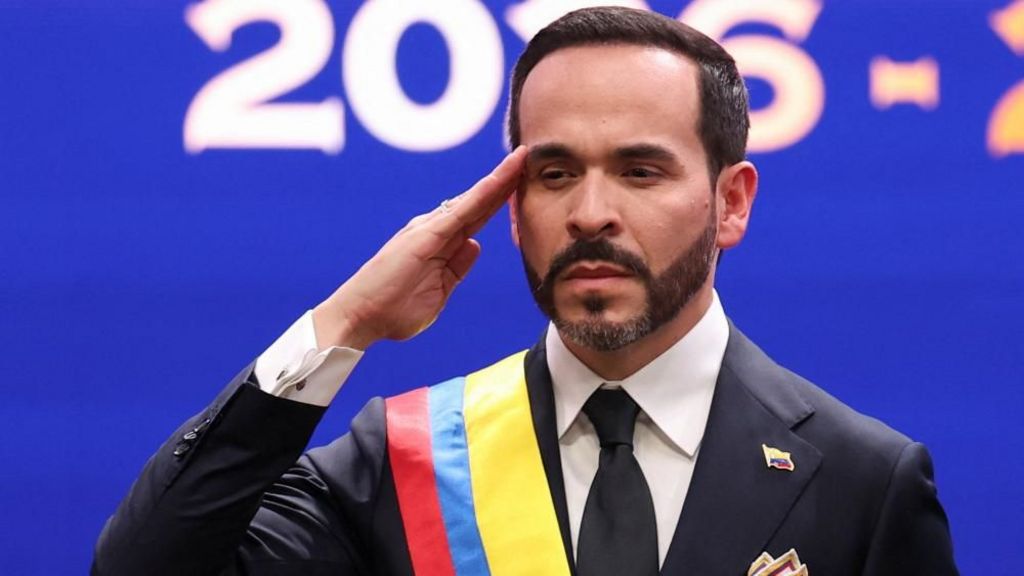
Just hours after Abelardo de la Espriella, Colombia’s new right-wing populist president, took the oath of office, the United States announced a landmark $1 billion security package to support his administration’s core policy priorities. A self-described political outsider and avowed admirer of second-term US President Donald Trump, de la Espriella used his highly anticipated inaugural address to declare an all-out war on the drug cartels and organized criminal networks that have long destabilized Colombian society.
The US State Department framed the security assistance as a collaborative effort to advance shared bilateral goals, including countering transnational organized crime and curbing irregular migration flows. For years, Trump harshly criticized de la Espriella’s left-wing predecessor Gustavo Petro for his approach to both issues, setting the stage for a reset in bilateral relations following de la Espriella’s June election victory. Ahead of the vote, Trump publicly pledged the “total support and strength of the United States” to the Colombian candidate, predicting a far more productive working relationship between the two nations.
De la Espriella, a lawyer and millionaire businessman by trade, took an unorthodox approach to his inauguration, opting to deliver his oath not in the national capital Bogotá, but in the violence-plagued western city of Cali. The choice was widely interpreted as a deliberate signal of his commitment to reassert state control over regions grappling with chronic gang activity. Speaking to assembled troops at a nearby military base, the new president laid out a hardline agenda: he pledged to crush armed insurgent groups, rebuild national institutions, and defend Colombian democracy “by reason or by force.” Adopting his self-styled nickname “El Tigre” (The Tiger) as a branding for his administration, de la Espriella emphasized that the Colombian state would act with unflinching decisiveness against criminal actors, declaring: “There will not be a single place in our territory where criminals can feel safe.”
Political analysts have drawn clear parallels between de la Espriella’s proposed crackdown and the harsh anti-gang policies implemented by high-profile right-wing populist leaders Nayib Bukele of El Salvador and Daniel Noboa of Ecuador. This approach marks a complete break from the “total peace” strategy pursued by former president Petro, which prioritized negotiated settlements with armed groups and economic incentives for coca farmers to transition away from illicit crop cultivation. Critics of Petro’s framework argue it failed to curb growing criminal influence: armed group membership has expanded across Colombia in recent years, and a brutal clash between rival rebel factions along the Colombia-Venezuela border displaced more than 30,000 people in 2025.
In one of his first official acts as head of state, de la Espriella confirmed that Colombia will join the Shield of the Americas, a US-led regional security partnership launched by the Trump administration. The move aligns Colombia with a growing bloc of right-leaning Latin American governments that have pursued closer ties with Washington, including Argentina under libertarian President Javier Milei, whom de la Espriella has publicly praised. The US State Department welcomed the accession, noting that de la Espriella’s pro-growth policy agenda creates new opportunities to expand bilateral trade and deepen economic integration.
De la Espriella’s election is the latest milestone in a broader regional shift toward right-wing politics across Latin America, driven by widespread public frustration over economic stagnation and surging gang violence. With de la Espriella in office and Keiko Fujimori recently taking power in Peru, Brazil’s Luiz Inácio Lula da Silva remains the only prominent left-wing head of state in the region, though he will face a challenge from Flávio Bolsonaro, son of pro-Trump former president Jair Bolsonaro, in October’s general election.
On foreign policy, de la Espriella has also broken sharply with Petro’s approach, promising to forge close military alliances with both the United States and Israel. Petro cut diplomatic ties with the Israeli government over its military offensive in Gaza and was a prominent vocal advocate for Palestinian statehood, a stark reversal of the new administration’s stance.
Notably, de la Espriella has held US citizenship since 2023, after decades of living and working in Miami, Florida. Before entering politics, he built a high-profile career as a defense attorney representing drug-trafficking paramilitaries — the very criminal groups he now pledges to lock up. He launched his presidential candidacy just one month after a rival conservative candidate was assassinated during the campaign, and often appeared at public rallies behind bulletproof glass, wearing a bulletproof vest alongside his signature Colombian football jersey.
High-profile guests in attendance at his inauguration included US Attorney General Todd Blanche and FIFA President Gianni Infantino, who attended alongside the head of CONMEBOL, South America’s governing football body, amid ongoing scrutiny of Infantino’s leadership of global football. For his part, Petro, who was constitutionally barred from seeking a second consecutive term, had been a fierce critic of Trump’s influence in Latin America, particularly condemning the Trump administration’s arrest of Venezuelan socialist President Nicolás Maduro and his wife Cilia Flores on US drug charges, a move that opened the door for US energy firms to access Venezuela’s vast untapped oil reserves. Petro and his left-wing ally Iván Cepeda had repeatedly warned that Colombia must not become a US “vassal” under a de la Espriella administration.