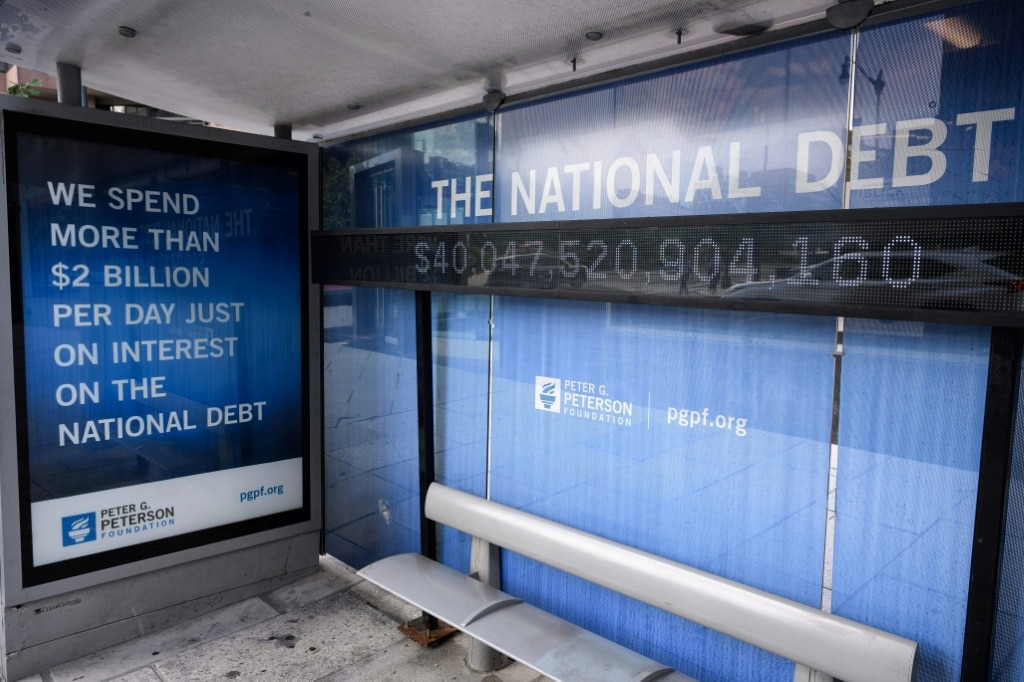
For the first time in United States history, the country’s total gross national debt has surged past the $40 trillion mark, new federal government data released Wednesday confirmed — a symbolic threshold that has arrived far faster than official forecasters initially projected, fueled in part by the lingering fiscal impact of invalidated tariffs implemented during the Donald Trump administration.
According to Treasury Department figures, total public debt outstanding hit $40.05 trillion when markets closed on Tuesday. That milestone comes years earlier than the Congressional Budget Office’s prior projection, which forecast total federal borrowing would reach just $39.4 trillion by the end of the 2026 fiscal year.
Multiple overlapping factors have driven the rapid acceleration of U.S. debt. Long-term mandatory obligations for social safety net programs including Social Security and major health care initiatives have grown steadily alongside an aging national population, while rising interest rates have pushed the government’s interest payment costs sharply higher in recent years. Federal spending on overseas conflicts, paired with across-the-board tax cuts that reduced government revenue, have also widened annual budget gaps that the U.S. funds through new borrowing, as the federal government consistently operates at a deficit.
The crossing of the $40 trillion threshold comes at a moment of already heightened market uncertainty, with ongoing inflationary pressure, the Israel-Hamas war in the Middle East, and persistent concerns over unconstrained government spending already leaving investors on edge. On Tuesday, yields on long-term U.S. Treasury bonds climbed to their highest level since 2007, as geopolitical risks tied to tensions involving Iran and growing anxiety over deficit spending drove price shifts in bond markets. Higher yields have forced the federal government to refinance existing debt at interest rates not seen since the period leading up to the 2008 global financial crisis, further increasing long-term fiscal costs. Early Wednesday, the Treasury Department took action to stabilize the long-term bond market, pulling yields lower by the end of the trading session.
Fiscal policy experts have warned that the current trajectory of U.S. government borrowing is on an unsustainable path. “It’s been well known for a while that the United States government was on a pretty unsustainable path with deficits,” explained Jessica Riedl, a budget and tax fellow at the Brookings Institution. “Over the last few years, the United States has moved into roughly $2 trillion deficits, even during peace and prosperity.” Riedl noted that while annual deficits equal to 3% to 4% of gross domestic product were once enough to spark concern among financial market participants, current deficit levels now sit closer to 6% to 7% of GDP — a shift that has left markets increasingly nervous. Beyond discretionary spending choices, rising interest rates driven by persistent inflation have lifted interest costs on the national debt, while age-related program costs for an aging population continue to put upward pressure on annual deficits.
While analysts point out that there is no specific debt-to-GDP ratio that automatically triggers a fiscal crisis, the $40 trillion mark carries significant psychological weight for markets. “But psychologically, these are the landmarks that warn financial markets that they need to take another look at rising debt,” Riedl said.
Caleb Quakenbush, director of fiscal policy at the Bipartisan Policy Center, noted that federal borrowing first saw a dramatic surge during the 2007–2009 Great Recession, then grew even further after the U.S. government rolled out massive emergency stimulus spending to offset the economic downturn caused by the COVID-19 pandemic. But Quakenbush told AFP that neither Congress nor successive White House administrations have addressed the long-term trajectory of U.S. budget spending in a “meaningful or durable way.” He warned that the current unprecedented levels of borrowing create major uncertainty for the U.S. economy.
In a crisis scenario, Quakenbush noted, bond markets could face severe disruptive challenges. Even without a full-blown crisis, however, the growing debt burden will translate to higher borrowing costs for American consumers and businesses, creating incremental headwinds that squeeze overall economic growth over time. Prior to the debt milestone, Treasury Secretary Scott Bessent had set a policy goal of cutting the U.S. deficit down to 3% of GDP, a target that looks increasingly out of reach amid current fiscal trends.