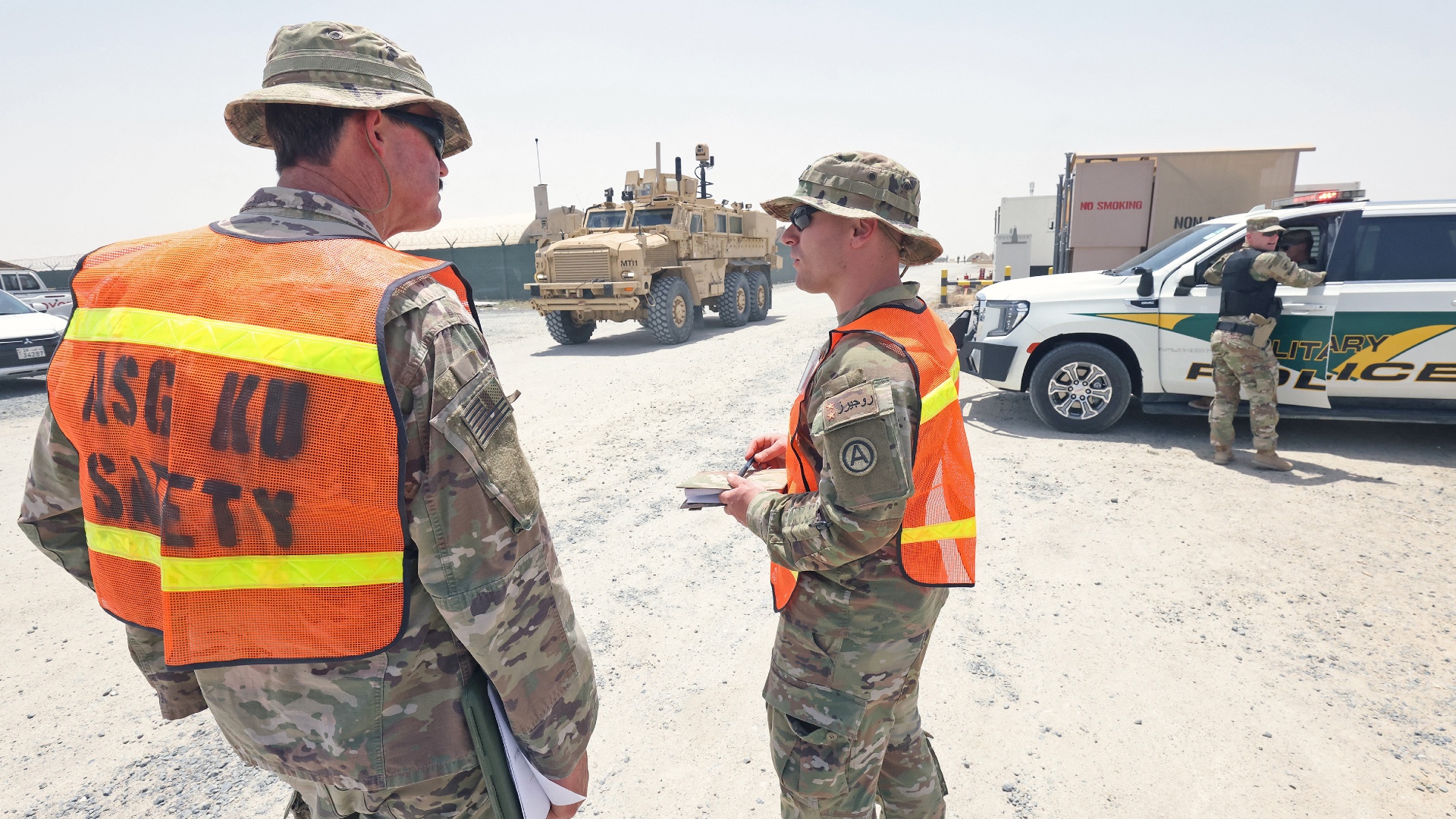
A group of leading Middle East policy experts warned Thursday that extensive damage to over a dozen U.S. military installations across the Gulf region from Iran’s retaliatory strikes has flipped the strategic calculus of America’s decades-long military presence in the area – turning long-held security assets into major liabilities that create more risk than they mitigate.
Details of the severe damage to the bases, which multiple outlets have described as effectively uninhabitable, were first revealed in a New York Times report last month, but the Trump administration has still not publicly confirmed the full scope of the destruction.
Speaking at the Arab Center Washington DC’s annual conference, Marc Lynch, director of George Washington University’s Project on Middle East Political Science, called the bases the physical foundation of decades of American primacy in the Middle East, noting Iran effectively rendered that infrastructure useless in just one month. Lynch emphasized that U.S. officials have failed to release a full, transparent accounting of the damage sustained across the installations, which are tightly restricted by both the Pentagon and host Gulf nations including Bahrain, Saudi Arabia, the United Arab Emirates, Kuwait, Qatar, and Oman.
Lynch shared that regional contacts have shared on-the-ground imagery of damage to Naval Support Activity Bahrain, the headquarters of the U.S. Fifth Fleet that hosts roughly 9,000 U.S. military personnel. He argued that the widespread damage to regional bases has made the strategic position of the Fifth Force in Bahrain untenable, saying the risk of further attacks is too great to reestablish a full permanent presence there. “So in a sense, the entire purpose of ‘America’s Middle East’ has come crashing down [and] we don’t have an alternative way yet of articulating or thinking about what might replace it,” Lynch added.
In total, 19 publicly acknowledged U.S. military sites are spread across the broader Middle East, stretching from Egypt to Iraq and from northern Syria to southern Oman, holding up to 50,000 total U.S. service members. The U.S. military presence in the region dates to the late 1950s, but the large-scale network of active bases in the Gulf took shape after the 1990 Gulf War, built on a long-standing core agreement: the U.S. would provide security guarantees to Gulf states in exchange for access to energy resources and a stable petrodollar system.
That decades-old arrangement has now collapsed following the recent wave of Iranian strikes that came in response to U.S. and Israeli attacks, experts say. Gulf states have been forced to drain their air defense interceptor stockpiles, shut down civilian airports and schools, and suffer major damage to key energy production facilities, eroding any remaining benefits of the security agreement for host nations.
Shana R Marshall, associate director of George Washington University’s Institute for Middle East Studies, told the conference that as the benefits of the transactional relationship between the U.S. and Gulf states have eroded sharply, the bilateral relationship is inevitably fraying. Marshall noted that tensions over U.S. basing are not new, pointing to the 1996 Khobar Towers bombing that killed 19 U.S. service members in Saudi Arabia, and al-Qaeda founder Osama bin Laden’s long-stated core grievance over the permanent presence of U.S. troops in the Gulf. “Close relations with the U.S., whether it’s U.S. military bases or promoting normalisation with Israel, or enforcing U.S. sanctions or maintaining the dollar peg of their currencies, is less a benefit now than actually a liability,” Marshall explained.
Trita Parsi, executive vice president of the Quincy Institute for Responsible Statecraft, added that the seven-week escalation has made clear Gulf states can no longer count on the U.S. as a reliable security partner, a sentiment amplified by the recent ceasefire deal that failed to explicitly end Iranian attacks on U.S.-linked assets across the Gulf. The omission has left many Gulf leaders feeling betrayed, Parsi said.
“Those bases were not a deterrent against Iranian attacks. Instead, they became the target of those attacks. They became magnets for those attacks, and as a result, reliance on the American security umbrella really seems to be in shatters,” Parsi explained.
Parsi outlined one likely outcome of this shift: disillusioned Gulf states that cannot reach a new security accommodation with Iran may pivot toward Israel as an alternative security partner. Unlike the 2020 Abraham Accords, which were anchored by explicit U.S. security guarantees, Parsi said this potential shift could happen even without major new concessions from the U.S., driven purely by Gulf states’ loss of faith in American security commitments. “There may be some sort of a gravitation towards Israel among some of these [Gulf] states, if they believe that they either cannot or do not want to find a new relationship with Iran,” he added.