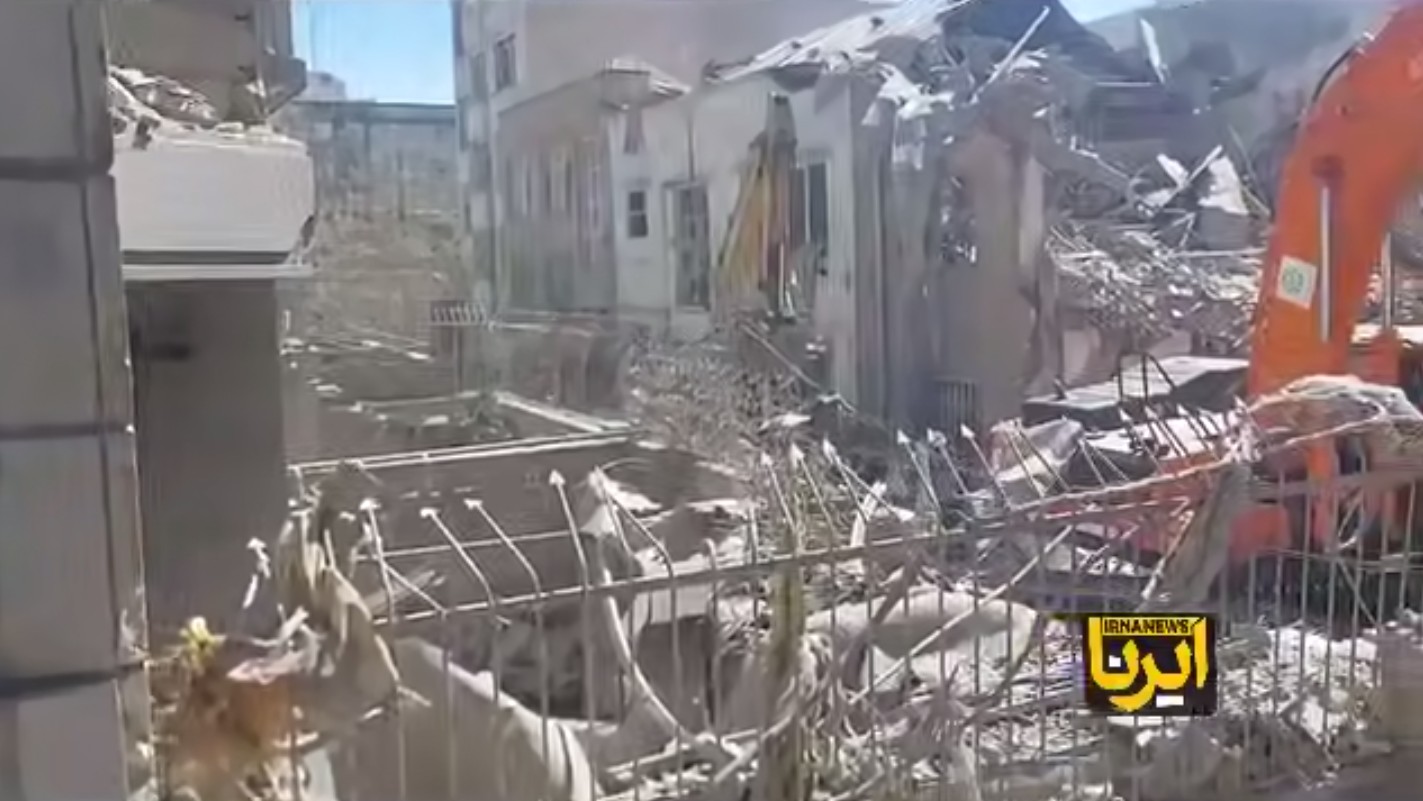
Amid weeks of sustained Israeli and American air bombardment across Iran that has killed thousands of people, an early morning Israeli strike on the Iranian capital Tehran has completely leveled the city’s historic Rafi-Nia Synagogue, according to multiple Iranian local media reports.
Iran’s official Mehr News Agency and reformist publication Shargh confirmed the synagogue was hit in the attack carried out on April 7, during the Jewish holy holiday of Passover. Video footage shared by local journalists and media outlets shows rescue teams sifting through the rubble of the destroyed structure, with scattered Hebrew religious liturgical texts visible among the debris. As of the latest updates, no casualties have been reported from the incident.
Shargh noted that the Rafi-Nia Synagogue served as a central gathering place for Tehran’s Khorasan Jewish community, a group of Jewish Iranians whose families trace their roots back to Iran’s historical northeastern Khorasan region. Iran is home to the third-largest Jewish population in the Middle East, following only Israel and Turkey. A 2016 Iranian national census recorded the country’s Jewish population at just over 9,000, though many community members estimate the actual number is significantly higher. Under Iranian law, Judaism is an officially recognized and protected religion, and Tehran alone hosts roughly 30 active synagogues for the local Jewish community.
The destruction of the synagogue comes amid a sustained campaign of cross-border strikes that began on February 28, when Israel and the United States launched ongoing bombardment across Iranian territory. Data collected by the U.S.-based Human Rights Activists News Agency (HRANA) indicates that more than 3,600 Iranians have been killed in the attacks since they began, including at least 1,665 civilian casualties. Neither Israel nor the United States has issued an official statement confirming or commenting on the strike that hit the synagogue. Middle East Eye has reached out to the Israeli military to request comment on the incident.
For weeks, members of Iran’s Jewish community have already expressed growing anxiety over their safety and future amid the escalating conflict. In interviews with Middle East Eye conducted in March, multiple Jewish Iranians emphasized their deep ties to the country, rejecting framing that casts them as outsiders amid rising regional tensions. “Yes, I’m Jewish. But I cannot see the country where I was born and raised as my enemy,” a 46-year-old Jewish businesswoman from Shiraz told the outlet. “I am both Jewish and Iranian. Because of that, I believe I can judge this situation without hatred. Much of the chaos we have seen in the region in recent years is connected to Netanyahu’s policies.”