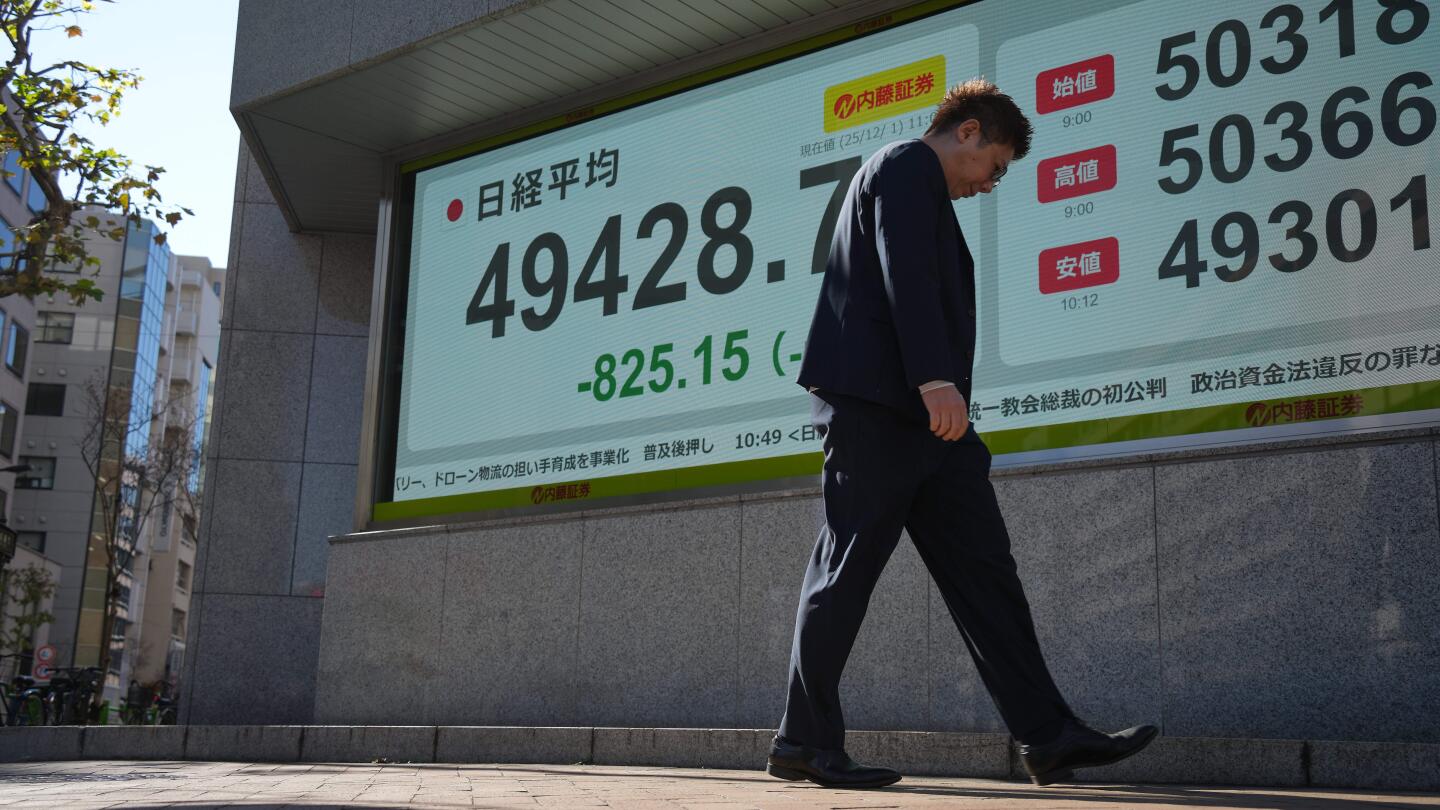
Asian financial markets exhibited a divergent trajectory at the start of the trading week, characterized by significant declines in Japan’s Nikkei 225 index which plummeted 1.9% to 49,285.66. This downturn followed the release of disappointing corporate investment figures and a persistently contracting manufacturing sector. The S&P Global Japan Manufacturing Purchasing Managers Index (PMI) registered at 48.7 in November, marking its fifth consecutive month in contraction territory below the critical 50-point expansion threshold.
China’s industrial sector mirrored these challenges, with official data confirming an eighth straight month of factory activity contraction. This ongoing weakness in Asia’s largest economies occurs despite the extended trade truce between Washington and Beijing, highlighting deeper structural economic challenges.
Regional performance varied considerably across Asian markets. Hong Kong’s Hang Seng index defied the trend with a 0.8% gain to 26,068.05, while mainland China’s Shanghai Composite advanced 0.4% to 3,904.90. South Korea’s Kospi remained virtually unchanged, and Australia’s S&P/ASX 200 slipped 0.3%. Notable corporate movement included Meituan, the Chinese food delivery giant, whose shares declined 1.5% despite revenue growth, as intense competition compressed profit margins.
Energy markets witnessed substantial movement with benchmark crude oil prices climbing over $1 per barrel. Currency markets saw the U.S. dollar weaken against the Japanese yen to 155.57, while the euro gained modest ground. Cryptocurrency markets experienced volatility as Bitcoin retreated 5.3% to $86,225.
The manufacturing slowdown across Asia is being closely monitored for indications of how elevated U.S. tariffs might be affecting export-dependent economies. Despite these industrial challenges, regional exports have demonstrated resilience in recent months. Market attention remains divided between manufacturing weaknesses and robust consumer spending during the recent Black Friday and Cyber Monday retail events, which reportedly exceeded expectations.
U.S. futures pointed to a lower opening, with S&P 500 futures down 0.7% and Dow Jones Industrial Average futures declining 0.4%. This follows a technical disruption on Friday that halted trading for hours at the Chicago Mercantile Exchange due to a data center outage, though markets ultimately finished the abbreviated post-Thanksgiving session with gains.