The United States’ military strategy against Iran has reached a critical juncture where aerial supremacy alone proves insufficient for achieving decisive victory. Historical patterns from the Gulf War to anti-ISIS campaigns demonstrate that air power, while effective for targeted strikes and infrastructure degradation, consistently fails to produce regime change or lasting resolution.
Current operations against Tehran have successfully eliminated key political figures and impaired missile capabilities, yet Iran’s deliberately decentralized military architecture has withstood these precision attacks. The Islamic Republic maintains operational capacity to launch assaults against US-allied neighbors and strategically disrupt vital shipping lanes through the Strait of Hormuz.
This tactical stalemate has forced Washington policymakers to confront an uncomfortable question: if aerial bombardment cannot force surrender, what alternative remains? The emerging answer points toward ground deployment—not necessarily full-scale invasion but potentially targeted operations against critical infrastructure like Kharg Island, through which 90% of Iran’s oil exports flow.
Special operations units—Navy SEALs, Delta Force, and Green Berets—present politically palatable intermediate options between air strikes and full invasion. Their tactical flexibility and perceived deniability make them attractive to military planners, though historical precedents like Operation Eagle Claw’s catastrophic failure in 1980 serve as sobering reminders of operational risks.
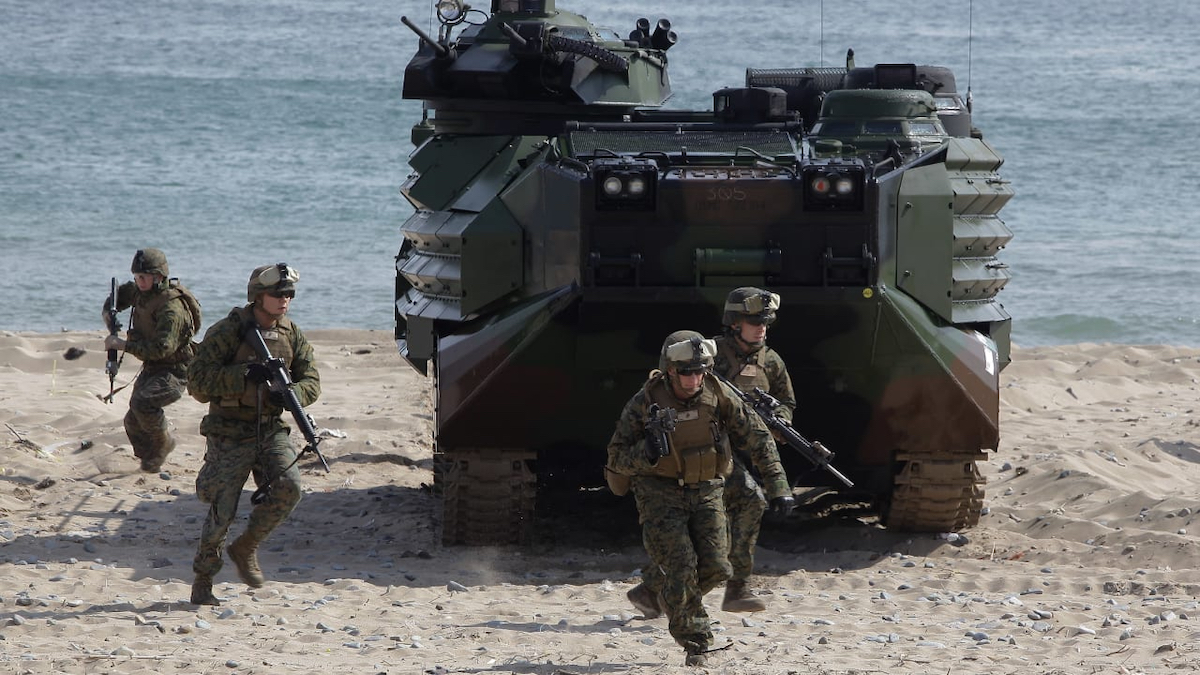
The recent deployment of Marine Expeditionary Units to the Persian Gulf signals escalating capabilities rather than immediate invasion intent. These 2,500 troops with amphibious assets represent tools for controlled escalation while diplomatic channels remain theoretically open.
Geopolitical complications abound regarding any ground engagement. Iran’s coastline features sophisticated defensive networks including radar systems, mobile missile batteries, and naval assets optimized for asymmetric warfare. Even successful seizure of territory would initiate prolonged occupation challenges, with Iran’s harsh terrain, larger population, and cohesive political structure presenting greater difficulties than those encountered in Iraq.
The ultimate escalation—full-scale invasion—would require troop commitments dwarfing the 2003 Iraq campaign, with daunting logistical demands and uncertain regional support. Victory would merely begin a longer struggle, as Iran’s complex ethnic and religious landscape would complicate any stabilization effort.
This conflict embodies fundamental asymmetry: America seeks measurable outcomes while Iran pursues survival through endurance. The discussion now centers not on whether ground troops are desirable, but whether they have become unavoidable as the conflict enters its fourth week—with historical patterns suggesting that limited engagements often expand into prolonged commitments once boots touch ground.