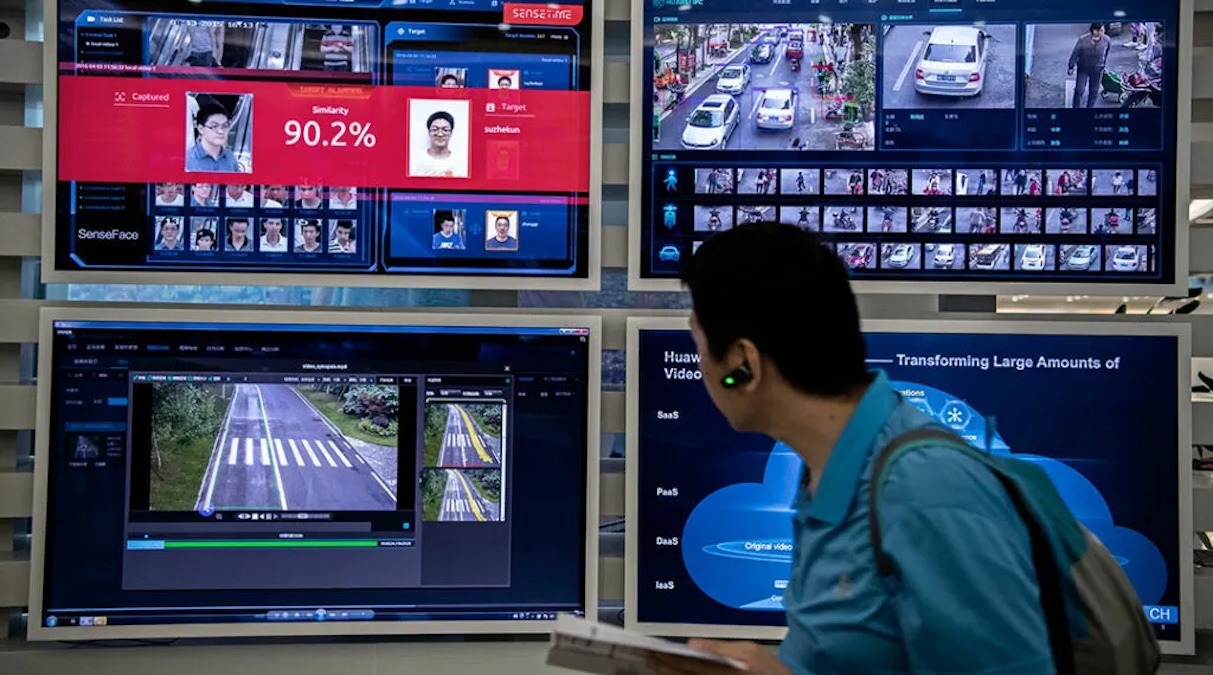
For nearly two decades, Chinese-manufactured security cameras from major firms like Hikvision and Dahua Technology have quietly permeated critical infrastructure, government buildings and military installations across North America, Europe and dozens of nations worldwide. Marketed as affordable, high-quality public safety and traffic monitoring tools, these devices have long been suspected of serving a secondary purpose: enabling state-aligned surveillance that critics warn erodes national sovereignty and enables digital control. What was once a quiet challenge of embedded fixed surveillance has now evolved into a more mobile, harder-to-detect threat, according to national security analysts, following successive bans on Chinese camera technology by Western governments.
The roots of the current espionage landscape stretch back to China’s 2003 launch of its Safe City program, a domestic initiative that built a nationwide network of internet-connected cameras integrated with facial recognition, license plate tracking and artificial intelligence to enable large-scale social and political control. In the decades that followed, China exported this entire surveillance ecosystem to more than 25 countries across Africa, Asia, the Middle East and Latin America, with Hikvision and Dahua serving as the primary hardware suppliers. Even as late as 2018, long after security concerns were first raised, a sole-source contract for Hikvision cameras at the U.S. Embassy in Kabul, Afghanistan, raised urgent questions about embedded vulnerabilities in Chinese hardware. Investigations soon revealed that both Hikvision and Dahua cameras built with backdoor access that allowed unauthorized remote access, effectively opening a gateway for foreign hackers to infiltrate networked surveillance systems.
What began as a concern over compromised cameras at a single diplomatic outpost quickly expanded into a full-blown national security issue for the U.S. It was revealed that Chinese-manufactured cameras had been deployed across dozens of U.S. military bases and federal government facilities, creating a widespread surveillance risk. By 2019, the U.S. passed the National Defense Authorization Act (NDAA), which mandated the removal of all Hikvision and Dahua equipment from federal facilities, and banned new purchases of the technology for government use. Other Western nations followed with similar restrictions.
But the ban triggered an unexpected shift in how Chinese-linked espionage operates, the report by former U.S. Deputy Under Secretary of Defense Stephen Bryen reveals. In place of fixed cameras that can be identified and removed, China has increasingly turned to unmanned aerial vehicles (drones) to conduct surveillance on sensitive Western sites. This shift aligns almost perfectly with the timeline of U.S. restrictions: a sharp rise in unauthorized drone incursions over military and critical infrastructure sites began immediately after the 2019 camera ban went into effect.
Recent high-profile incursions underscore the scale of the new threat. In March 2026, repeated unauthorized drone flights were recorded over Barksdale Air Force Base in Louisiana during the loading of B-52 bombers for a deployment linked to operations in Iran. Just weeks earlier, unidentified drones were spotted over Fort McNair in Washington, D.C. — home to senior U.S. defense and diplomatic officials — triggering White House emergency meetings and elevated security protocols. In 2023, Langley Air Force Base, the headquarters of the U.S. Air Force’s Air Combat Command, recorded 17 consecutive nights of unauthorized drone flights over its flight line, with swarms of up to 15 drones, some as large as small cars, documented. Even as far back as 2019, dozens of unidentified drones shadowed a U.S. Navy warship fleet off the coast of Southern California for weeks, with investigators ultimately linking the incursion to a Hong Kong-flagged cargo vessel. Across the U.S. in late 2024, the Pentagon confirmed that hundreds of unauthorized drone incursions were recorded over sensitive defense sites in a two-month window, even as thousands of other drone flights were authorized by the FAA.
Beyond the shift to drones, the past year has revealed how vulnerabilities in Chinese surveillance hardware have been exploited by Western intelligence agencies themselves in operations abroad. In Venezuela, where Hikvision and Dahua cameras built a nationwide surveillance network for the Nicolas Maduro regime, U.S. Cyber Command pre-loaded malware into the camera network years in advance, creating hidden “shadow administrator” accounts that allowed real-time surveillance of Maduro in the lead-up to Operation Absolute Resolve. U.S. intelligence was able to track every detail of Maduro’s daily movement, residence, travel schedule, and even identify his personal pets, according to comments by Joint Chiefs of Staff Chairman General Dan Caine in early 2026.
A similar operation unfolded in Iran, where Israeli intelligence hacked a vast network of Chinese-supplied cameras across Tehran to track senior Iranian regime leaders. By mapping movement patterns of bodyguards and drivers via cameras on residential streets, parking lots and shift change locations, Israeli analysts were able to pinpoint the schedule of Iran’s Supreme Leader Ali Khamenei, enabling a strike that killed Khamenei and other top leaders in February 2026. Hikvision and Dahua cameras are the most widely deployed surveillance hardware across Iranian cities, where the regime used Chinese technology to build what analysts call a “digital iron curtain” for internal control; a third Chinese firm, Tiandy, supplied specialized low-light facial recognition cameras to the Iranian Revolutionary Guard Corps.
The high-profile compromises of Chinese surveillance systems in Venezuela and Iran have triggered internal upheaval within China’s top surveillance firms. In April 2026, reports emerged that Chinese authorities had arrested 300 Hikvision employees on allegations of espionage-related failures, according to reporting from Chinese-Canadian dissident journalist Sheng Xue, who has long documented China’s export of surveillance technology. The arrests come after waves of mass layoffs and corporate restructuring at Hikvision in 2024 and 2025, which were initially attributed to financial pressures, though analysts now suspect internal political purges linked to the failures of Chinese surveillance and defense technology in overseas operations. It is widely reported that Chinese leadership is alarmed by the repeated compromise of Chinese-supplied systems, raising questions about ongoing internal accountability for the breaches.
For the United States, the threat remains far from resolved. While the federal government has moved to remove banned Chinese cameras from military and government facilities, millions of previously imported Hikvision and Dahua cameras remain in use by private businesses, commercial property owners and non-government organizations across the country. Even more concerning is the prevalence of Chinese-designed components hidden in domestic-branded products: the 2026 compliance challenge centers on Chinese-built Systems on a Chip (SoC) and firmware that appear in third-party cameras, which still carry the same security vulnerabilities. In early April 2026, the Federal Communications Commission proposed expanding existing restrictions to implement a full ban on all imports of Hikvision and Dahua-related equipment, moving beyond the existing ban on new models to cover all imports.
The rise of drone-based surveillance has created an entirely new set of challenges that the U.S. has yet to address. Modern low-cost drones can be linked to satellite communications networks like Starlink, enabling high-resolution 4K video streaming and high-speed data transfer from anywhere in the country. Drones can not only capture imagery of sensitive installations, but also detect unsecure mobile phone signals from base personnel, harvest personal and professional data from those devices, and even plant spyware that enables long-term tracking of service members. Even for unclassified mobile devices, the data available — including names, contact information, travel schedules, and photos of personnel — creates significant long-term counterintelligence risks.
Ironically, the successful push to remove vulnerable fixed Chinese cameras has cleared the way for a more agile, harder-to-counter threat. “We are just at the beginning of the drone war here at home,” Bryen argues, noting that the Pentagon has yet to develop a comprehensive national strategy to counter repeated unauthorized incursions. As drones can be launched from remote locations, hidden in cargo, and operated by cross-border teams, the threat is expected to grow in coming years as restrictions on Chinese fixed surveillance technology continue to expand globally.